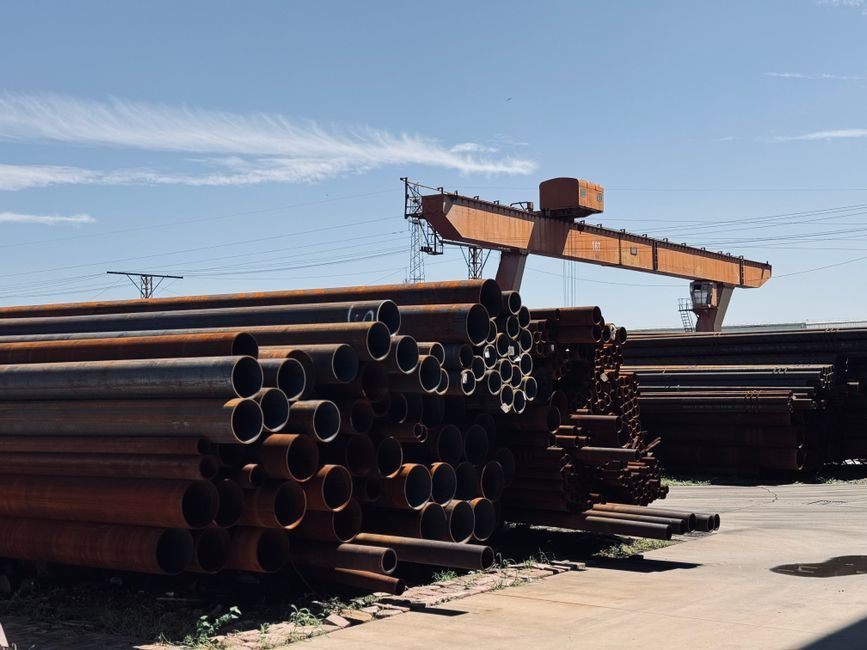
Alloy steel is a steel to which one or more alloying elements (Mn, Si, Cr, Ni, Mo, V, B, Cu) are added beyond the limits set for carbon steel, with total alloy content generally above 1.0-1.5 wt% in the common low-alloy structural family [S4][S5].
The selection problem is not "which steel is strongest" but which grade family — through-hardening Cr-Mo, Ni-Cr-Mo, Mn case-hardening, spring silicon-chromium, or bearing Cr — holds the required strength, toughness, and fabricability in the section size the part actually has, not the size on the drawing [S5].
Definition, Scope, and What the Term Actually Covers
In EN 10020 and the equivalent AISI/SAE lexicon, alloy steel is defined by the deliberate addition of alloying elements above the residual levels permitted in unalloyed steel, the goal being to control hardenability, strength, toughness, wear, or corrosion resistance rather than to follow the carbon-only route [S4].
Low-alloy grades (total alloy typically 1-5 wt%) dominate the structural and through-hardening market; medium-alloy grades (5-10 wt%) cover high-temperature bolting and die-block service; high-alloy grades transition into tool, stainless, and maraging systems [S4][S5]. Common alloy additions behave predictably: Mn raises hardenability and tensile strength roughly 80 MPa per 1% addition; Cr improves hardness and high-temperature oxidation resistance; Ni toughens the ferrite and lowers the ductile-to-brittle transition temperature; Mo delays temper embrittlement and resists creep above ~400 degC; V and Nb form fine carbonitrides that pin grain growth [S5].
Carbon content remains the primary lever on achievable hardness and tensile strength, with structural alloy grades typically landing between 0.25-0.60% C and case-hardening grades in the 0.10-0.25% C window [S5].
Selection Criteria That Actually Drive the Call
Five inputs decide the grade before any supplier quote matters: required mechanical strength (yield/tensile/impact), section size and hardenability, operating temperature, corrosion/wear environment, and the secondary process chain (welding, machining, surface treatment) [S4].
Hardenability — measured as the Jominy end-quench distance to a target HRC — is the most often mis-specified parameter; a 4140 (Cr-Mo) bar 100 mm in diameter will not through-harden in oil, so the equivalent 4340 (Ni-Cr-Mo) or a higher-Mo variant is needed for uniform core properties [S5]. The AISI H-band (e.g. 4140H, 4340H) tightens composition to deliver a guaranteed hardenability window for buyers running predictable heat-treat cycles [S4].
Operating temperature separates the families cleanly: carbon and low-alloy steels cap practical service near 350-400 degC; 1.25Cr-0.5Mo (e.g. ASTM A387 Grade 11) reaches ~565 degC in pressure-vessel service; 2.25Cr-1Mo (A387 Grade 22) runs to ~600 degC; 9-12% Cr martensitic grades (A387 Grade 91, T/P92) push creep strength up to 620-650 degC in power-plant piping [S4]. Below -40 degC impact duty, fine-grain Ni-bearing grades (3.5% Ni per EN 10028-4, or 9% Ni for LNG service) are the standard route, with each 1% Ni roughly lowering the 50% FATT by 10-15 degC [S5].
Main Grade Families Compared on Decision Criteria
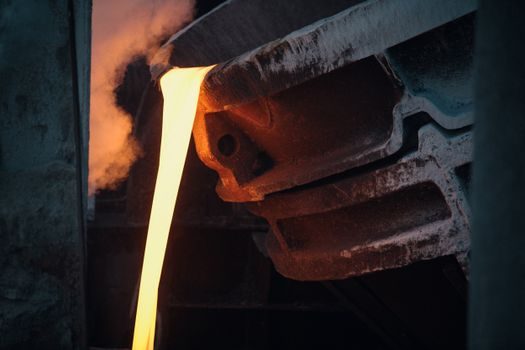
The AISI-SAE 4-digit families and their GB/DIN equivalents are the working vocabulary of alloy-steel buyers; the table-style comparison below lines up the dominant low-alloy structural and engineering grades against the four criteria that drive most purchasing decisions [S4][S5].
Cr-Mo family (AISI 4130, 4140, 4150; DIN 25CrMo4 / 34CrMo4 / 50CrMo4; GB 30CrMo / 42CrMo): moderate cost, good through-hardenability to roughly 50-75 mm round, yield strength 650-900 MPa after Q&T, weldable with preheat to 150-200 degC, used for shafts, gears, high-strength bolts, and drill chuck bodies [S5].
Ni-Cr-Mo family (AISI 4340, 8620; DIN 36NiCrMo4 / 21NiCrMo2): higher hardenability and toughness for the same carbon; 4340 holds impact energy above 40 J at -40 degC in heavy sections; 8620 is the dominant case-hardening grade for carburised gears and pinions; cost runs 15-30% above plain Cr-Mo at the same bar size [S5].
Mn case-hardening grades (AISI 1524, 1527; GB 20Mn2 / 30Mn2): the budget option for small-section carburised parts; limited hardenability past ~25 mm round; chosen where the service duty is moderate and the production line is high-volume [S4][S5].
Spring and shock grades (AISI 5160, 9260; DIN 55Cr3 / 60SiCr7): silicon-chromium steels with 0.55-0.65% C for leaf and coil springs; tensile strength routinely 1200-1600 MPa after Q&T; not for welded assemblies [S5].
Bearing grade (AISI 52100; DIN 100Cr6): 1% Cr, 1% C, through-hardened to 58-62 HRC for rolling-element bearings; fatigue life governed by inclusion control per ASTM E45 [S4][S5].
Real Use Cases and Failure-Mode Mapping
Gear and shaft service: 4140 or 4340 Q&T to 28-34 HRC, with 8620 case-hardened to 58-62 HRC surface for high-contact-stress pinions; the common failure mode is rolling-contact fatigue rather than bulk fracture, pushing the choice toward cleaner-inclusion melts and surface-finish control under 0.2 Ra [S4].
High-temperature bolting and headers: 1.25Cr-0.5Mo (A193 B7) for ~400-450 degC flanged joints; 2.25Cr-1Mo (A387 Gr.22) for superheater tubing and pressuriser components; 9% Cr martensitics (Grade 91) for ultra-supercritical headers above 600 degC; failure mode shifts from bulk yield to creep cavitation, and the design rule is to keep operating stress below one-third of the 100,000-hour rupture strength [S4].
Cryogenic and pressure-vessel duty: 3.5% Ni (EN 10028-4) for -60 to -101 degC LPG and CO2 service; 9% Ni for -196 degC LNG tanks; 5% Ni variants cover the -120 to -165 degC band; common failure mode is brittle fracture at a weld HAZ, addressed by PWHT control and the EN 10164 Z-grade guarantee on through-thickness reduction of area [S4][S5].
Construction and offshore structural: quenched and self-tempered (QST) plate to EN 10025-4 in S460ML or S690QL for jack-up legs and wind-turbine towers; the selection lever is the yield-to-tensile ratio (capped at 0.85-0.93) and CVN at -40 degC, both governed by the delivery condition rather than a different chemistry [S4].
Standards, Specifications, and Traceability
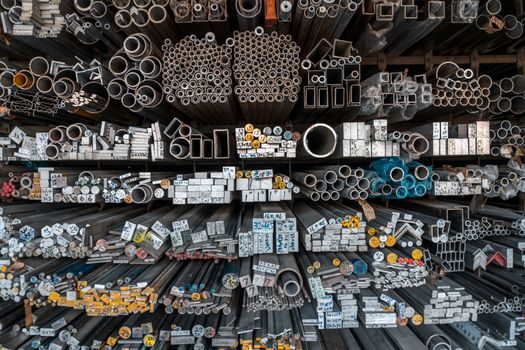
Buying decisions should anchor to a published standard and a heat-traceable test certificate (EN 10204 3.1 or 3.2), not a trade name [S4]. The common reference set includes AISI/SAE grade definitions, ASTM A29 (general requirements), AISI H-band hardenability limits, EN 10083 (Q&T steels), EN 10025 (structural plate), EN 10028 (pressure-vessel plate), GB/T 3077 (Chinese structural alloy), and JIS G4103-G4106 (Japanese Cr, Ni-Cr, Cr-Mo) [S4][S5].
For sour-service hydrogen-charging environments, NACE MR0175 / ISO 15156 caps hardness at 22 HRC and restricts grade chemistry to avoid sulphide stress cracking; the same parts in benign service can run to 32-35 HRC [S4]. For nuclear duty, ASME SA-508 and SA-533 govern the heavy forging and plate used in reactor pressure vessels, with impact tested at -29 degC and a defined Cu-Sn-P ceiling for irradiation-shift control [S4].
Who Alloy Steel Is For — and Who Should Pick Another Family
Alloy steel is the right call for parts that need a through-section strength above ~600 MPa yield, a guaranteed impact floor at a stated low temperature, predictable response to Q&T, or service in the 350-650 degC creep window [S4][S5]. Buyers specifying it for plain structural angles and channels, for ambient-temperature water piping, or for cosmetic stainless appearance are overpaying — carbon steel (per the carbon-steel reference) or a stainless or aluminum-alloy substitution will land cheaper and fabricate easier [S4].
It is also the wrong call where corrosion is the dominant failure mode rather than wear or load; in that case stainless or a nickel-base alloy will outlast a coated low-alloy steel at lower lifetime cost [S4]. For ultra-high-temperature creep above ~700 degC, the nickel-alloy and cobalt families take over, and the alloy-steel selection logic no longer applies [S4].
Limitations, Constraints, and Sourcing Reality
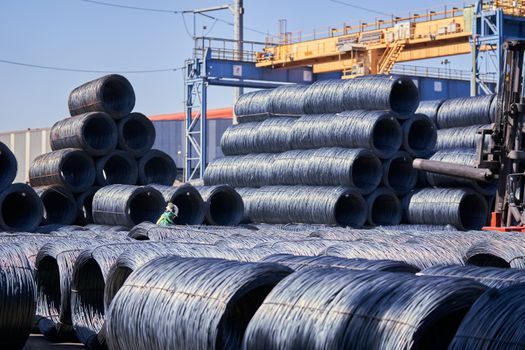
Alloy steel is weldable, but the heat-affected zone must be managed: preheat to 150-300 degC for the Cr-Mo and Ni-Cr-Mo grades, interpass temperature capped at 230-300 degC, and PWHT at 620-680 degC for 1-2 hours to restore toughness — these are not optional for sour, low-temperature, or creep service [S4]. Machinability is best in the 280-320 HB band (roughly 28-34 HRC), which is why many alloy-steel parts are delivered annealed and then Q&T after rough machining [S5].
On the supply side, the Asian trade catalogue offers alloy steel in twin-clevis link, S-type load-cell, and hot-work die forms from a wide set of Chinese mills and trading companies; buyers should confirm the mill source, the heat-treatment delivery condition, and the test certificate before accepting a price [S1][S2][S3]. The alloy-steel merchant market historically grew at a low-single-digit AAGR on a multi-billion-dollar base, with growth tied to the steel-making cycle rather than grade innovation, so the realistic buying signal is capacity and lead-time, not grade novelty [S6].
Two trackable signals for the next sourcing cycle: AISI-SAE grade revision updates to the H-band tables, and mill test certificates moving to digital EN 10204 3.2 with full alloy-heat traceability — both are now within reach of the 2026 procurement window.