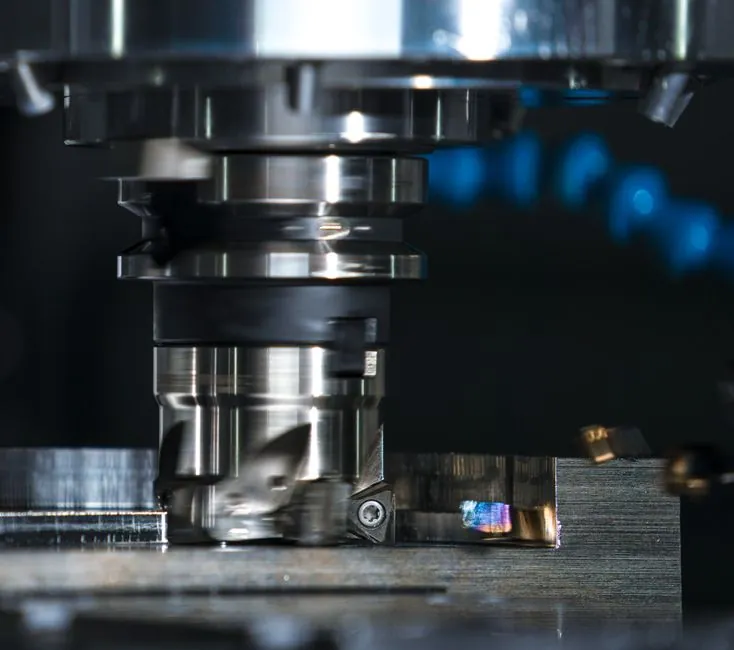
Selection of tool and die steel for mold and die making is governed by six AISI families: cold-work (A2, D2, D3), hot-work (H11, H13, H21), shock-resisting (S1, S5, S7), oil-hardening (O1, O6), water-hardening (W1, W2), and high-speed (M2, M42, T1) [S6]. Mold and cavity steels layer in P20/1.2311, P20+Ni/1.2738, and 420 stainless/S136 as a fourth practical family, supplied pre-hardened to 280-330 HB for direct machining without post-quench distortion [S1].
A correctly specified premium steel delivers 3x to 10x longer productive life than an off-spec substitute on a high-volume 500,000-cycle mold, per Fushun Special Steel industry guidance (2026-05) [S3]. That ratio, not the per-kilogram price, is the real procurement decision: tool steel is an amortized cost per part, not a raw-material line item. Cavity tolerances of 0.005 mm and surface roughness of Ra 0.01 micrometer are routine in precision tooling, and they are only achievable when the steel, the heat-treatment specification, and the EN 10204/3.1 certification are aligned from the melt stage [S3].
Cold-Work Tool Steels: A2, D2, and the Wear-versus-Toughness Trade
A2 (DIN 1.2363) is a 5% chromium air-hardening cold-work steel that hardens to 57-62 HRC with minimal dimensional movement, typically expanding only 0.001 in./in. of cross-section when air-quenched from the proper austenitizing temperature [S2]. Its balanced chemistry, 1.00 C, 1.10 Mo, 0.25 V, 5.25 Cr, 0.60 Si, 0.60 Mn, makes A2 the default for complex punch profiles, forming dies, coining tools, and precision blanking where post-heat-treat geometry must hold to a few thousandths [S2][S3]. Machinability in the annealed condition (212 HB max) is rated at 65 against a 1% carbon tool steel baseline of 100, so A2 is workable but not free-cutting [S2].
D2 (DIN 1.2379, ~12% Cr, 1.5% Mo, 1.0% V) is the high-carbon, high-chrome cold-work grade, hardening to 58-62 HRC and serving dies where abrasive wear and edge retention dominate over fracture toughness, such as long-run blanking, thread-rolling, and pelletizing dies [S6]. When the application swings to heavy section sizes or impact loading, D2's lower toughness becomes the limiting factor and the spec should step to A6 or S7 rather than a thicker D2 block [S2]. The decision is wear-versus-toughness, and the answer sits in the HRC, the section thickness, and the run length, not in the price sheet.
Hot-Work and Die-Casting Steels: H13 as the Working Default
H13 (DIN 1.2344) is the chromium-molybdenum-vanadium hot-work benchmark used for die casting, forging, and extrusion tooling, where it retains mechanical strength at elevated temperature (red hardness) and resists thermal-fatigue cracking through the H10-H19 chromium-based hot-work family [S4]. A typical H13 die-casting die spec calls for 48-52 HRC at the cavity surface after nitriding, with the pre-hardened block delivered at 180-220 HB for rough machining before final quench [S5]. For higher-temperature forging service or larger die blocks, DIN 1.2714 (55NiCrMoV7) is the alternative, trading some hot strength for deeper hardenability and better through-thickness toughness [S5][S7].
The hot-work family decision is fundamentally a temperature-versus-cycle-time trade: H13 holds hardness and resists heat-checking up to roughly 600 degC working surface, while tungsten-bearing H21-H26 grades extend the ceiling but cost more and grind harder [S4]. A die casting die running aluminum at 2,000-3,000 shots before index typically uses H13; a brass or copper-alloy die running hotter should be re-evaluated against H21 or a powder-metallurgy H19 variant.
Plastic-Mold Steels: P20, 2738, 420/S136, and the Polish Question
Pre-hardened P20 (DIN 1.2311, AISI P20) at 280-320 HB is the default plastic-mold cavity and core steel for large molds where machining time dominates cost; P20+Ni (DIN 1.2738, ~1% Ni) at the same hardness range adds 50-80 mm of through-thickness hardenability for deeper sections [S7]. Industeel's 1.2738 mod HH (1% Ni enhanced) and 1.2738 mod E are the named modifications for higher polishability and uniform hardness in deep sections, and the 41xx-series (4130, 4140, 4340) fills the mold-base and clamping-plate role at 280-340 HB [S7].
When the application demands optical polish, corrosion resistance, or a glass-filled/abrasive resin, the spec shifts to 420 stainless / S136 family, supplied as S136 (HRC 48-52), S136H (HB 290-330), or the S136 SUP / S-STAR ESR-clean variants at HB 290-330 for the most demanding medical and optical cavities [S1]. ESR remelting is the gating process step: it drops inclusion content, raises polishability to SPI A1/A2 mirror, and is the reason S136 SUP commands a meaningful price premium over standard S136 [S1]. For a casting mold running chemically aggressive polymer, the 420/S136 path is essentially mandatory; for commodity polypropylene packaging, P20+Ni is over-engineered but easier to machine and re-weld.
Shock-Resisting and High-Speed Grades: S7, M2, and M42
S7 (DIN 1.2357, AISI S7, ~5% Cr, 1.5% Mo) is the shock-resisting grade used for punches, chisels, shear blades, and heavy-duty forming where impact loading dominates over wear [S2][S6]. It hardens to 54-58 HRC with air quenching and combines high fracture toughness (~75 J Charpy V at 54 HRC, typical) with enough wear resistance for blanking of mild and stainless steel up to 6 mm thickness. The shock family also includes S1 (chrome-tungsten, hot-shock) and S5 (silicon-manganese-moly-vanadium, cold-shock) for applications where S7 is over-quenched or too wear-prone [S2].
For cutting tools and high-wear punches that also see heat, M2 (DIN 1.3343, AISI M2) and M42 (DIN 1.3247, 8% Co) high-speed steels are the working ceiling: M2 to 62-65 HRC, M42 to 65-68 HRC, with M42's cobalt content holding red hardness at the cutting edge [S2][S5]. M2 and M42 are not normally selected for cavities or large die blocks, where machinability and dimensional stability rule them out, but they remain the reference for trim steels, ejection punches, and threading components inside a mold base.
Selection Criteria, Comparison Matrix, and Sourcing Gates
The five decision criteria that drive 90% of tool-and-die steel selection are: working hardness (HRC or HB), toughness (Charpy V or unnotched impact), wear resistance (often inferred from Cr/V content), thermal conductivity, and polishability/corrosivity (ESR cleanliness, inclusion rating). The matrix below lines the dominant grades against those criteria, drawing on the spec pages in [S1], [S2], [S3], [S4], [S6], and [S7].
AISI A2 (1.2363): 57-62 HRC, medium wear, medium toughness, low polishability, no corrosion resistance, default for blanking/forming [S2][S3]. AISI D2 (1.2379): 58-62 HRC, high wear, low-medium toughness, low polishability, low corrosion resistance, default for long-run blanking and thread rolling [S6]. AISI H13 (1.2344): 48-52 HRC (cavity, after nitriding), medium wear, high hot toughness, low polishability, low corrosion resistance, default for die casting and forging [S4][S5]. AISI P20+Ni (1.2738): 280-320 HB pre-hard, medium wear, medium toughness, medium polishability, low corrosion resistance, default for plastic-mold cavities and cores [S7]. AISI 420/S136: 48-52 HRC or 290-330 HB pre-hard, medium wear, medium toughness, high polishability (ESR/SUP), high corrosion resistance, default for optical/medical/injection molds [S1]. Sourcing gates that follow the grade choice: EN 10204/3.1 mill certificate, ultrasonic testing to ASTM A388 or SEP 1921, ESR remelt declaration for polish-grade cavities, and through-thickness hardness mapping for sections above 100 mm [S3][S7].
Standards, Certification, and the ESR Gate
Material certification is a non-negotiable procurement line, not paperwork: EN 10204/3.1 is the European standard for mill test certificates carrying actual chemical analysis and mechanical test results traceable to the heat, and it is the documentation auditors and tier-1 OEMs will request [S3]. Ultrasonic testing to ASTM A388 (heavy steel forgings) or SEP 1921 (European practice for ESR-remelted tool steel) is the practical gate against internal porosity and inclusions, and Fushun Special Steel, with 100,000-tonne annual capacity across 5,400+ grades, lists it as a standard production step in its 2026-05 guide [S3].
For mold and die making, four working standards cover the bulk of specifications: AISI/SAE for North American grade naming, DIN/EN for European tool-steel numbering (1.2311 P20, 1.2738 P20+Ni, 1.2344 H13, 1.2379 D2, 1.2363 A2, 1.2357 S7), JIS for Japanese equivalents (SKD11 ~ D2, SKD61 ~ H13, S50C ~ mid-carbon P20 analog), and GB/T for Chinese-domestic equivalents [S3][S4][S7]. Industeel's downloadable datasheet set covers 1.2311, 1.2312, 1.2711, 1.2738, 1.2738 mod E, 1.2738 mod HH (1% Ni), 1.2344, and 4140/4340 in a single reference pack, which is a useful cross-walk for global sourcing [S7]. For an injection-mold spec walking P20+Ni into S136 cavities, pairing that data set with tool and die steel reference pages and the sand casting mold baseline gives a complete property envelope from rough base to mirror cavity.
Trackable signals for the next procurement cycle: (1) whether the supplier delivers EN 10204/3.1 with the heat number physically stamped on the block (most premium mills do, but a spot-check of the certificate against the bar is still the cheapest audit), (2) inclusion rating and ultrasonic attenuation per SEP 1921 for any cavity grade specified above 50 HRC, and (3) the documented lead time for ESR-remelted S136 SUP versus standard S136, which is typically 6-10 weeks longer and the practical bottleneck for medical and optical mold builds [S1][S3][S7]. The cross-check between the die casting machine tonnage and the H13 block thickness also belongs in the spec review: a 1,600-tonne die-cast machine will punish an H13 die that is under-sized for through-thickness hardenability, regardless of the cavity hardness.
See also our earlier report, Spherical Roller Bearing vs Ball Bearing: Selection Map for Radial Load, Speed, and.