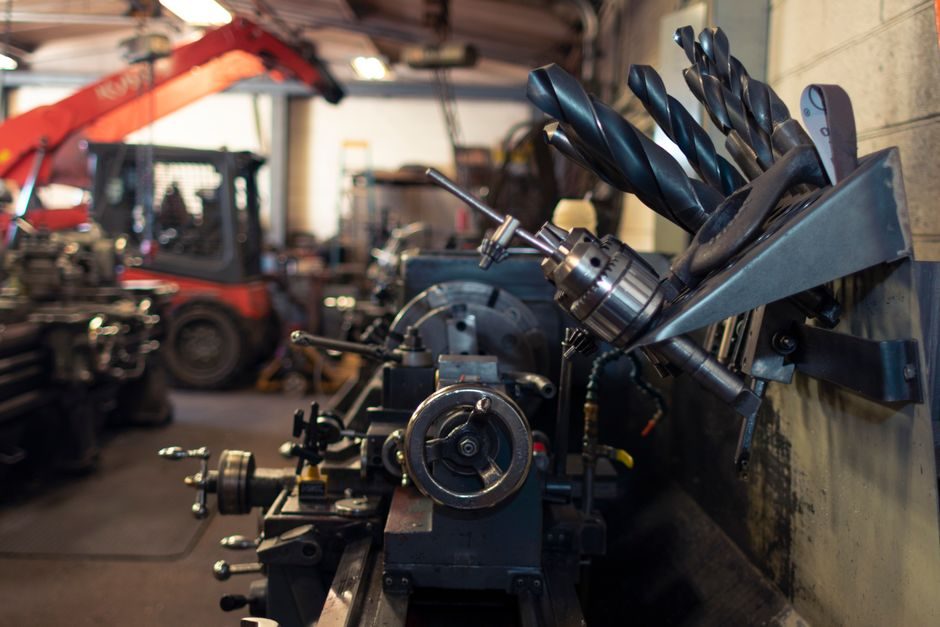
Tool & die steel and silicon steel share a mill vocabulary but solve opposite problems: one holds shape under impact, heat, and plastic flow; the other channels magnetic flux with minimum loss. Tool & die grades such as H13 (SKD61 / AISI H13 / W.Nr. 1.2344) and D2 are selected for hardness, hot-strength, and thermal-fatigue resistance [S8], while silicon (electrical) steel is selected for magnetic permeability, core loss in W/kg, and lamination thickness.
The mis-specification cost is real. A H13 billet driven into a motor-lamination stamping die burns through punches; a silicon-steel coil fed into a forging die cavity lacks the hardenability and the wrong carbon balance collapses the cut edge. The two families cross at one node only: grain-oriented silicon steel is sometimes stamped with carbide punches set into a D2 or DC53 die, so the die steel grade you pick sets the cost-per-stroke of the electrical-steel supply chain [S8].
What Each Material Actually Is
Tool & die steel is a hardened, high-alloy family covering cold-work (D2, DC53, SKD11), hot-work (H13, H11, DH31-S), plastic-mold (P20, NAK80, S50C-based), and high-speed grades (M2, SKH51), typically supplied annealed at 190-230 HB and heat-treated to 58-62 HRC for cutting edges [S8][S1]. Chinese distributors such as Sanhexing route EAF 25T, LF 20T, VD 20T, and ESR 1-10T heats for H13 hot-work die steel, with a stated 800 T/month agreement capacity and premium partnerships with Schmiedewerke Gröditz, Baosteel, and Fushun [S1]. Daido's tool steel list maps hot-work grades SKD61, DHA1, DH31-S, DH2F, and modified 5% Cr variants against JIS, AISI, and W.Nr. equivalents for hot forming, die-casting, hot stamping, cold forming, and plastic-mold duty [S8].
Silicon steel is a low-carbon (typically ≤0.005% C) electrical steel alloyed with 2.5-3.5% Si, sometimes with Al, supplied as cold-rolled strip 0.20-0.35 mm for conventional CGO, and 0.18-0.30 mm for high-permeability HiB grain-oriented grades. The function is magnetic: high Si raises resistivity, lowers eddy-current loss, raises permeability, and (with cold rolling + annealing + MgO coating) aligns grains so flux flows along the rolling direction. This is not a "structural" or "tooling" steel and it is never used for dies.
Selection Criteria: Hardness and Hot-Strength vs Permeability and Core Loss
Specifying tool & die steel comes down to four numbers: working hardness (HRC), hot-yield strength at service temperature, thermal-fatigue resistance (often expressed as the number of cycles to first heat-check crack at 600 °C), and dimensional stability after tempering. H13 modified grades target 55-58 HRC after nitriding, with a typical nitrided case depth of 0.15-0.30 mm and a service ceiling of ~600 °C for aluminum die-casting dies; D2 targets 58-62 HRC at room temperature for cold-work blanking and fineblanking [S8]. Sanhexing's EAF-LF-VD-ESR route plus 40 T annealing furnaces is aimed at the low-S, low-O inclusion control that die-casting and plastic-mold buyers require, because MnS stringers in a polished mirror-finish mold cavity translate directly into surface defects [S1].
Specifying silicon steel comes down to a different set: core loss in W/kg at 1.5 T / 50 Hz (or 1.7 T / 50 Hz for power transformers), magnetic polarization B in T at a defined H (typically 800 A/m or 2500 A/m), lamination thickness in mm, and whether you need grain-oriented (GO) for transformer cores or non-oriented (NGO / NO) for rotating machines. GO 30Q120 or 27QG110 families are common HiB picks for distribution transformers; NGO 50W470-50W1300 covers motor and EV-rotor duty.
If your part is a die, punch, mold insert, plastic-injection cavity, or die-casting shot sleeve sleeve-liner, you are in the tool & die steel domain. If your part is a stator, rotor, transformer core, or EV traction-motor lamination, you are in the silicon-steel domain. Mixing them up is a procurement error, not a "trade-off".
Decision Frame: A Side-by-Side Criteria Match
Use the table below to anchor the four governing criteria; numbers are typical industrial ranges, not specific mill guarantees, and any of them must be re-confirmed against the mill certificate. [S1]
Tool & die steel vs silicon steel on the four criteria that drive the buy:
1) Carbon and alloy content — tool & die: 0.30-2.30% C plus Cr, Mo, V, W, sometimes Ni or Co; silicon: ≤0.005% C, 2.5-3.5% Si, trace Al. Tool & die gains hardenability and wear life from C; silicon gains resistivity and permeability from Si, but at the cost of ductility and weldability.
2) Mechanical target — tool & die: 190-230 HB annealed, 58-62 HRC hardened, transverse fracture toughness typically 15-30 J for H13; silicon: yield strength 300-500 MPa in finished strip, elongation 10-30% in NGO, 5-15% in GO, no hardening treatment. Tool & die is bought on hardness, silicon is bought on magnetic loss [S8].
3) Operating environment — tool & die: cyclic thermal shock 300-700 °C in die casting, repeated plastic injection at 200-300 °C, cold-work blanking at room temperature with friction heating peaks; silicon: continuous 25-150 °C service in oil- or cast-resin-immersed cores, no thermal-cycling load.
4) Form factor — tool & die: forged or ESR round bar 50-500 mm dia, rolled plate 10-200 mm thick, machined and EDM'd; silicon: cold-rolled strip 0.18-0.35 mm in coils up to 1200 mm wide, surface-coated with MgO (GO) or insulating inorganic coating (NGO), stamped and annealed.
Who Each Is For — and Who It Is NOT For
Tool & die steel is for mold makers, stamping shops, die-casting tooling suppliers, plastic-injection mold builders, and forging-die manufacturers. Sanhexing is positioned as a Guangdong premium distributor for H13 hot-work die steel [S1]; Daido supplies DHA1 (SKD61 equivalent), DH31-S for high-toughness hot-work dies, DC53 and SLD-MAGIC for cold-work, and NAK80, PX5, and G-STAR for plastic-mold and mirror-finish duty [S8]. HS Steel has run cast and forged special-steel components for 25+ years [S5]. For stamping and die-casting tool buyers reviewing the die-casting die side, the steel grade is the line item that drives 70-80% of cavity life.
Tool & die steel is NOT for: motor laminations, transformer cores, magnetic shielding, or any application that depends on B-H curve behaviour. It is also a poor fit for large structural sections where the carbon content drives weld-cracking risk and where you would otherwise be looking at a low-alloy structural plate, an engineering plastic, or a cast iron [S1][S5].
Silicon steel is for transformer OEMs, motor manufacturers, EV traction-motor and generator laminations, reactor cores, and magnetic-shielding fabrications. It is NOT for: cutting tools, dies, punches, plastic-injection mold cavities, or any load-bearing structural use. The Si content that makes it magnetically useful makes it brittle: a Si-3 steel strip cannot survive a forging or stamping load that an H13 die cavity applies to it every cycle.
Real Use Cases, Real Failure Modes
A die-casting plant running 6061 aluminum at 680-720 °C melt and 60-100 MPa injection pressure will spec H13 (or a modified 5% Cr variant such as DH31-S / 1.2344 ESR) for the die cavity, gate, and shot sleeve region, nitrided to ~1000 HV0.3 surface. H13 at substandard cleanliness fails as heat-check cracks after 5,000-15,000 shots; the fix is ESR re-melt (Sanhexing's ESR 1-10T line) and a 40 T vacuum-annealed pre-machining condition [S1][S8].
A precision-stamping shop running 0.35 mm NGO silicon-steel laminations through a progressive die will spec DC53 or DC11 punches and a D2 die at 58-60 HRC. A tungsten-grade HSS like M2/SKH51 is required only when the part thickness exceeds ~1.5 mm or the run is in the millions of strokes [S8]. This is the one node where the two families meet on the shop floor: the punch steel is the cost lever for the silicon-steel supply chain. A motor-lamination plant running 0.20 mm HiB GO at 600 strokes/min has zero tolerance for punch chipping, which is why Daido keeps a 5% Cr hot-work family and a DC53 cold-work family in the same catalog [S8].
Common failure modes by steel family — tool & die: heat-check cracking (H13 at >600 °C service), gross cracking from inclusions (D2 with high S), EDM recast layers, distortion after uneven quenching, and wear at the gate for filled-nylon compounds. Silicon: magnetic aging (residual C and N pinning domain walls), increased hysteresis loss, brittleness fracture at the stamped edge if burr height exceeds 30-50 µm, and insulation-coating breakdown that creates inter-laminar eddy currents.
Sourcing, Standards, and Verification
For tool & die, the standard reference frame is AISI/SAE grades (H13, D2, M2, P20) cross-referenced to JIS (SKD61, SKD11, SKH51, S50C) and DIN/W.Nr. (1.2344, 1.2379, 1.3343, 1.2738), and Daido's DHA1 / DH31-S / DC53 / SLD-MAGIC brand equivalents [S8]. For silicon, the standard reference is GB/T 2521 (China), ASTM A677 / A726 / A876 (USA), EN 10106 / EN 10107 (EU), and JIS C2552 / C2553 (Japan), each grading by core loss at a defined B and frequency, not by hardness. Buyers should always pull a mill test certificate (MTC) showing chemistry, mechanical or magnetic data, and surface-coating weight, and verify it against the ordered spec before acceptance.
On the supply side, Sanhexing lists 800 T/month of agreement tonnage with steel-mill partnerships including Schmiedewerke Gröditz, Baosteel, and Fushun [S1]; HS Steel and Winning Steel frame themselves as multi-grade special-steel manufacturers with 25+ years of operation [S5][S2]; Kunshan Benchi lists die, tool, alloy, carbon, and bearing steel as its main product lines [S4]. Daido's English catalog positions tool steel as the company's flagship product family for plastics, die-casting, hot stamping, and cold forming [S6][S8]. Distributors like these are the realistic procurement path for small-to-mid-volume buyers; large OEMs typically contract direct with mills.
When the two families are both on a buyer's RFQ (a stamping die for silicon-steel laminations is the most common case), the tool steel specification drives the cost-per-stroke of the silicon steel finished part. A 0.20 mm HiB strip that requires a DC53 fineblanking die with 58-60 HRC, ≤0.003 mm punch-to-die clearance, and a 0.1-0.2 µm surface finish is a different procurement problem from a hot-stamping die that has to survive 900 °C boron-steel blank contact — which is why Daido splits the catalog into hot-work, cold-work, plastic-mold, and high-speed families with explicit JIS/AISI/W.Nr. cross-references [S8].
Two trackable signals to watch: (1) Mill disclosures of ESR + vacuum-annealed H13 cleanliness data from Chinese distributors (Sanhexing's 40 T annealing + ESR route is a reasonable proxy [S1]) versus imported equivalent grades from Daido or Gröditz, and (2) NGO silicon-steel loss-grade migrations as EV traction-motor OEMs push for lower W/kg at 1.5 T / 400 Hz. The buy-side rule is unchanged: tool & die steel is selected on hardness, toughness, and thermal fatigue; silicon steel is selected on permeability, core loss, and lamination thickness — and the two should not appear on the same line of a purchase order. For buyers also running carbon-steel structural components, the carbon-steel selection frame is the parallel reference for that adjacent family.