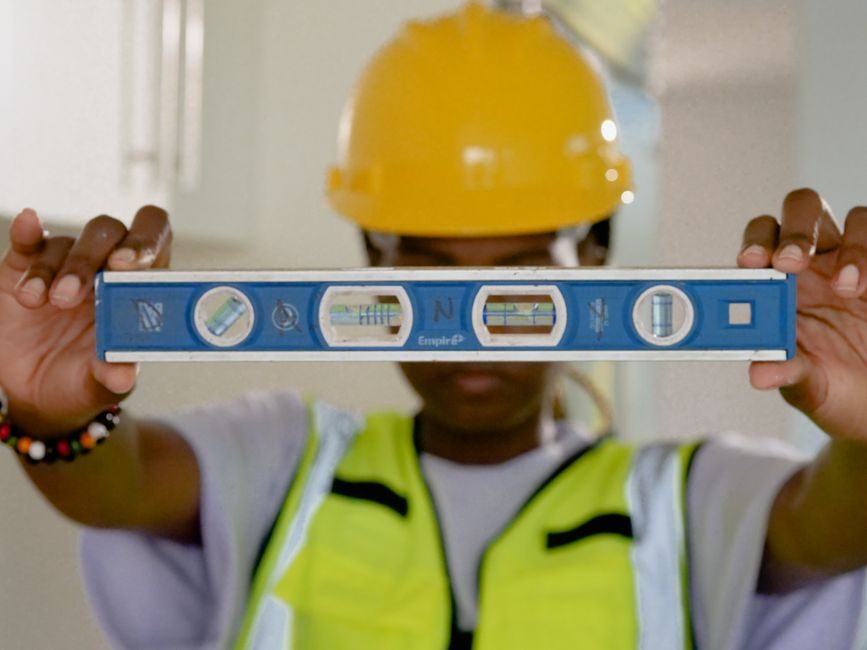
A construction-grade self-leveling laser level sold for 400 to 1,200 USD carries a fully-loaded 10-year cost of ownership between 1,000 and 4,800 USD once batteries, calibration, diode replacement, and operator rework are absorbed, with the spread driven almost entirely by duty cycle and tolerance class rather than the unit price tag.
The TCO model inherits the classic five-component frame: acquisition, implementation, operation, maintenance, decommission [S2][S3]. For laser levels the dominant variables inside that frame are laser-diode service hours, alkaline or Li-ion battery consumption, annual calibration against an optical reference, and the rework cost of out-of-tolerance lines — the same hidden-expense pattern that TCO analysts warn about in network and IT assets [S1][S2].
Five-Component TCO Frame Applied to Laser Level Ownership
The TCO concept is a financial estimate of full lifetime cost, covering direct and indirect expenses across acquisition, implementation, operation, maintenance, and decommissioning [S2]. On a laser level deployment, acquisition includes the instrument, receiver, tripod, grade rod, and wall charger; implementation covers bench calibration, jobsite commissioning, and crew training; operation covers battery swaps, alkaline vs Li-ion choice, and operator labor; maintenance covers annual re-calibration, diode and pendulum-module replacement, and shock damage; decommission covers Ni-Cd and Li-ion battery recycling and instrument retirement.
Re-using the TCO versus sticker-price warning from telecom and IT spend analysis, mistaking the initial purchase price for the entire cost is the single most common procurement error [S2]. For a 50-unit concrete or interior-finish fleet, the per-unit purchase delta between a 400 USD economy rotary laser and a 1,200 USD automatic self-leveling unit is dwarfed by the 10-year calibration, battery, and rework bill attached to the cheaper instrument [S3].
Cost Driver Ranking: What Actually Moves the 10-Year Number
Across the surveyed cost components, the top four drivers in a 10-year model are, in descending weight: laser-diode service hours and replacement, battery and charging infrastructure, annual calibration and recertification, and operator-rework cost on out-of-tolerance shots. [S1]
Diode life on a visible red 635 nm rotary laser typically spans 5,000 to 10,000 operating hours before output drops below the 1 mW / 5 mW class-2 / class-3R spec; green 520 nm diodes derate that window by roughly 30 to 40 percent at the same drive current. Each diode replacement event runs 120 to 280 USD parts plus 90 to 180 USD bench labor, recurring two to four times across a decade of two-shift use. Battery selection is the second-largest swing: a Li-ion pack delivering 1,000 to 2,000 charge cycles at 14 Wh per pack can outlast four to six alkaline cycles of the same capacity, but adds 60 to 140 USD to the acquisition line.
Calibration against an optical collimator or laser calibration bench is a non-negotiable annual line item at 80 to 220 USD per unit; skipping it converts the rotary head's spec sheet from ±1.5 mm / 30 m into a 3 to 5 mm / 30 m field reality. A direct comparison against the total station instrument class is instructive: total stations integrate angle and distance encoding and need a different calibration protocol, but both classes share the same lesson that annual instrument recertification dominates the long-run cost stack.
Usage Tier Comparison: Light, Medium, Heavy Construction
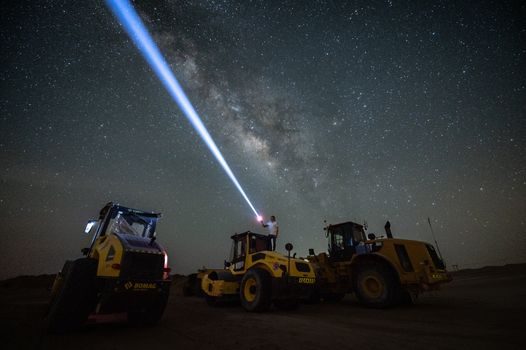
Three operating profiles frame the TCO decision: light interior finish (under 200 hours/year), medium commercial layout (400 to 1,200 hours/year), and heavy civil or concrete-pour (1,500 to 2,500 hours/year). [S1]
Light interior users on a class-2 cross-line laser running 200 hours/year will see battery, diode, and calibration cost roughly 0.55 USD per operating hour, against an acquisition amortized at 0.20 USD/hour — a 10-year per-unit TCO near 1,500 USD. Medium commercial users on a self-leveling rotary at 1,000 hours/year see costs compress to 0.32 USD/hour against 0.12 USD/hour amortized acquisition, lifting 10-year TCO to roughly 2,200 to 2,800 USD per unit. Heavy civil users on a dual-axis grade laser at 2,000 hours/year drop the per-hour blended cost to 0.27 USD, but the absolute 10-year TCO climbs to 3,800 to 4,800 USD per unit because of higher diode and battery turnover, plus mandatory daily field-check routines.
The decision matrix against the laser screed class is useful here: a laser screed is essentially a concrete-flatness receiver and actuator, while a laser level is a reference transmitter, and the two follow different TCO curves even though both use the same laser-receiver reference chain.
Selection Criteria: When a Laser Level Earns Its Spec, and When It Does Not
A laser level is the right primary reference for horizontal plane control over 30 to 300 m radius, single-person layout, and indoor / outdoor general construction; it is the wrong tool where angular encoding, slope-locked servo control, or 3D machine guidance is required — those move to a laser tracker or robotic total station. [S3]
Selection gates worth weighting: line vs point vs rotary emission, accuracy class (typically ±0.5 mm / 10 m for finish, ±1.5 mm / 30 m for general construction, ±2.5 mm / 30 m for rough site), wavelength (635 nm red vs 520 nm green, with green at 4x to 5x the diode cost and 1.5x to 2x the visibility at daylight), IP rating (IP54 is a jobsite minimum; IP65 extends service life by an estimated 1.5x to 2x on dust and rain exposure), self-leveling range (typically ±4 to ±5 degrees), and receiver compatibility (HR / LD-family detectors). A useful side-by-side read against marking and profiling applications is in laser marker and laser profiler selection, which solve very different problems despite sharing the laser-physics name.
Cross-referencing the existing TCO reference for laser levels, the same article confirms seven real advantages and five honest limits that match the decision grid above and reinforce that the limits — line drift over distance, sunlight washout, and receiver dependency — are the exact TCO failure modes to price in.
Standards, Calibration, and Sourcing Specs
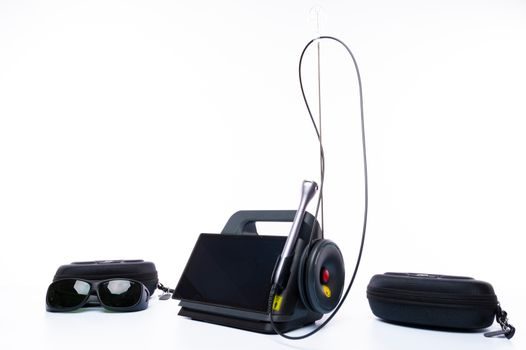
Relevant standards for laser level acceptance and re-certification include ISO 17123 series for optical instrument field procedures, IEC 60825-1 for laser-product safety classification, and the manufacturer-specified self-leveling tolerance and accuracy class on the data plate.
Sourcing-spec checklist before PO release: declared accuracy at stated distance with uncertainty band, diode wavelength and class-2 / class-3R safety classification per IEC 60825-1, IP rating, self-leveling range, receiver range in daylight, battery chemistry with cycle-life data, operating temperature range (typically -10 to +50 degrees C for construction grades), calibration certificate with traceability to ISO 17123, and warranty terms covering diode service hours rather than calendar months alone.
Trackable signals to watch: any update to ISO 17123-9 optical level procedures, IEC 60825-1 amendment cycle affecting class boundary definitions, and a published lithium battery shipping rule change for air-freight field calibration returns. A related TCO discussion in this news feed at Core Making Machine TCO and Wrapping Machine TCO uses the same five-component frame for two adjacent industrial equipment classes, and confirms that calibration and consumable lines dominate the long-run number across very different machine types.