
Selecting a tower crane is a footprint-and-load problem, not a brand problem: match jib length to the longest lift radius, then verify the radius-capacity curve still lifts the heaviest panel at the farthest reach, with the free-standing mast height cleared before the first tie-in to the structure [S1][S5].
Three structural families cover almost every vertical-construction site: the classic hammerhead with its horizontal jib and counter-jib, the topless (flat-top) variant designed for tight sites where multiple cranes must overlap jibs, and the luffing-jib crane that trades reach for a steep upward slewing path [S5].
Hammerhead vs Topless vs Luffing: Which Variant Fits Which Site
For an open site with one crane serving a rectangular footprint, the hammerhead delivers the lowest cost per tonne-metre because its trolley hoists vertically along a fixed jib, with no luffing hydraulics on the jib path [S5]. On a constrained urban infill project where two or more cranes must overlap jibs without tie-rods clashing, the topless design removes the upper tie-frame and lets jibs cross at different heights, which is why this variant now dominates mid-rise work in dense Asian and Middle Eastern city cores [S5][S6].
Luffing-jib cranes add a pivot point partway along the jib so the load can be pulled in toward the tower, cutting the swing radius by 30–50% versus a hammerhead at the same tip capacity; that geometry is what allows a luffing crane to work inside a tight site hemmed in by existing structures or air-rights boundaries [S5]. One independent design note from a Shenyang-based manufacturer, Useter Crane, lists luffing, topless, and derrick configurations side by side, with the derrick used for self-climbing demolition or mast-jacking on a finished tower [S5]. For a different lift problem entirely, see the Jib Crane Selection Guide: Capacity, Rotation, Mount, and Spec Gates for workshop-scale loads under 20 t.
The Four Spec Gates That Decide the Buy
Site planners consistently weight four numbers before any vendor talk: maximum jib length, capacity at the jib tip, maximum free-standing height without tie-in to the building, and maximum lift capacity at minimum radius near the tower [S1][S5]. A typical mid-range 6 t unit at 50 m jib will lift roughly 1.0–1.3 t at the tip and 6 t at minimum radius; buyers should refuse any quotation that does not publish the full radius-capacity curve, not just the headline maximum [S1][S5].
Free-standing height matters because every tie-in to the structure adds engineering, drilling, and a structural-engineer sign-off; a crane that free-stands to 40–50 m can serve a 10–12 storey building with zero tie-ins, which is the threshold most residential and mid-rise commercial buyers aim for [S1]. Slewing radius, hoist speed, and trolley travel speed are secondary and only matter once the four primary gates are cleared; vendors that lead with these three are usually hiding a poor radius-capacity curve [S5].
Standards, Certification, and Why a Chinese Factory Stamp Is Not Enough

The European market recognises EN 14439 as the governing safety standard for tower cranes, while many Chinese manufacturers additionally design to German DIN 15018 (now folded into FEM 1.001 / EN 13001 for the structural side) and obtain TÜV product certification to satisfy German, Singapore MOM-WSH, Australian AS, South Korean KOSA, Malaysian DOSH, and Russian EAC regulatory regimes [S5]. SYM Hoist & Tower Crane Equipment, a Shenyang trading company, lists ISO 9001 on its machinery management system certification, which covers the manufacturing process but is not a crane-safety standard itself [S7].
For buyers in the EU, the practical gate is: TÜV or DEKRA product certificate + EN 14439 design compliance + a CE declaration covering the Machinery Directive 2006/42/EC. For Southeast Asian and Middle Eastern projects, look for the local jurisdictional mark (MOM-WSH, DOSH, or the equivalent GCC conformity scheme) rather than relying on the CE mark alone [S5]. Spare parts such as the 415 mm / 330 mm / 290 mm guide rope pulley, hoist mechanism, slewing mechanism, trolley mechanism, mast section, and fixing angle are all standardised components that can be sourced across vendors, but buyers should confirm the wire-rope diameter, sheave groove profile, and pin diameter match before substitution [S2].
Total Cost of Ownership: Buy, Rent, or Self-Erect
A new 6 t / 50 m hammerhead from a Shenyang-area manufacturer sits in the US$80,000–150,000 FOB range for the bare machine, with a complete jump-form and tie-in kit adding another 20–40%; freight, erection, and climbing labour typically double the landed cost on a foreign site [S1][S6]. Rental on a monthly basis usually lands at 4–6% of new price for a short contract under 6 months, but the math flips once the project extends past 12 months [S1].
For a related but lower-capacity problem, the Portable Generator Price and Cost Guide 2026: What Drives the Number walks through similar TCO logic for site power, which is the second-largest cost line on a tower crane site after the crane itself.
Who Should NOT Specify a Hammerhead Crane
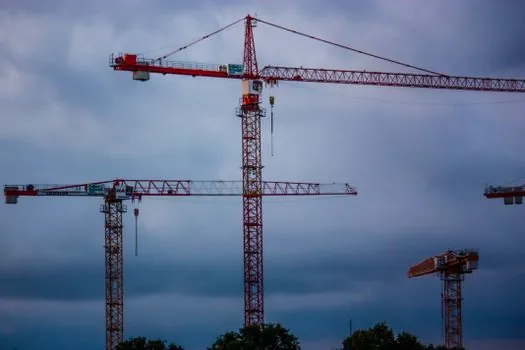
A hammerhead is the wrong choice when the site has air-rights constraints, neighbouring structures within 8 m of the swing circle, or a tight urban footprint where the jib envelope overlaps an occupied building; the luffing-jib variant is the only geometry that keeps the load inside a reduced swing envelope in those cases [S5]. It is also the wrong choice for indoor or covered construction, where a derrick or overhead crane takes over entirely; for the small-to-medium indoor lift case, see the cross-discipline coverage of tower crane basics versus crawler-mounted alternatives.
A hammerhead is also the wrong choice for projects with multiple cranes where jibs would otherwise collide at the tie-frame level: the topless design was invented precisely for this duty, and insisting on a hammerhead in a multi-crane overlap usually forces an expensive tie-frame re-engineering or a forced derating of the upper jib [S5]. On heavy industrial lifts of 20 t and above, a crawler crane becomes a stronger answer because the heavy-lift class is dominated by lattice-boom crawlers with counterweight rigging that a tower crane cannot match.
Shortlist Logic: From Requirement to Vendor
Lock the four spec gates first: jib length, tip capacity at full jib, free-standing height, and max lift near the tower; reject any proposal that does not return all four as a numeric curve, not a single headline figure [S1][S5]. Step two, confirm the certification path: EN 14439 + CE + TÜV for Europe, MOM-WSH or DOSH for Singapore and Malaysia, and AS or KOSA for Australia and Korea, with the corresponding DEKRA, TÜV, or local jurisdictional certificate attached to the quote [S5][S7]. Step three, price the full TCO: bare machine + freight + erection + dismantle + monthly inspection, not just the FOB figure [S1][S6].
Trackable signals for the rest of 2026: the spread of topless models into the 8–10 t tip-capacity class (a response to dense high-rise in Tier-1 Asian cities), and the gradual replacement of fixed-voltage 380 V drive systems with variable-frequency drives on mid-range Chinese cranes, which reduces peak starting current and lets site electricians feed a single crane from a smaller site transformer [S5][S8]. For the electronics and motor side that sits under the hood of a modern tower crane, the linear guide and signal tower light references cover the sub-components that show up on the bill of materials when a topless crane is specced with anti-collision and remote diagnostics. The next decision gate for any buyer is the radius-capacity curve sheet, signed by the manufacturer's structural engineer, and the matching TÜV or local-jurisdiction certificate number stamped on the crane's data plate [S5][S7].