A signal tower light is a columnar industrial signaling device that stacks color-coded indicator segments to communicate the status of a machine or process to operators, technicians, and supervisors across a shop floor. Also called a stack light, andon light, or warning light, it is one of the most visible control-panel components in any factory, encoding states such as running, warning, and fault into instantly recognizable colors, flash patterns, and optional audible alarms.
Because the device is the operator's primary at-a-glance status interface, its design is governed by human-machine-interface color and signaling conventions rather than purely electrical specifications. This guide treats the tower light both as a wiring component and as a communication device, mapping its color logic, light technologies, and physical specifications to the standards and selection decisions that procurement and design engineers actually face.
This guide is written for industrial purchasing engineers and machine designers. Across 6 chapters it covers what a signal tower light is, the color and signaling conventions of IEC 60204-1, IEC 60073, and IEC 61310-1, the modular tier architecture, LED versus strobe light technologies, the key electrical and environmental specifications, and a step-by-step selection sequence, followed by 7 selection FAQs. Color, signaling, and machinery-safety references trace to IEC 60204-1, IEC 60073, IEC 61310-1, IEC 60529 (IP ratings), and IEC 60947-5-1, cross-checked against PATLITE, Rockwell Automation, Werma, and Banner Engineering datasheets.
Chapter 1 / 06
What is a Signal Tower Light
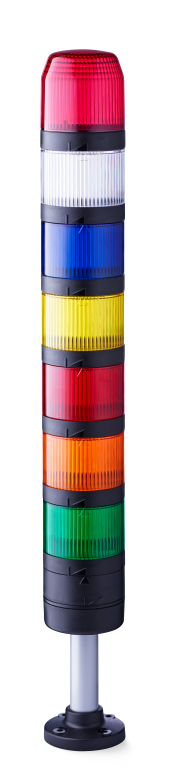
A signal tower light is a vertical assembly of independently controlled, color-coded indicator segments, optionally topped or interleaved with an audible buzzer, mounted on or near a machine to display its operating status. Each segment can be off, steadily lit, or flashing, and the combination of color, state, and sound encodes information that an operator reads instantly from a distance. It is one of the four staple devices of any control-panel human-machine interface, alongside pushbuttons, pilot lights, and selector switches, and is the only one designed primarily to be read from across the room rather than at arm's length.
The device goes by several names that all describe the same hardware class. Stack light is the common North American term, referring to the way the colored segments stack on top of one another. Andon, from the Japanese word for a paper lantern, is the lean-manufacturing term for a visual status signal, of which the tower light is the most common physical embodiment. Indicator light, warning light, tower lamp, and signal lamp also appear in catalogs. Regardless of name, the function is constant: turn an internal machine state into an external visual and audible signal that any passerby can interpret without touching a screen.
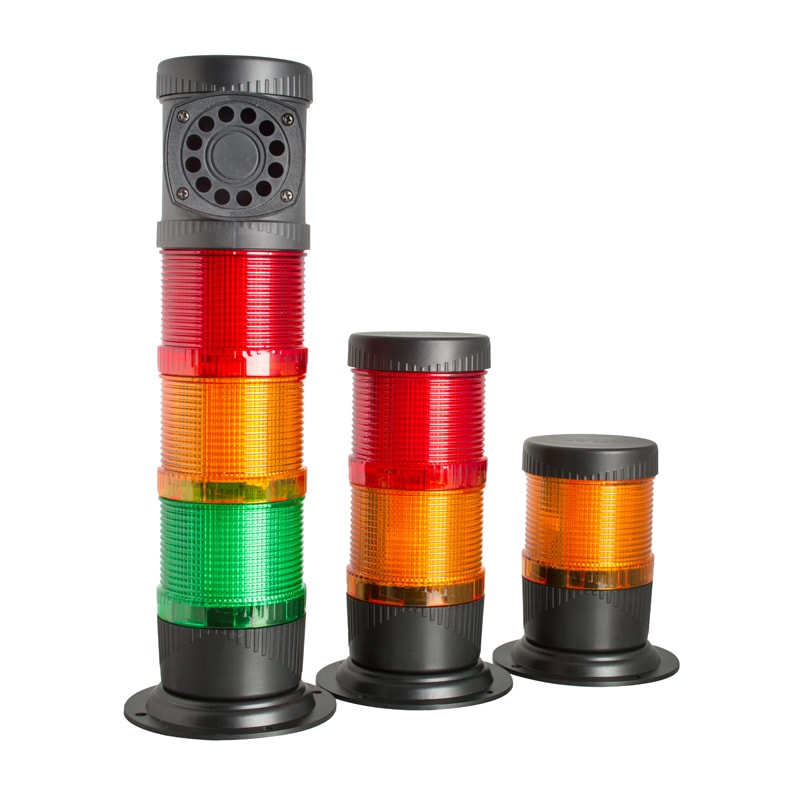
Structurally, a modern tower light consists of three parts: (1) the base or mounting module, which carries the electrical terminals or connector, the cable gland, and the physical mount to the panel, pole, or machine frame; (2) one or more light modules, each a translucent colored or RGB lens enclosing an LED, incandescent, or xenon light source, joined by a twist-lock or bayonet coupling so segments can be added, removed, or reordered; and (3) an optional sound module that adds a buzzer or sounder. The twist-lock modularity is what distinguishes a true signal tower from a fixed multi-lamp beacon: a user can field-build a two-tier, three-tier, four-tier, or five-tier stack from common parts.
The conceptual roots of the device lie in railway and traffic signaling, where stacked colored lamps long predate the factory floor. In manufacturing, the tower light rose to prominence with the Toyota Production System and the andon concept of empowering any worker to signal a line problem, and it became ubiquitous from the 1980s onward as factories adopted visual management and lean 5S practice. The shift from incandescent bulbs to LED modules through the 2000s, and more recently to IO-Link smart RGB segments, has transformed a simple indicator lamp into a networked status node that both displays state and reports its own health back to the control system.
Four practical attributes determine whether a tower light is fit for purpose: visibility (brightness and color against the ambient light of the workspace), signaling clarity (how unambiguously its colors and patterns map to machine states), environmental robustness (the IP and temperature rating against dust, washdown, and vibration), and integration effort (how many control outputs or what protocol it consumes). The chapters that follow examine each of these in the order an engineer encounters them during specification.
Chapter 2 / 06
Types and Architecture
Signal tower lights divide into families by how the segments are built and controlled. The oldest and still most common is the modular discrete tower, where each colored segment is a separate single-color module wired to its own control output. Newer is the smart programmable tower, where one or more RGB segments display any color and are commanded over a digital protocol such as IO-Link. Alongside these sit fixed pre-configured towers, compact mini towers for small machines, and dedicated beacon or strobe heads for high-visibility alarm duty. The table below summarizes the architecture families and their trade-offs.
Architecture
Segment type
Control method
Wiring per tower
Best for
Modular discrete
One color per module
Hardwired discrete
1 wire per color + common
Standard machine status
Smart programmable
RGB segments
IO-Link / serial
1 x M12 (3 to 4 wire)
Flexible, retoolable lines
Fixed pre-configured
Factory color order
Hardwired discrete
1 wire per color + common
Cost-driven OEM volume
Compact / mini
1 to 3 colors
Discrete or IO-Link
Few wires or 1 x M12
Small or space-tight machines
Beacon / strobe head
Single high-output
Discrete
1 wire + common
Loud-area or outdoor alarm
Modular discrete towers are the workhorse of the category. Each colored lens is its own module containing a single-color light source, and the modules twist-lock or bayonet together onto a base. A classic five-tier stack carries red, amber, green, blue, and white or clear, but the user picks any subset and any order. The PATLITE LR6 (60 mm diameter) and Werma KombiSIGN families are representative: segments join with a twist-lock or bayonet contact system, and the assembled height grows one module at a time. Each color needs a dedicated switched supply wire plus a shared common, so a five-color tower consumes five control outputs.
Smart programmable towers collapse that wiring into a single digital link. Instead of fixed-color modules, one RGB segment can show any of millions of colors, and a single telegram sets the color, flash pattern, rotation effect, and intensity of every segment. The Banner TL50 Pro is a leading example, supporting up to ten RGB light segments plus one audible segment, for as many as eleven segments in one column, all driven over a single IO-Link cable. This dramatically reduces control I/O and wiring, lets one stocked part serve many color schemes, and allows the device to report diagnostic data back to the controller.
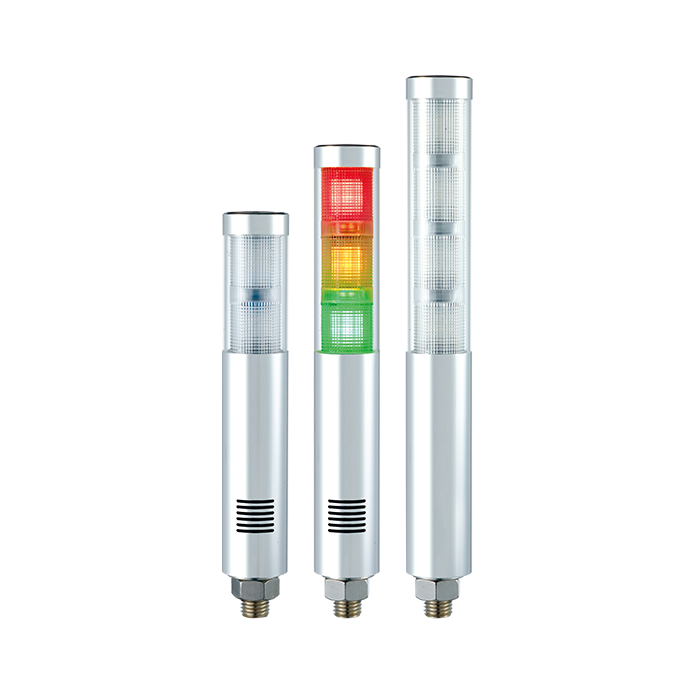
Diameter is the headline mechanical class. Common sizes are 50 mm (Banner TL50), 60 mm (PATLITE LR6), and 70 mm (Werma KombiSIGN 71, Rockwell 856T). Larger diameter means a larger, brighter lens visible from farther away, at the cost of more panel space and weight. A 50 mm tower suits a benchtop or compact machine, 60 mm is the general-purpose middle ground, and 70 mm serves large machinery and longer viewing distances. Mini towers below 30 mm exist for very space-constrained equipment.
Mounting follows a small set of patterns: direct base mount flush to the machine top, pole mount that raises the tower above the machine on a tube with an L-bracket, circular bracket, or folding bracket, and wall or side mounting. PATLITE, for instance, offers direct mount and three pole-mount bracket styles, plus through-hole and ½-inch NPT base options. Raising the tower on a pole improves sight lines over surrounding equipment, while direct mount keeps the profile low where overhead clearance is tight.
Chapter 3 / 06
Light Source Technologies
Three illumination technologies appear in signal tower lights: LED, incandescent, and xenon strobe. LED has become the default for almost all new designs, but the older technologies persist in specific niches, and understanding their physics clarifies when each is the right choice. The table below compares the three light sources on the attributes that matter for a status signal.
Light source
Typical life
Power draw
Vibration tolerance
Strength
LED
30,000 to 100,000 h
Low
High (no filament)
Efficiency, life, instant switching
Incandescent
1,000 to 3,000 h
High
Low (filament fails)
Legacy compatibility, low unit cost
Xenon strobe
Flash-tube limited
Pulsed high
Medium
Very high peak brightness
LED modules dominate because they win on nearly every operational metric. A typical LED light source lasts tens of thousands of hours against a few thousand for an incandescent bulb, draws a fraction of the current, switches on and off instantly with no warm-up delay, and has no filament to break under the constant vibration of machinery. Instant switching matters specifically for flashing modes: an incandescent filament has thermal lag, while an LED can flash crisply. Multi-effect LED drivers can also generate flashing, blinking, and electronically simulated rotary-beacon effects within a single static module, replacing the mechanical rotating mirror of older beacons.
Incandescent and filament lamps survive mainly in legacy installations and the cheapest fixed towers, where an existing socket base accepts a bulb and unit cost is the only criterion. Their disadvantages are decisive in any new design: short life that forces routine bulb replacement, high current draw that strains control outputs, heat generation, and filament failure under shock and vibration. Most major makers now ship LED equivalents that drop into the same form factor, so incandescent specification is generally a sign of an aging design rather than a deliberate choice.
Xenon strobes occupy the opposite extreme: maximum instantaneous brightness. A xenon flash tube discharges a brief, intense pulse of light that is far brighter at its peak than a steady LED, which lets it cut through high ambient brightness or signal an alarm across a large outdoor yard. The trade-off is that xenon produces only a sharp flash, not a steady glow, draws a high pulsed current, and the flash tube is a wear item. As high-power LEDs have improved, xenon has retreated to the highest-visibility alarm duty, while routine status indication has moved entirely to LED.
A separate dimension is steady versus dynamic light effects. Most towers support at least steady-on and flashing; higher-end modules add multiple effects. The PATLITE LR6, for example, flashes at 60 plus or minus 2 flashes per minute (a 1 Hz strobe rate), while the Rockwell 856T light module set offers steady, flashing at 2 Hz, strobe at about 1.4 Hz, and double-strobe modes. Reserving a faster flash or strobe for higher-priority events is consistent with IEC 60073 guidance that higher flashing frequencies carry higher-priority information, which the next chapter examines in detail.
Chapter 4 / 06
Color Coding and Signaling Standards
Unlike most control-panel components, a tower light is selected as much for what its colors mean as for its electrical ratings. Several international standards govern that meaning. IEC 60204-1 (electrical equipment of machines) clause 10.3 defines indicator color meaning, IEC 60073 sets the basic coding principles for the human-machine interface, IEC 61310-1 covers visual, acoustic, and tactile safety signals on machinery, and IEC 60947-5-1 governs the low-voltage control devices and indicator hardware itself. The color logic is the foundation of any selection.
IEC 60204-1 clause 10.3 assigns meaning by color, summarized in the table below. These are the canonical machinery meanings; the colors are the same physical lenses used on every tower, but the standard fixes what each is allowed to communicate.
Color
IEC 60204-1 meaning
Operator action
Typical machine state
Red
Emergency / hazardous
Act immediately
Fault, e-stop, machine down
Yellow / amber
Abnormal condition
Monitor or intervene
Warning, low material, over-temp
Green
Normal
None required
Running, ready, safe
Blue
Mandatory action
Take required action
Call for operator or maintenance
White
Other / neutral
As defined locally
User-defined, productivity status
Red is reserved for emergency and hazardous conditions that demand immediate response, such as a fault, an activated emergency stop, or a machine-down state. Because red is the highest-priority color, it should never be used for routine or low-urgency status, or operators will learn to ignore it. Yellow or amber signals an abnormal condition that requires monitoring or intervention before it becomes critical, for example an approaching limit, low raw-material level, or rising temperature.
Green signals the normal, safe, running condition and requires no operator action; it is the color an operator wants to see during routine production. Blue indicates a mandatory action, often interpreted on a shop floor as a call for the operator, a setter, or maintenance to attend the machine. White is the neutral or other category, left for user-defined meanings such as cycle-complete, productivity tracking, or a custom local convention. Crucially, IEC 60204-1 does not force a single global mapping of machine states onto these colors, so the machine builder must declare the chosen scheme in the documentation, and a facility should keep that scheme identical across all equipment to avoid dangerous ambiguity.
Beyond color, signaling standards address dynamics and sound. IEC 60073 recommends that higher flashing frequencies and shorter pulse-pause ratios be used for higher-priority information, which is why an alarm typically flashes faster than a routine warning. IEC 61310-1, part of the machinery-safety framework, specifies how visual, acoustic, and tactile signals should be coded so that hazardous situations are unambiguous, and explicitly builds on IEC 60073 for color coding while extending beyond purely electrical aspects. For the audible element, the buzzer is treated as an acoustic signal that must be distinguishable above workplace noise. In North America, NFPA 79 (electrical standard for industrial machinery) gives parallel color guidance, and operators should confirm which regional framework applies to their machine.
The practical takeaway for procurement is that the standards constrain meaning, not hardware. The same five colored lenses appear on every tower; what differs is whether the integrator has applied a disciplined, documented, facility-wide scheme. A consistent scheme is what turns a row of colored lamps into a reliable visual language that reduces reaction time and supports lean visual management.
Chapter 5 / 06
Key Specification Parameters
Reading a tower-light datasheet means decoding a compact set of electrical, optical, acoustic, and environmental parameters. The same device may be listed under a dozen catalog codes, but only about eight specifications truly drive a selection: diameter, number of tiers, supply voltage, light source and effects, IP rating, operating temperature, buzzer level, and connection or wiring method. Each is explained below with representative real values.
Supply voltage is the first electrical filter. The two dominant options are 24 V DC and 100 to 240 V AC; the PATLITE LR6 offers DC 24 V and AC 100 to 240 V, the Rockwell 856T runs all modules on 24 V AC/DC fed from 24 V or 120/240 V AC power modules, and the Banner TL50 Pro operates on 18 to 30 V DC. Wide-range parts exist, such as Werma KombiSIGN modules rated 12 to 240 V AC/DC. The rule is to match the tower to the available control supply, confirm the buzzer shares that supply, and check whether voltage is applied per color (discrete) or to a single bus (IO-Link).
IP rating per IEC 60529 defines dust and water protection. IP65 is the general baseline, meaning fully dust-tight and protected against low-pressure water jets; the PATLITE LR6 is IP65 (IEC 60529) and additionally NEMA Type 4X and 13. Washdown duty in food, beverage, and pharmaceutical lines demands IP66 or IP69K for high-pressure and high-temperature jets, as offered by the Werma KombiSIGN 40 at IP66 and IP69K. The rating must apply to the assembled stack, including the segment couplings and the base cable gland, since those joints are the usual leak path rather than the lens itself.
Operating temperature bounds where the electronics stay within spec. A representative ambient range is roughly minus 20 to plus 50 degrees Celsius (minus 4 to plus 122 degrees Fahrenheit), as quoted for both the PATLITE LR6 and the Werma KombiSIGN families. Towers mounted on hot machinery, near furnaces, or in unheated outdoor cabinets must be checked against this window, since LED brightness and life degrade above the rated maximum and condensation becomes a concern below the minimum.
Light source and effects follow Chapter 3: confirm the source is LED for any new design, and list the required dynamic effects. The PATLITE LR6 supports continuous-on and flashing at 60 plus or minus 2 flashes per minute, while the Rockwell 856T light modules add 2 Hz flash, 1.4 Hz strobe, and double-strobe. Specify the effect needed for each priority level rather than accepting a default.
Audible buzzer level is given as sound pressure in decibels at one meter, commonly across a 70 to 105 dB range. The PATLITE LR6 sound unit is about 88 dB at 1 m and offers four selectable patterns sweeping roughly 1000 to 4032 Hz, such as rapid beep, continuous beep, and two-tone sweeps. The alarm should sit at least 10 to 15 dB above the ambient noise at the operator station so it is heard, while staying within hearing-safety limits, and distinct patterns should encode distinct events.
Connection and wiring method determines installation effort. The list below covers the common interfaces:
Discrete terminal block: one switched wire per color plus a common, simple and protocol-free, but consumes one control output per color and reports nothing back.
M12 connector (discrete): a pre-wired multi-pin M12 carries each color on a pin for quick-disconnect installation, as on PATLITE LR6-WC and LR6-WM variants.
IO-Link (single M12): a three or four-wire M12 to an IO-Link master sets every segment by telegram and reads device diagnostics, as on Banner TL50 Pro and Rockwell 856T IO-Link modules.
Field-configurable (no live bus): editor software presets colors and effects, so a discrete trigger then plays a programmed display without a running IO-Link link.
Fieldbus / network gateways: bridges to Modbus, PROFINET, EtherNet/IP, or similar for plant-wide andon data aggregation.
Number of tiers and diameter close the specification: classic stacks reach five colored tiers, the Rockwell 856T controls up to seven levels, and the Banner TL50 Pro reaches ten RGB segments plus an audible segment, while diameter (50, 60, or 70 mm) sets brightness and viewing distance against panel space.
Chapter 6 / 06
Selection Decision Factors
To turn the preceding chapters into a specific model, follow the decision sequence below. Most tower-light selection errors come not from a single wrong number but from skipping the signaling-scheme decision and jumping straight to a part number. These eight steps double as a fixed RFQ template.
Define the signaling scheme first: List the machine states to display and map each to a color per IEC 60204-1 (red emergency, amber abnormal, green normal, blue mandatory action, white other). Decide which states flash and which stay steady, and document the scheme so it is identical across the facility before choosing hardware.
Number of tiers and colors: Derive the tier count from the state list, plus a buzzer tier if audible alarms are needed. Choose modular discrete for a fixed small set of states, or smart RGB if the line is retooled often and color meanings change.
Diameter and viewing distance: Pick 50, 60, or 70 mm against the farthest point an operator must read the tower from and the panel space available. Larger diameter and pole mounting both extend effective sight lines over surrounding equipment.
Light source and effects: Specify LED for any new build; reserve xenon strobe only for the highest-visibility alarm in bright or large-area environments. List the required steady, flash, strobe, or rotary effect per priority level.
Supply voltage and wiring method: Match 24 V DC or 100 to 240 V AC to the control supply, confirm the buzzer shares it, and choose discrete wiring (one output per color) versus IO-Link (single M12, fewer outputs, with diagnostics) based on available I/O and the need for status feedback.
Environment, IP, and temperature: Select IP65 for general indoor or sheltered duty and IP66 or IP69K for washdown, verifying the rating covers the assembled joints and base gland. Confirm the minus 20 to plus 50 degrees Celsius class (or wider) suits the mounting location.
Audible alarm: If a buzzer is required, set the decibel level at least 10 to 15 dB above ambient at the operator position while respecting hearing limits, and choose distinct patterns to encode distinct events.
Mounting and connection hardware: Choose direct, pole-with-bracket, or wall mount, and the base interface (terminal, M12 connector, ½-inch NPT, or through-hole) so the tower physically and electrically fits the machine and is serviceable.
A final, frequently overlooked dimension is serviceability and standardization: a modular tower whose segments twist-lock onto a common base lets a maintainer swap one color or add a tier in minutes without rewiring, and standardizing on one diameter and one brand across a plant simplifies spares stocking and operator training. PATLITE, Rockwell Automation (Allen-Bradley 855 and 856T), Werma, Banner Engineering, Eaton, and ifm all supply globally with documented modular ecosystems, which matters more over a ten-year machine life than the small unit-price differences visible at the purchasing stage.
FAQ
What do the colors on a signal tower light mean?
IEC 60204-1 clause 10.3 assigns meaning by color: red signals an emergency or hazardous condition needing immediate action, yellow or amber signals an abnormal condition requiring monitoring or intervention, green signals a normal or safe condition, blue signals a mandatory action, and white signals any other neutral condition. In lean manufacturing practice the convention is often red equals stopped or fault, amber equals warning or low material, green equals running, blue equals a call for operator or maintenance attention, and white equals user-defined status. No single global standard forces these meanings, so the machine builder must declare the chosen color scheme in the documentation, and a facility should keep it consistent across all machines.
What is the difference between a signal tower light, a stack light, and an andon light?
They describe the same class of device. Signal tower light is the catalog term used by makers such as PATLITE and Werma, stack light is the common North American name because the colored segments stack vertically, and andon is the Japanese lean-manufacturing term for a visual status board, of which a tower light is the most common physical form. Other names include indicator light, warning light, and tower lamp. Functionally all describe a columnar device with up to five or more independently controlled colored segments, optionally with an audible buzzer, that shows machine or process status to operators across a shop floor.
How many tiers or segments can a signal tower light have?
Classic modular towers stack up to five colored segments, typically red, amber, green, blue, and white or clear. Smart programmable towers go further: the Banner TL50 Pro supports up to ten RGB light segments plus an audible segment in one column, with each segment able to display any of millions of colors. Rockwell 856T can control up to seven levels in a single stack. The practical limit is set by total height (a tall tower becomes hard to read and mechanically unstable), the drive current the base can supply, and how many discrete states the operator needs to distinguish at a glance.
What voltage do signal tower lights use?
The two dominant supplies are 24 V DC and 100 to 240 V AC. 24 V DC is the default for new machine builds because it matches PLC output cards and IO-Link masters directly: the PATLITE LR6, Rockwell 856T, and Banner TL50 all run on 24 V DC. Wide-range modules exist, for example Werma KombiSIGN parts rated 12 to 240 V AC/DC. AC versions at 110 V or 230 V suit retrofits wired straight to mains-referenced control circuits. Verify the segment and the buzzer share the same supply, and confirm whether each color needs its own switched wire (common-cathode discrete wiring) or a single bus connection (IO-Link or serial).
What IP rating should a signal tower light have?
IP65 is the baseline for general machine-mounted towers and means dust-tight plus protection against low-pressure water jets, which covers most indoor factory and outdoor-sheltered duty. The PATLITE LR6 is rated IP65 (IEC 60529) and NEMA Type 4X and 13. Washdown environments in food, beverage, and pharmaceutical lines need IP66 or IP69K, which adds high-pressure and high-temperature jet resistance, as offered by Werma KombiSIGN 40 at IP66 and IP69K. Confirm the rating applies to the assembled stack including joints and the base gland, not just a single lens, because the weak point is usually the segment couplings and the cable entry.
Why choose LED over incandescent or xenon strobe tower lights?
LED is now the default light source. Compared with incandescent bulbs, LEDs draw far less current, last tens of thousands of hours instead of a few thousand, survive vibration without filament failure, and switch instantly with no warm-up, which matters for flashing modes. Xenon strobes still win where extreme peak brightness is needed to pierce bright ambient light or signal an alarm across a large outdoor yard, since a xenon flash produces a very high instantaneous intensity. Modern multi-effect LED modules can mimic flash and even rotary-beacon effects electronically, so xenon is now reserved for the highest-visibility alarm duty rather than routine status.
How loud should the buzzer be and how do I pick the sound pattern?
Tower-light buzzers are specified as sound pressure level in decibels at one meter, commonly in the 70 to 105 dB range. The PATLITE LR6 audible unit is about 88 dB at 1 m with four selectable patterns sweeping roughly 1000 to 4032 Hz. The alarm must be audible above the workplace ambient noise: aim for at least 10 to 15 dB above the background level at the operator position, but do not exceed hearing-safety limits. Use distinct patterns (continuous, rapid beep, slow beep, two-tone sweep) to encode different events, and pair the buzzer with the matching light color so the alarm is understood even where the tower is out of sight.
Signal Tower Light Manufacturers
Source-backed product routes. Open a company dossier for procurement scope and cited evidence.