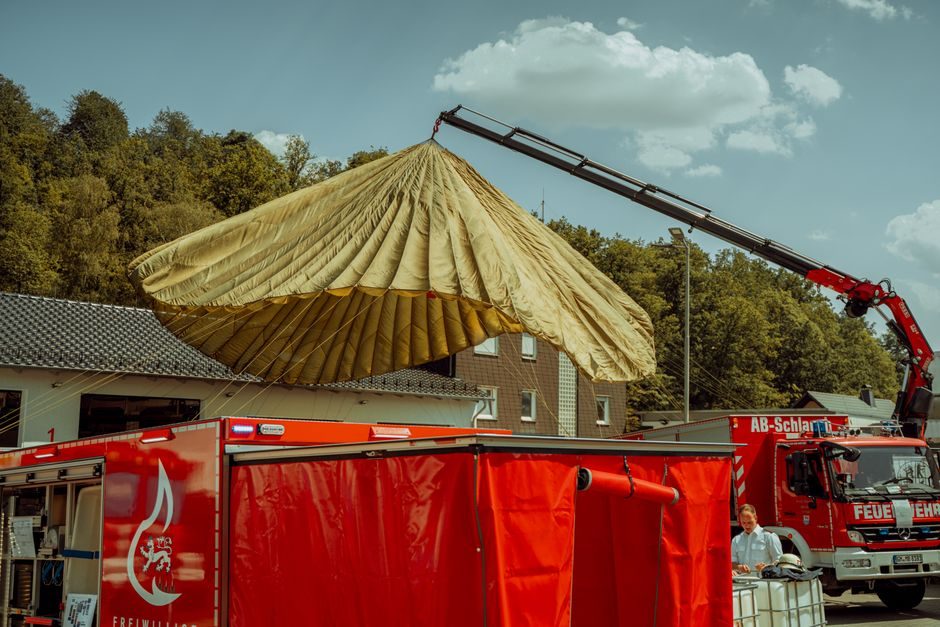
A truck-mounted crane is a self-contained lifting unit bolted to a commercial carrier, classified first by boom architecture (boom/Z-boom, articulated, telescopic, tower/self-erecting, or forestry), then by lift class, axle count, and power source. Current OEM data shows the structural family covers a working-height range of roughly 8 m to 70 m and lift capacities from 1,040 kg on compact 4-axle articulated units to 250 t on 5-axle all-terrain chassis [S2][S3].
Six structural families dominate the 2026 specification landscape, each tied to a duty profile. Forestry and city-class Z-booms handle 12–17 tonne-metre loads on lighter carriers [S1][S4]; mid-range articulated cranes dominate European construction fleets at 1–2 t payloads with 4-axle chassis [S2]; heavy telescopic and all-terrain units carry 50–250 t for tower-crane erection and energy projects [S3][S6][S9]. A side-by-side look at truck-mounted crane families shows the boom architecture is the single biggest driver of reach, weight, and price.
Boom and Z-Boom Cranes: Forestry, City, and Loader Duty
Z-boom architecture — a knuckle boom with a Z-shaped folded geometry — is the default for forestry trailers, recycling loaders, and low-headroom city deliveries where straight telescopic strokes would not fit. The Kesla 22-series spans 12, 14, and 17 tonne-metre load classes on a redesigned transfer boom that gained up to 30 cm of useful outreach without a weight penalty [S1].
Z-booms are also the standard for urban distribution. The Kesla Z14 CITY series delivers 14 t (15.4 US ton) lifts with working heights of 8,080 mm, 9,375 mm, or 10,100 mm depending on extension count, all with stability control as a published feature [S4]. For operations that pair a lift unit with material transport, similar chassis thinking appears in dump-truck body selection, where the structural reinforcement needed behind the cab mirrors the subframe demands of a Z-boom pedestal.
Articulated Loader Cranes: Mid-Range Construction
Articulated cranes use a knuckle/joint between the main and outer boom to fold the unit tightly against the truck body, trading ultimate reach for compact stowage. The Palfinger PK 12502 SH is a current 4-axle benchmark at 1,040 kg (2,292.8 lb) lift, 9.7 m working height, and 1,160 kg (2,557 lb) total weight, with Soft Stop, AOS overload protection, and S-HPLS high-pressure load sensing as published options [S2].
Articulated architecture dominates 1–15 tonne-metre loader-crane sales in Europe because the folded envelope lets the operator run a shorter wheelbase truck while keeping the deck clear for payload. The Palfinger coating line — zinc phosphating, cathodic dip painting at 115 °C for 1.5 hours, and a robotic water-soluble topcoat — is the OEM reference for corrosion protection in this segment [S2]. Reach envelopes and chassis loadings for this class are categorised in the truck-mounted crane types and classifications reference, and the same payload-prioritised wheelbase logic shows up when comparing aerial work platform truck mounts for sign and street-light work.
Telescopic Truck Cranes: Reach and Heavy Lift
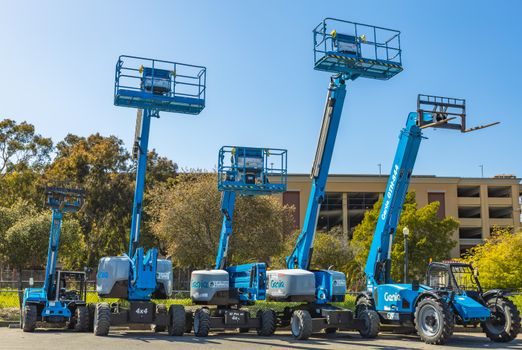
Telescopic booms extend via nested sections to deliver long horizontal reach and high tip heights. The Fassi F385A.2 series is a 3-/4-axle unit rated at 37,550 kg (82,783.6 lb) lift with a 28.65 m horizontal reach, base width 2,515–2,550 mm, and total weight 4,080–5,890 kg depending on configuration [S8]. The Effer iQ.2255 HP reaches 55 m working height at 39,900 kg (87,964 lb) total weight on a telescopic chassis [S6].
At the heavy end of the telescopic class, the Tadano Faun AC 5.250-2 carries 250 t (275.6 US ton) on a 5-axle diesel chassis, with main-boom working heights from 13.4 m to 70 m, an 80 t (88.185 US ton) counterweight, 390 kW (530 hp) drive power, and a 15.74 m base length. Its lift capacities run up to 30 % above prior benchmarks in this class, and the 70 m main boom extends by roughly 42 m with a HAV main boom extension [S3]. For similar transport-side rigour, the truck scale selection guide and the truck-mounted concrete pump size classes use the same axle-load envelope thinking.
Self-Erecting Tower and Compact Electric Units
Self-erecting tower cranes mount on a truck chassis but deploy a vertical tower for low-footprint, high-reach lifts in confined urban sites. The Gruas Saez HT 47 covers 1,200–6,000 kg loads, with a maximum load at maximum radius of 1,360 kg (2,998 lb), and is marketed for lifting, loading, heavy-duty handling, and transport on construction sites [S5].
Compact electro-hydraulic telescopic units are the fastest-growing sub-segment. The Liebherr LTC 1050-3.1E is a 3-axle electric/electro-hydraulic unit rated 0–50 t (0–55.1 US ton) lift, 48 m working height, 39 m horizontal reach, 85 km/h (52.8 mph) road speed, 243 kW (330 hp) drive power, and 7 t (8 US ton) total system weight — its marketing positions it as a lower-emission alternative for urban and indoor work [S9]. The entry-level mid-range Hiab iX.188 HIDUO delivers 15,305.7–17,949.3 kg (33,743.3–39,571.4 lb) lift at 1,946–2,786 kg (4,290–6,142 lb) total weight, with the HIDUO branding signalling a hydraulic/electronic dual-mode control evolution [S7]. The same urban low-emission logic shows up in the reach-truck aisle-width spec matrix for indoor material handling.
Selection Criteria: Architecture, Capacity, Axles, Power
Four decision criteria separate the families in practice: boom architecture (Z-boom, articulated, telescopic, tower, forestry), lift capacity and lift-moment class, truck axle count, and on-board power source. Boom architecture sets the stowed envelope and reach curve; lift class sets the truck minimum GVM; axle count sets road-permit class; and power source sets duty cycle and emission compliance. [S3]
A practical comparison of the six structural families against the four main decision criteria: (1) Z-boom/forestry — 12–17 t·m lift, 2–3 axles, electric or diesel, lowest stowed height, suited to forestry and city delivery [S1][S4]; (2) articulated loader — 1–15 t·m lift, 3–4 axles, hydraulic with electronic control, compact fold, suited to mid-range construction [S2]; (3) telescopic — 37–250 t lift, 3–5 axles, diesel or electro-hydraulic, longest reach, suited to tower-crane erection and energy sites [S3][S6][S8][S9]; (4) self-erecting tower — 1.2–6 t lift, 3–4 axles, hydraulic, vertical lift envelope, suited to confined urban construction [S5]; (5) compact heavy loader — 15–18 t lift, 2–3 axles, hydraulic/electronic dual mode, suited to delivery fleets [S7]; (6) entry-level telescopic truck crane — 14 t lift at 35 t·m moment, 26 MPa rated hydraulic pressure, 63 L/min system flow, 120 L oil tank, 4,800 kg crane weight on a 1,300 mm installation space [S10]. Standards typically applied to these units include EN 13000 for crane safety, EN 12999 for loader cranes, and ISO 4309 for inspection; operators should also confirm compliance with the carrier's local road-permit and axle-load rules before specifying a chassis.
Operating Limits and Failure Modes
Every architectural choice carries a published operating limit that constrains site selection. Z-booms lose horizontal reach at full lift height because the knuckle geometry folds the tip back; articulated cranes trade tip height for compact stowage; telescopic units need a long, level outrigger pad because the bending moment at full extension is the highest in the class [S1][S2][S3].
Common failure modes follow the architecture. Z-boom hinge pins and extension-cylinder seals wear fastest on forestry units because of cycle intensity. Articulated loader cranes are sensitive to overload at the knuckle — electronic aids like AOS and S-HPLS on the Palfinger PK 12502 SH exist specifically to prevent that [S2]. Heavy telescopic units are boom-buckling-limited: the Tadano Faun AC 5.250-2 ships with IC-1 Plus load-moment control and Surround View to manage the 250 t envelope [S3]. Electric and electro-hydraulic units add battery thermal management and high-voltage cable wear as new maintenance items [S9]. The pairing of a knuckle boom with chassis dynamics also shows up in the aerial work platform spec map, which covers the related outrigger-pad and moment-limit logic for elevated work.
Sourcing, Standards, and Trackable Specifications
Direct OEM specification sheets remain the cleanest source for current ratings, because distributor pages often list nominal class without the axle count, working-height range, or counterweight. The six families in this map are documented across Kesla, Palfinger, Tadano Faun, Fassi, Effer, Hiab, Liebherr, and Gruas Saez, with each OEM publishing working height, lift capacity, total weight, axle count, and power source in the same data-sheet format [S1]–[S9].
Trackable signals to watch in the next specification cycle: extension of electro-hydraulic drive to the 50 t+ class beyond the Liebherr LTC 1050-3.1E [S9]; wider adoption of dual-mode hydraulic/electronic control in mid-range loaders like the Hiab HIDUO line [S7]; and continued migration of the 250 t heavy-lift class toward higher-capacity main-boom extensions, as seen in the 42 m HAV extension on the Tadano Faun AC 5.250-2 [S3]. For buyers cross-checking reach envelopes against carrier chassis, the crawler crane site-spec reference covers the stationary alternative, while this article's data points remain anchored to the 10 OEM and one distributor specification sheet above.