Drum volume on a transit mixer scales with axle count, not the other way around: 3-axle chassis typically carry 7-8 m³, 4-axle chassis 9-10 m³, 5-axle chassis 10-12 m³, and semi-trailer mixers up to 15 m³ [S2]. Federal Bridge Formula states allow tri-drive arrangements to gross 80,000 lbs carrying up to 12 cubic yards with an 11.5-cubic-yard McNeilus Bridgemaster drum, a full cubic yard more than older trucks limited to 76,000-lb gross [S1].
Concrete weighs roughly 2.4 t per cubic meter, so a 9 m³ drum means about 21 t of load before chassis and water, which is the physical reason drum size tracks axle count instead of customer preference [S2]. For reference, the standard concrete mixer truck class breakdown and the legal-mass envelope are the two numbers that actually decide what fits on a given route.
Drum vs Axle: the Coupling Most Buyers Miss
Drum size and axle configuration are not independent choices; a bigger drum only pays off if the chassis can legally carry it full [S1]. A standard tandem-rear-axle mixer (6x4 with two driven rear axles) is the baseline most ready-mix trucks run, while tri-drive (8x4 or 8x6) adds a third driven rear axle specifically to raise gross vehicle weight and payload without breaching per-axle limits [S1]. Kenworth has built T880 mixer specs with seven axles, three steerable liftable pusher axles plus a swing-down booster, to push into the 80,000-lb Federal Bridge envelope [S1].
European class data lines up closely: the 3-axle 26 t truck holds 7-8 m³ with 12-14 t of payload, the 4-axle 32 t truck holds 9-10 m³ with 16-19 t of payload, and the 5-axle 40 t truck holds 10-12 m³, often with a lift axle [S2]. The standard power mixer reference pages cover the rotating-drum geometry that makes these envelopes possible.
Payload vs GVW: the Numbers Behind the Spec
Two-axle mixer trucks support maximum weight capacities of 16,000 kg, suitable for smaller projects and urban routes with weight restrictions [S4]. The standard single-axle 3-axle configuration in North American service is limited to about 48,000 lbs, sufficient for small pours only; adding a tag or pusher axle is the path to higher gross [S6]. Standard transit mixers run loaded weights up to 72,000 lbs with 10 cubic yards of nominal drum capacity, while drum mixing capacity is usually rated at 9 cubic yards [S4].
Concrete density comes in at 4,056 lb per cubic yard (about 2,400 kg/m³), which means a 10 yd³ load is roughly 40,560 lb of fresh mix before chassis, water tank (300-500 L), and crew [S2][S4]. That is why a sand mixer drum and a transit mixer drum, while both inclined rotating vessels, are sized on completely different mass budgets.
Selection Matrix: Tandem vs Tri-Drive vs Semi-Trailer
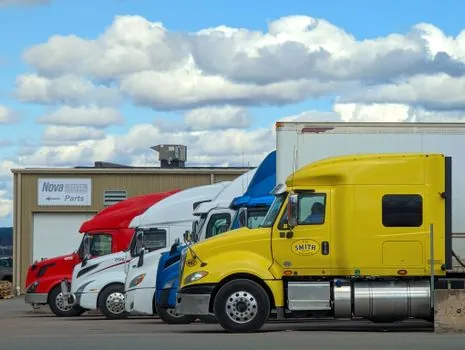
For urban and regional ready-mix delivery on suitable roads, the 6x4 three-axle tandem balances drum capacity, traction, and manoeuvrability, and is the workhorse of the segment [S3]. For higher-output infrastructure pours where the route can accept a longer vehicle, the 8x4 four-axle configuration supports a higher-capacity drum within legal mass limits but is the wrong pick for the tightest urban sites [S3]. For maximum single-load volume on long plant-to-site hauls, the semi-trailer mixer holds 10-15 m³ and dominates long-distance moves in Europe [S2].
Specifying rule: short-load contractors hauling a few miles for footings get the best return from a standard tandem plus a mid-size drum, because the tri-drive axle premium does not pay back over short routes [S1]. Ready-mix producers running spread-out service areas benefit from tri-drive plus a larger drum, since each additional yard offsets more drive time per trip [S1].
Route, Site, and Discharge Constraints
Final drum volume depends on the approved chassis and project limits, not on buyer preference [S3]. Fresh concrete is a perishable good with roughly 90 minutes of workability from water addition, less in hot weather, so transit mixers run tight cycles typically within 30-50 km of the plant [S2]. Discharge options also feed back into chassis choice: rear-discharge mixers are the most widely produced configuration across every major OEM, while front-discharge mixers are regional in the US and dominate in select niche markets [S5].
Special bodies add axle load in their own right. A conveyor-belt mixer carries a swivelling 8-16 m belt at the rear for placing over obstacles, while a pump mixer combines drum and concrete pump with a 20-28 m placing boom on one chassis, at the cost of drum volume, higher tare weight, and higher purchase and maintenance cost [S2]. Where pumping reaches into placing depth, the comparison lines up with spec thinking similar to a pressure transmitter selection, where the rated envelope must match the worst-case process condition, not the average.
Front-Discharge vs Rear-Discharge: the Other Axle Story
Front-discharge mixers have been around for four decades, are only found in a few regions in the US, and in those regions tend to dominate because the driver can position the truck and pour without a chute helper [S5]. Rear-discharge remains the oldest, most popular, and most iconic layout, with every major truck OEM offering a mixer-capable chassis [S5]. Front-discharge typically pairs with a tag axle ahead of the drive axles for better steering geometry on tight sites, which in turn re-opens the axle-count question for that specific use case.
Front-discharge visibility is not free: the cab-forward pusher-axle arrangement adds an axle to maintain and increases tare, so the same legal-mass ceiling yields slightly less payload than an equivalent rear-discharge tandem. For ready-mix buyers comparing industrial valve and flow hardware on the chassis water system, the same logic applies: layout follows the route, not the other way around.
What Usually Goes Wrong in Sizing
Buyers frequently shop a transit mixer the same way they would shop a dump truck, by drum size and chassis brand, and only discover that the axle configuration actually fixed legal payload after the truck was spec'd [S1]. The drum's nominal volume is always greater than the stated usable volume, so a 9 m³ nominal drum will not deliver 9 m³ of placed concrete on every load [S2]. Drum water tanks of 300-500 L, crew, and fuel further erode the gap between nominal drum and legal payload, especially on shorter-wheelbase tandem chassis [S2].
For buyers cross-referencing fluid-system hardware, the flow meter class on the water-tank fill line is often sized for the wash-out cycle, not the mix-water dose, which is a parallel example of nominal rating exceeding working capacity. Always compare legal payload (vehicle registration document) against nominal drum, not against the brochure headline number.
Mini Mixers and 4x2 Exceptions

Mini mixers on 18-t two-axle chassis carry 4-6 m³ and are built for confined inner-city sites where a full-size 6x4 will not enter [S2]. The 4x2 two-axle compact configuration suits lighter project requirements and access-constrained urban projects, but is the wrong pick when drum and legal-load requirements exceed the confirmed chassis envelope [S3]. In practice, the 4x2 segment is the fastest-growing configuration in dense European city centres because curb weight and turning radius, not drum volume, drive the spec.
Two-axle max payload caps at roughly 16,000 kg, which at 2.4 t/m³ of fresh concrete yields a 6-7 m³ drum ceiling, matching the 4-6 m³ mini-mixer band [S2][S4]. Going past that band without adding an axle simply means operating over legal weight, which is a citation risk on most enforcement routes, not a workable plan.
Track the next data points: any 2026-2027 update to Federal Bridge Formula thresholds affecting tri-drive mixer envelopes, and any European GVW revision that lifts the 40-t 5-axle ceiling, since both would re-rank the axle-vs-drum table above. The Concrete mixer truck axle guide for chassis layout strategy is the adjacent reference for spec-side trade-offs that sit one level up from drum sizing.