
The 1.6 m × 1.6 m square mast is the workhorse of the global fleet, paired with mid-range cranes such as the Potain L46A1 and weighing about 1,180 kg per 3.0 m segment with ∠180×18 main chords [S1]. One step up, the 2.0 m × 2.0 m section targets heavy-lift high-rise work and ships near 1,400 kg per segment with ∠200×20 chords, the configuration stamped into the L68B1 family [S1][S5]. The 2.5 m × 2.5 m section, built around H-beam 293×266 chords in 6.0 m lengths, sits at the top of the lifting-moment envelope for super-tall and infrastructure work [S2].
Cross-section is the dominant lever on bending stiffness and free-standing height, not just on axial capacity, so the jump from 1.6 m to 2.0 m delivers a disproportionate gain in allowable load moment [S1]. The complete tower crane mast and structural section guide is the right reference page when comparing chord profiles side by side. Within each square size, segment length commonly runs 2.2 m, 2.5 m, 2.8 m, or 3.0 m, chosen to match container packing and climbing-cycle logistics [S8].
Cross-Section and Lifting-Moment Envelope
Manufacturers tier masts by cross-section, and the tier maps almost one-to-one onto maximum load moment, per a 2025 OEM sizing guide [S1]. The 1.2 m × 1.2 m tier covers small and self-erecting cranes such as the Potain S24, with segments near 850 kg and D40/D45 pin connections [S1]. The 1.6 m tier covers mid-range machines and is, by both 2025 industry write-ups, the most prevalent footprint in the global installed base [S1][S4].
At 2.0 m, segments move up to roughly 1,400 kg with ∠200×20 chords and D55 pins, which is the typical envelope for the L68B1, L68, and L69 series [S1][S5]. The 2.5 m square tier, often built with H-section chords at 293×266 in 6.0 m lengths, is reserved for super-tall cores and large infrastructure lifts where the 1.6 m and 2.0 m tiers run out of bending capacity [S2]. For the broader system context, the tower crane design and lifting-capacity reference lines these section sizes up against jib length and maximum load charts.
Main-Chord Steel Section and Section Mass
Main-chord steel section is the second key number, and it varies as much as the outer dimension. The 1.6 m mast typically uses ∠180×18 angle chords at 3.0 m segment length, or 135×10 square-tube chords in shorter 2.5 m QTZ50-class segments [S1][S2]. The 1.8 m × 1.8 m tier uses ∠180×14 or ∠180×16 chords in 3.0 m lengths, a useful intermediate for the 132HC class [S2].
Step up to 2.0 m and chord steel typically thickens to ∠200×20, ∠200×24, or ∠200×26 depending on the duty rating, with Q355B as a common specified grade [S2][S5]. A 2.45 m intermediate seen in some heavy-lift lines uses ∠180×18 chords with internal rib-stiffened angles, while the 2.5 m tier is dominated by H-beam 293×266 chords in 6.0 m segments [S2]. The steel section property reference is the right place to check section modulus when comparing these chord profiles directly.
Segment Length, Pin/Bolt Diameter, and Connection
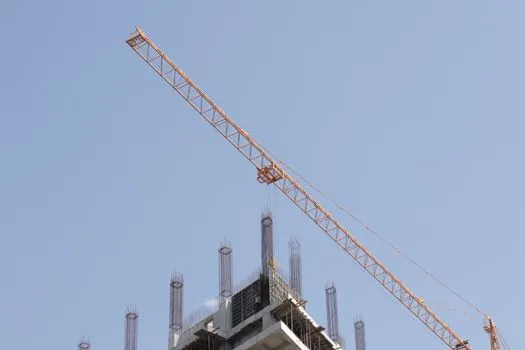
Segment length is quoted as the third dimension, and it controls transport packing and erection cycle time. The 1.6 m × 1.6 m × 2.8 m form factor is widely cited as the most common, because 2.8 m segments pack 12–14 units into a standard 40HQ container and the height is convenient for climbing-form cycles [S4]. A 3.0 m segment is the more common length for the L46A1 and L68B1 lines, where the extra 0.2 m per segment saves joints on a 60 m tower [S1][S3].
Connection hardware scales with section size: D40–D45 pins on the 1.2 m tier, D50 pins on the 1.6 m L46A1, and D55 pins on the 2.0 m L68B1 [S1]. High-strength bolts, lugs, and pin sleeves are the standard joining method across all three sizes, and a small team of 3–4 trained technicians is the typical crew for one segment lift [S5]. When capacity is borderline between 1.6 m and 2.0 m, the tower crane counter-jib and counterweight design reference is a useful cross-check on the bending moment the mast must resist.
Free-Standing Height and Foundation Reaction
Free-standing height grows with cross-section because the mast must resist overturning moment without tie-ins. A 1.6 m square mast is generally adequate for low- to mid-rise projects where free-standing heights stay under roughly 40–50 m, depending on jib length and counterweight [S1]. Moving from 1.6 m to 2.0 m raises the allowable free-standing height and reduces the number of tie-ins needed on a tall core, which is one reason high-rise specs default to the 2.0 m tier [S1][S5].
The 2.5 m tier is specified when the project demands both high free-standing height and heavy lift capacity at long radius, where the larger footprint and H-beam chord resist the combined axial and bending load with smaller tower-sway under wind [S2]. A practical note from the field: the 2.5 m segment, at 6.0 m length, is roughly twice the piece mass of a 1.6 m × 1.6 m × 3.0 m segment, so the site crane and counter-jib handling plan must be sized for the heaviest single pick before the mast stack starts [S2][S5].
Brand Compatibility and Interchangeability

There is no single global standard for mast dimensions, so cross-brand interchange is partial. The 1.6 m × 1.6 m × 2.8 m and 1.6 m × 1.6 m × 3.0 m sections are described as a near-universal fit within certain Potain, Zoomlion, and Yongmao series, which is why this size dominates the used and rental market [S4]. Within the Potain range, the 1.2 m, 1.6 m, and 2.0 m tiers correspond to S24, L44/L46, and L68 series respectively [S1].
Within a 2.0 m family, L68A1, L68B1, and L68B2 differ mainly in lug and connection details, and the L68B1 is the most widely produced variant, with documented compatibility against L68, S24, L69, 132HC, 154HC, 120HC, and 290HC machines [S5]. Buyers should always verify pin diameter, bolt pattern, and lug geometry before swapping a 1.6 m segment into a 2.0 m-rated tower, because the two tiers are not field-interchangeable even when the outer dimension looks similar [S1][S5]. For a sizing perspective from a different angle, the jib-length and footprint coverage rules sit alongside mast selection in any pre-tender engineering check.
Materials, Manufacturing, and Service Life
Mast sections are built from Q235B or Q345B structural steel for the 1.6 m class, with Q355B becoming the default for the 2.0 m L68B1 line and heavier tiers [S4][S5]. Production typically runs through CNC cutting, robotic or submerged-arc welding, shot blasting, and either powder coat or anti-rust primer, with a Mill Test Certificate expected on export orders [S4]. Weld quality for European delivery is often tied to EN ISO 3834, and the CE mark plus ISO 9001 are the standard paperwork items a buyer should request [S4].
Service life is consistently quoted at 10–15 years for 1.6 m × 1.6 m × 2.8 m sections under normal maintenance, which is visual inspection of flanges, bolt holes, and welds plus a fresh anti-rust coat every few years [S4]. Heavier 2.0 m and 2.5 m sections follow the same maintenance logic but see higher cycle counts, so the inspection interval is usually tightened on those fleets [S5]. The signal-tower-light and indicator reference is unrelated mechanically but worth flagging for any site where aviation warning lights are mounted on tall 2.5 m masts.
Sourcing, Standards, and Buyer Checklist

Export-grade 1.6 m × 1.6 m × 2.8 m sections price in the low-hundreds USD per segment on the Chinese OEM market, with a documented 1.6 m × 2.5 m QTZ50-spec section at $418–500 per set and a 100-set-per-month supply ability from a representative maker [S2]. A 40HQ container takes 12–14 segments of the 1.6 m × 1.6 m × 2.8 m form factor, which is the standard packing assumption for used and refurbished stock [S4]. The measurement and test methods reference is the right page when buyers need to specify a tensile, weld-integrity, or dimensional QA plan on receipt.
Three items to verify before any cross-size purchase: main-chord section (angle size and thickness, or H-beam designation), pin or bolt diameter (D40/D45/D50/D55 line), and segment length. Mismatches on any one of these three will block assembly even when the outer square dimension matches [S1][S2][S5]. Watch the 2026–2027 supply window for 2.0 m L68B1 stock and the 2.5 m tier pricing, since heavy-lift project pipelines have been the leading driver of section-tier demand into 2026.