
A new truck crane exported from China carries a factory FOB spread of roughly US$8,000 for a 2-3 t mini unit up to US$10,000,000 for a 60 t telescopic boom machine, with 25-50 t mobile truck cranes — the segment most procurement engineers actually spec — clustering between US$40,000 and US$100,000 per unit on current supplier listings [S1][S2][S6].
That wide range is not a market anomaly; it tracks cleanly with maximum lifting capacity, number of boom sections, outrigger count and the brand tier (XCMG, Zoomlion, SANY vs smaller Shandong / Hubei integrators). A US$8,000 listing is typically a 2-5 t knuckle-boom unit on a 4x2 chassis, while a US$300,000+ listing buys a 50-110 t five-section telescopic with full hydrostatic outriggers [S2][S8][S9].
Price Bands by Lifting Capacity (FOB China, 2026 Q2 listings)
Supplier data from May 2026 clusters new truck cranes into four working bands: (1) US$1,999-19,999 for 1-5 t mini / knuckle-boom units, dominated by Shandong Honfu and similar small-frame builders [S7]; (2) US$8,000-49,000 for 5-10 t foldable cargo-truck-mounted cranes such as the LTMG and Luen Auto SKW-series [S1]; (3) US$40,277-117,127 for 25 t hydraulic boom models like the HBQZ SQ500ZB5 and Hubei Best folding manipulators [S6]; and (4) US$100,000-10,000,000 for 25-110 t telescopic truck cranes from XCMG and Zoomlion, where the 25 t XCT25L5_Y sits near US$100,000 and the 60 t XCT60_Y opens at US$100,000 with stretch headroom to US$10,000,000 for fully optioned variants [S2][S8][S9].
Used Japanese stock adds a parallel floor: a 25 t KATO NK250E (1998 build) lists at US$35,000 FOB, climbing to US$50,000 for 2006 builds — a useful benchmark when buyers accept 15-25 year old iron over new Chinese units [S5].
The Four Levers That Move the Quote
Capacity is the headline number but only one of four cost drivers. Boom configuration (2-section knuckle vs 4-5 section telescopic) typically adds 30-60% to price within the same tonnage class because of the additional hydraulic cylinders, luffing cylinders and slewing bearing assemblies [S2]. Chassis origin is the second lever: XCMG and Zoomlion self-build the carrier, allowing all-in pricing, while smaller Hubei / Shandong integrators mount the crane on a purchased Dongfeng or Foton chassis and pass that cost through with a 8-15% integrator margin visible in the spread between US$40,277 and US$88,055 for nominally identical 25 t HBQZ units [S6].
Third, certification scope moves the number: listings tagged ISO9001:2015 only trade at a discount versus units carrying CE, GS and RoHS marks for EU/UK import, where the STC500s 50 t class lists as "Negotiable" pending certification review [S1][S8]. Fourth, the number of hydraulic outriggers (H-style 4-point vs simple rear jacks) and counterweight stack is a 10-20% premium that often goes unmentioned in headline RFQs [S2][S9].
New vs Used: Where the Crossover Sits
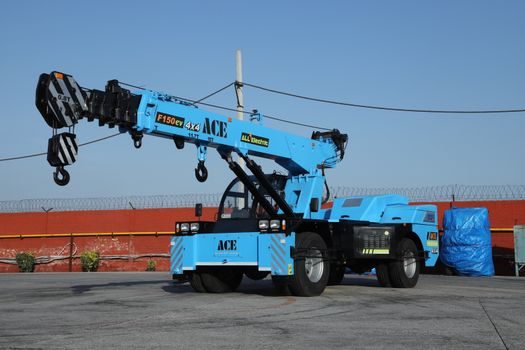
For a 25 t class machine, the used Japanese import from Ruihao lists at US$35,000-50,000 (1998-2006 KATO NK250E) against a new Chinese 25 t HBQZ or XCT25L5 at US$40,000-100,000 — a 20-50% used discount that disappears once you add typical 25-year-old rebuild costs of US$8,000-15,000 for hydraulics, boom pins and slewing ring inspection [S5][S2][S6].
Decision rule used by most Middle East and African rental fleets: buy new below 50 t, buy used above 50 t — a 50 t used KATO is rare, and the rebuild risk on 100 t+ lattice-boom iron is real. For a related look at mobile lifting equipment sizing across smaller scales, see this forklift jib vs truck-mounted crane spec cut.
What's Included in the FOB Number — and What's Not
All prices cited above are FOB Chinese port and assume a bare machine: no operator, no rigging slings, no load chart manual in the buyer's language unless negotiated. Tires are a separate line — a single 18.00R25 OTR radial for a 50 t crane-class axle runs US$200-2,000 per piece depending on Hanmix, Aeolus or comparable brand, and a full 6x6 or 8x4 truck crane needs 6-10 tires, adding US$1,200-20,000 to the landed cost [S10].
Spare parts kits, the second hydraulic filter set, and the standard 12-month factory warranty are typically included for new units from audited Diamond Members, while training, commissioning and English load-chart documentation are quoted separately at 3-8% of the unit price. The truck-mounted crane reference on this site outlines which sub-assemblies drive the option cost once the base FOB figure is fixed.
Standards and Certifications That Affect Re-Sale Value
New units from XCMG, Zoomlion and SANY carry CE marking under the Machinery Directive 2006/42/EC for EU import, ISO9001:2015 quality-system certification at the factory, and — for the 50 t+ class — GS third-party structural verification on critical welds [S1][S2][S8][S9].
Buyers shipping to GCC, Nigeria or Southeast Asia typically accept ISO9001-only documentation; buyers into the EU, UK or Australia should insist on the CE Declaration of Conformity and a separate EN 13000 hoisting-appliance compliance file, which adds 4-6 weeks to delivery and roughly 1-2% to the unit price as the certifying body's audit fee. Buyers looking at smaller carriers on a dump truck chassis should confirm that the chassis itself carries a separate type-approval, as the crane CE file does not cover the carrier.
Comparison Matrix: 25 t vs 50 t vs 110 t Truck Crane (FOB China, 2026)
Three capacity tiers line up against four buyer-relevant criteria. On purchase price, the 25 t XCT25L5_Y / HBQZ SQ500ZB5 sits at US$40,000-100,000, the 50 t STC500s / ZTC250A552 at US$100,000 list, and the 110 t XCT110 at US$10,000+ million-stretch FOB [S2][S6][S8][S9]. On boom configuration, 25 t ships as 3-4 section telescopic, 50 t is typically 4-5 section U-boom, and 110 t is 5-7 section with 78 m main-boom reach.
On certification floor, 25 t often runs ISO9001 only on smaller-builder units while 50 t+ always carries CE + ISO9001; on outrigger span and counterweight stack, 25 t uses simple rear jacks, 50 t adds H-style 4-point, and 110 t ships full hydraulic with 7-9 t removable slabs. On sourcing pathway, 25 t moves through Shandong / Hubei trading companies with 1-set MOQ flexibility, 50 t requires direct OEM or audited Diamond Member contact, and 110 t is a direct-factory sale with negotiable lead time. For buyers also sizing telescopic versus knuckle booms for light maintenance work, a reach truck class comparison is a useful adjacent read on lifting-height requirements.
Common Costly Mistakes in RFQs
Three pitfalls repeat across the 2026 quote stream. First, buyers compare headline tonnage without specifying boom-section count, and a 25 t 3-section machine is 25-30% cheaper than a 25 t 5-section — same hook rating, very different working radius [S2]. Second, "FOB price" on a Shandong trading-company listing often excludes the USD$1,800-3,500 export-crating fee and the 13% China VAT rebate paperwork that the buyer's agent must handle separately [S1][S3].
Third, MOQ is typically 1 set for standard models but jumps to 3-5 sets for custom colour, custom logo or non-standard outrigger span, which locks small rental-fleet buyers out of the best tier of the price curve [S1][S6]. Reading a truck scale for axle-load verification before finalising the RFQ is a cheap pre-shipment check many importers skip, only to discover at port that the crane's rear-axle load exceeds the destination road limit. For a wider cost-driver framework that also applies to truck-mounted lifting equipment, the helical gear reducer 2026 price guide walks through the same "size-ratio-tier" lever logic on a different product class.
Sourcing Map and Trackable Signals
Three supplier clusters dominate verified 2026 export listings: Hubei (HBQZ, Hubei Best, Hubei Xingyao) for 25-50 t hydraulic-boom units, Shandong (Luen Auto, Honfu, Xiangjin) for mini and 5-10 t cargo-truck-mounted cranes, and Jiangsu (XCMG direct, Zoomlion) for the 50-110 t telescopic class [S1][S2][S6][S7][S9].
Trackable signals for the next quarter: whether XCMG XCT-series prices firm up above the US$100,000 floor as Q3 2026 steel-cost adjustments pass through, and whether used-Japanese KATO 25-50 t stock tightens as Japanese domestic infrastructure spending draws down available 2005-2015 inventory. A 50 t STC500s shipped FOB in June 2026 at negotiable pricing above the US$100,000 mark is the current benchmark; movement of more than ±10% on that figure would be the signal worth watching [S8].