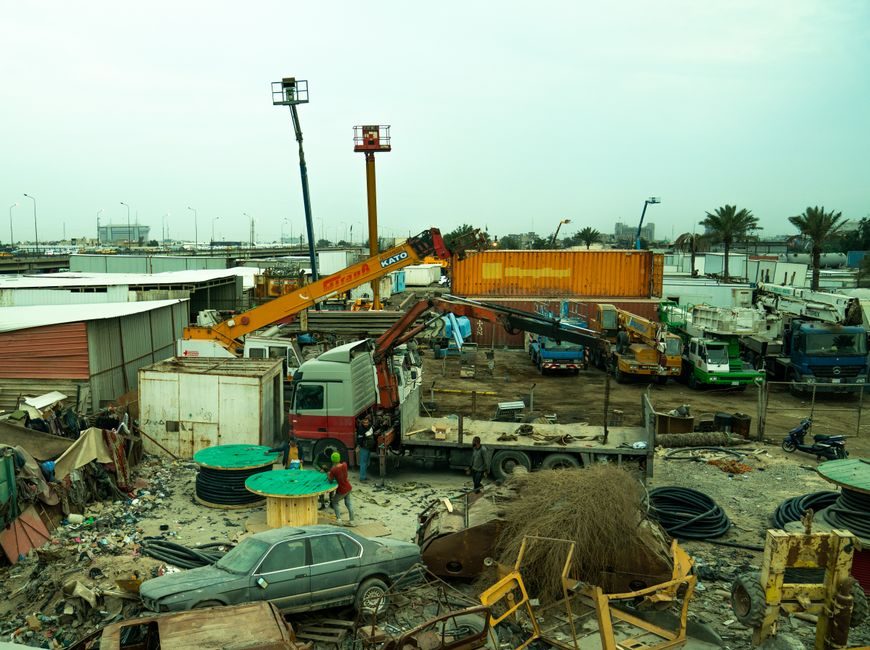
A truck crane is a carrier-mounted lifting machine that pairs a road-going chassis with a hydraulically powered telescopic (or lattice) boom, allowing one asset to drive, rig, lift and demobe on a single platform.
In practical 2026 fleet terms, truck cranes fill the gap between rough-terrain cranes and all-terrain cranes: road-legal, mid-capacity (commonly 8 t to 120 t maximum lift), and quick to deploy, with the trade-offs in axle load, ground-bearing pressure, and chart de-rating on uneven pads.
Definition and Operating Envelope
A truck crane is defined by mounting a complete crane upper-structure (boom, hoist, slewing table, operator cab, counterweight) on a commercial truck chassis rather than on a purpose-built crane carrier. This configuration is described alongside other carrier-mounted machines in the truck crane types and classifications spec map and the broader truck-mounted crane reference. Boom forms split into telescopic (1-box to 5-box hex section) and lattice (pin-connected modular sections); outriggers are typically H-pattern four-point hydraulic with single-stage or two-stage beams.
Maximum lift ratings cluster into identifiable bands: 8-25 t (urban delivery and HVAC), 30-50 t (general construction and steel erection), 60-90 t (precast and tower-crane assist), and 100-120 t (infrastructure and energy). Boom length on telescopic units commonly reaches 30-47 m main boom plus 8-17 m bi-fold swing-away jib, and lattice boom configurations can exceed 60 m when assembled section by section.
Selection Criteria: Where the Truck Crane Wins
The first decision is road legality and bridge-formula compliance. Truck cranes ride on production truck axles that already meet gross vehicle weight and axle-spacing rules for public roads in most jurisdictions, so a properly configured unit can travel between jobs without dismantling or special permits at typical ratings below 60 t. By contrast, an all-terrain crane may require load-distribution surveys or police escorts above its roadable envelope on certain corridors.
Mobilization speed is the second decision driver. A telescopic truck crane typically completes rig-in (outrigger deploy, counterweight install if removable, and load-chart set-up) in 10-20 minutes with a single operator and a rigger, compared with 30-60 minutes for a comparable all-terrain unit. The third criterion is cost-per-lift-hour: capital cost of a 50 t truck crane is broadly 25-35% lower than a 50 t all-terrain crane, while fuel burn on highway travel is closer to a 6×4 tractor than to a 6×6 carrier.
For job sites with paved, level, and well-drained surfaces — concrete slabs, sealed yards, completed road decks — a truck crane on full outriggers delivers close-to-chart capacity with minimal ground-prep work. This positions it as a strong fit for precast yard work, HVAC rooftop lifts, sign-structure erection, and shut-down maintenance in chemical or power plants where the approach road is already engineered.
Limitations and Failure Modes

The first hard limit is axle load. A 50 t truck crane with full counterweight can impose 9-12 t per axle on the carrier, and many jurisdictions cap single-axle load at 8-10 t and tandem-axle load at 15-18 t depending on bridge-class. Over-axle configurations must travel with reduced counterweight, water-ballast drained, and removable outrigger boxes off, which directly cuts maximum lift capacity on arrival.
The second limit is ground-bearing pressure under the outrigger pads. Truck crane outrigger foot-pads commonly apply 80-120 t/m² when the boom is at short radius and the lift is near maximum, exceeding the 50-80 t/m² safe bearing capacity of many unprepared soils. Timber mats, steel spreader plates, or crane-mat rigs are required on soft ground; without them, pad settlement creates chart-versus-actual divergence and overturning risk.
The third limit is on-road travel envelope. Overall height with boom retracted commonly reaches 4.0-4.3 m, and overall width with outrigger beams stowed runs 2.5-2.75 m — values that regularly hit bridge soffits, tunnel portals, and urban tree-canopy limits. Operators must plan a route survey; bridges posted under 4.2 m or weight-restricted below the unit's GVW force a detour or disassembly that erases the machine's main speed advantage.
Comparison: Truck Crane vs Crawler Crane vs All-Terrain Crane
Selection turns on four criteria: mobilization cost, ground preparation, on-road legality, and maximum lift at full chart.
Mobilization cost: a truck crane at 50 t rating typically mobilizes on standard low-loaders or self-rigs at low permit cost; an all-terrain crane at the same rating requires oversized-load permits and often a police escort; a crawler crane of equal rating must be broken into multiple truckloads (boom, carbody, tracks, counterweight) and re-assembled, pushing mobilization cost 1.5-2.5× higher.
Ground preparation: a truck crane on outriggers needs level, firm pads of roughly 1.0 m × 1.0 m per corner; an all-terrain crane uses the same outrigger pattern; a crawler crane distributes load through tracks at 10-30 t/m² and works on soft, uneven ground with minimal prep. On a muddy, unconsolidated site, the truck crane loses its speed advantage because pad-mat handling adds hours.
On-road legality: a truck crane is the only one of the three that drives itself to most sites at full road speed; all-terrain cranes drive at limited speed (typically 50-70 km/h) and face bridge-class scrutiny; crawler cranes do not self-drive on public roads at all.
Maximum lift at full chart: all three can reach 100-120 t at short radius with proper rigging, but a crawler crane holds a higher percentage of its chart at long radius (above 30 m) because of its heavier counterweight packages and rigid base, while a truck crane's chart falls faster with radius once the boom passes the 30 m mark.
Use Cases That Match the Truck Crane Profile

Urban construction lift: 30-50 t truck cranes routinely set precast panels, place rooftop AHUs, and erect structural steel on tight downtown sites where the unit can roll in, set outriggers inside a 6 m × 6 m footprint, and roll out the same day. Bridge inspection and light rehab: short-wheelbase truck cranes under 25 t work from a single lane closure, lifting inspection platforms and small replacement girders.
Industrial maintenance: in petrochemical, power, and steel plants, truck cranes with 35-60 t capacity feed scheduled shut-downs because the unit can be repositioned between vessel columns without re-rigging. Wind-energy erection: 80-120 t truck cranes are now specified for nacelle and hub lifts on smaller turbines (2-3 MW) where a full crawler mobilization would overrun the project budget.
Standards, Sourcing, and Documentation
Truck cranes are designed and rated under ASME B30.5 (Mobile and Locomotive Cranes) for operational safety, with structural design referencing ASME BTH-1 (Design of Below-the-Hook Lifting Devices) for load-handling attachments and EN 13000 for the European CENELEC envelope. Operator certification in most jurisdictions follows NCCCO (USA), CPCS (UK), or equivalent national schemes. Load-chart sign-off, the moment-limiting device calibration record, and the most recent annual thorough examination must travel with the machine; a discussion of the pre-lift documentation flow appears in the truck crane installation guide covering chassis prep, outrigger survey, and load-chart sign-off. [S3]
Sourcing reality in mid-2026: lead times for popular 30-80 t telescopic truck crane models from major OEMs (Liebherr, Tadano, XCMG, Sany, Terex, Manitowoc) range from 60-120 days ex-factory for standard configurations and 180-260 days for units with special booms or carrier specifications. Pre-owned 2018-2022 units in the 50-80 t band trade at roughly 55-70% of original list price, with hours and outrigger condition as the dominant price drivers rather than boom length or paint.
For a fleet decision in 2026, the truck crane remains the right answer when the job mix favors 6-15 lifts per day across multiple sites within a 100 km radius on prepared ground; it loses to a crawler crane above 120 t or on soft, unconsolidated ground, and loses to an all-terrain crane when bridge-formula, axle-load, or escort constraints on the public road network are tight. Material-handling fleets evaluating truck cranes alongside dump truck and concrete mixer truck acquisitions should run a joint utilization model — peak-day lift demand, average haul distance, and outrigger-pad handling time drive the ROI more than the headline lift rating.