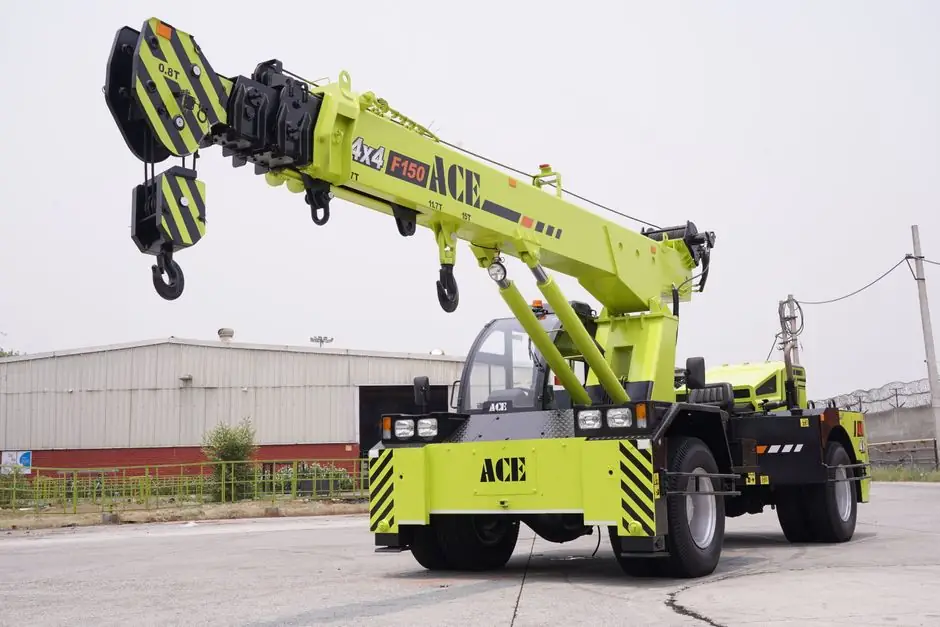
Specifying a truck crane for winter operations is not the same exercise as specifying one for a pipe yard. The chassis has to cold-start at -30 °C, the boom has to cycle with slush on the controls, and the work platform has to accept a rooftop scraper, a front plow, or a log grapple in under five minutes. In practice, three configurations cover roughly 90% of municipal and contractor fleets: a 5-12 ton knuckle/straight boom on a 4x2 or 4x4 carrier, a 16-25 ton telescopic for timber-and-ice cleanup, and a 37-60 ton heavy telescopic reserved for industrial sites that double as snow-storage yards [S1][S3].
Capacities track the carrier class. Foton-series factory-installed loader cranes cover 1-16 t on a standard commercial chassis and are widely used in China for municipal construction, coal-mine logistics, and landscaping [S6]. North American buyers typically step up to ISO9001-certified boom-truck builders such as Jining Jiaqing, whose catalog spans 3.2 t, 6.3 t, 8 t, 10 t, 12 t, 14 t, 16 t, and 20 t boom-truck configurations on Isuzu, HOWO, and Shacman chassis, with 30-37 m aerial-work variants on the same platform [S3].
Chassis and cold-weather package
Cold-rated chassis start with a block heater, thermostatically controlled fuel-line heaters, and a dual-battery 24 V system sized for the hydraulic pump at -29 °C ambient. North American plowing fleets usually run a 4x4 single-axle or tandem chassis with a front engine PTO driving a hydraulic pump rated 30-60 gpm, paired with a front-mounted plow and a rear underbody scraper [S2]. For combined crane-and-plow units, the boom is mounted behind the cab on a sub-frame that does not interfere with the front hitch receiver, and the outriggers must deploy inside a 2.4 m working envelope so the truck can park on a city street without blocking a traffic lane [S1].
Diesel particulate filter cold-cycle regeneration is a recurring failure mode on plow trucks that idle for hours; selecting a chassis with an automatic electric coolant heater and a fuel-fired coolant heater keeps the DPF above its light-off temperature and avoids the manual regen cycles that otherwise consume a shift. Tire selection matters as much as the engine: a 315/80R22.5 snow-tread or a studded winter tire with a load range of 4,500-5,000 kg per corner keeps the rear axle legal when the truck is fitted with a 1,500 kg rooftop scraper carriage [S2].
Boom sizing for snow duty
Boom lift capacity and snow duty are inversely related in one specific way: heavier roofs require bigger booms, but the booms themselves become useless if they cannot be cycled in freezing slush. For routine municipal work (street plowing, hydrant clearing, bus-stop canopy ice removal), a 3.2-8 t straight-boom crane on a 4x2 chassis is the common choice, with a 6-12 m hook height and a 4-8 m working radius. For logging-style ice-storm cleanup where the load is a 2-3 t broken branch or a 4 t section of utility pole, buyers move to 10-16 t telescopics, which are also the workhorses for pipe-yard construction [S3][S1].
For heavier industrial sites, 25 t (XCT25L5_Y) and 60 t (XCT60_Y) five-section telescopics from XCMG are catalog items on the Machmall platform, with 5-section booms that deliver longer reach and stronger outrigger-monitored lift charts at full extension [S1]. The relevant engineering trade is between a single 25 t unit and two 12 t units: a single 25 t truck has lower per-hour operating cost but costs roughly twice as much and cannot rotate between two job sites, while two 12 t units give a contractor redundancy on storm days when one machine breaks down. Cab-controlled load moment indicators (LMI) and a 2-camera rear-view system are standard on Jining Jiaqing's 10-20 t class and are worth the small upcharge on any sub-zero fleet [S3].
Work-platform and quick-coupler requirements
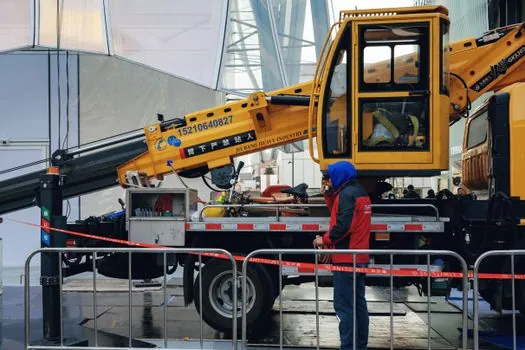
The work platform is the multiplier on a snow-removal crane. Rooftop snow on a 53 ft trailer can add 2,268 kg (5,000 lb) and force the rig overweight, and an increasing number of U.S. states issue fines of up to $1,500 per passage for trucks operating with uncleared snow on the roof [S2]. Automated rooftop snow scrapers such as the Scraper Systems fleet plow clear a single vehicle in under 30 seconds and process up to 60 vehicles per hour, with brush-style heads that pass over bus escape hatches, strobe lights, and tarped trailers without damage [S2]. A truck crane in this role is essentially a positioning lift: it carries the carriage frame to vehicle-roof height, then idles while the brush sweeps, which is gentle duty and lets a smaller 5-8 t boom do the work.
Quick-couplers are the make-or-break item. Hydraulic multi-couplers with flat-face ISO 16028 fittings let the operator swap between a grapple, a personnel basket, a concrete bucket, and a rooftop-scraper carriage in under five minutes, with no oil spillage that would otherwise freeze on the connectors. The 1-16 t Foton straight-boom line ships with manual single-pin couplers; buyers in mixed-duty fleets should specify the hydraulic option and a 12 V / 24 V electrical junction on the boom tip so a heated camera and LED work light can be added without rewiring the carrier [S6][S3].
Standards, certification, and supplier gates
For municipal tenders the relevant certifications are ISO 9001:2015 (quality), ISO 14001 (environmental), and ISO 45001:2018 (occupational health), all three of which Jining Jiaqing holds, plus a CE product mark for European shipments and a CCC mark for the Chinese domestic market [S3]. Operator-side standards are governed by OSHA 1926.1400-1441 for U.S. crane operations, ASME B30.5 for mobile and locomotive cranes, and CSA Z150 for Canadian fleets; any boom truck that will lift personnel must also carry a man-basket rated to the relevant standard and a two-block prevention device on the hoist line. Cold-weather hydraulic fluid (ISO VG 32 or VG 46 with a -34 °C pour point) is the most commonly missed line item; running summer-grade fluid turns the outrigger cylinders into solid billets inside two hours of -25 °C operation.
Verify the upper-structure builder separately from the chassis OEM. A Jining Jiaqing 6.3 t straight-arm crane on a 1suzu 4x2 chassis, for example, can be ordered with hydraulic outriggers and a diesel engine matched to the carrier, but the CE / CCC marks only apply to the upper structure as built in the supplier's plant; a dealer-repainted or dealer-reconditioned unit without an updated nameplate voids the certification [S3]. For a multi-year municipal fleet, the safer path is to source the full vehicle from a single audited supplier and require the ISO 9001:2015 audit report as a tender deliverable.
Operating economics and duty cycle
Crude operating economics for a 10 t boom-truck in mixed snow-and-construction duty: 1,500-2,000 engine hours per year, diesel at 25-30 L/hr under load, 200-300 hours of scheduled maintenance, and a service life of 8-12 years before the boom requires a structural inspection beyond B30.5 criteria [S1]. A 25-60 t telescopic costs more per hour but spreads its capital cost over more revenue hours, which is why contractor fleets with steady pipe-yard or wind-farm work run them year-round and only deploy them to storm duty when municipal contracts justify the mobilization [S1].
The harder economic question is whether to buy a dedicated rooftop-scraper machine (60 vehicles/hr throughput, brush-style heads, automated cycle) versus a truck crane with a scraper attachment (slower, requires a driver-operator) [S2]. For a fleet of fewer than 25 trucks per site, the dedicated machine pays back inside two winter seasons from labor savings alone, particularly when a single 5-8 t boom-truck on the same site is already busy lifting; for a fleet of 50+ trucks at a single distribution yard, the math flips and a second boom-truck is the more flexible answer. Either way, a 6 in (150 mm) layer of compacted snow on a 53 ft trailer adds roughly 2,268 kg (5,000 lb) of dead weight, which alone justifies the equipment on fuel and tire-wear grounds [S2].
Selection checklist and procurement gates
For a buyer building a tender, the decision tree collapses to five gates: (1) carrier class, 4x2 or 4x4, single or tandem axle; (2) upper-structure capacity, 3.2-8 t for municipal, 10-16 t for contractor, 25-60 t for industrial; (3) outrigger spread and LMI as standard; (4) cold-weather package including engine and fuel-line heaters plus -34 °C hydraulic fluid; (5) quick-coupler, hydraulic flat-face ISO 16028, with an electrical junction on the boom tip. The XCMG XCT25L5_Y at 25 t and the XCT60_Y at 60 t sit at the top of the catalog range, while the Foton 1-16 t line and the Jining Jiaqing 3.2-20 t boom-truck catalog cover the mid and lower tiers [S1][S3][S6].
Skip any unit without a published load chart that covers the full 360° slewing envelope, and require the supplier to provide a nameplate-matched test certificate for each outrigger pad. For a quick cross-reference of boom-truck duty in pipe-yard work, see the related spec map for pipeline construction sites. For aerial-work variants of the same chassis, the Jining Jiaqing 30-37 m platform truck uses the same engine and outrigger package and is worth shortlisting for tree-canopy ice-removal work in dense urban grids [S3].
Trackable signals over the next procurement cycle: a confirmed order date for a 25 t or 60 t XCMG telescopic with a winterization package from a North American municipal buyer, and a published retro-fit kit for ISO 16028 hydraulic quick-couplers on the Foton 1-16 t factory-loader line. A buyer watching either of these can lock in capacity before the Q4 price adjustment that historically hits the boom-truck segment.
For the relevant spec sheets and selection criteria, see truck mounted crane, dump truck, and reach truck.