
Truck cranes specified for cross-country pipeline spreads typically fall in the 12-60 t capacity band, with 25-30 t units on 6x6 or 8x4 off-road carriers dominating mainline lifts [S1][S4].
Chinese OEM supply is heavily concentrated: Jining Far East offers 6-16 t small/medium units on Dongfeng, Foton, and T-King chassis with ISO and CE certification, 2000 sets/year output [S2], while XCMG lists 25 t (XCT25L5_Y) and 60 t (XCT60_Y) 5-section telescopic boom models on Machmall [S4]. Dongfeng-branded loader cranes (随车吊) cover a 3-25 t lift envelope, paired with XCMG, Shimei, or Lifford upper works [S6].
Defining the pipeline-spread duty cycle
Pipeline construction lifts break into three repeatable load cases: stringing (unloading pipe joints from dump truck side-beds at 2-6 m radius), tie-in (low-radius 1-3 m lifts of 6-12 m pup joints), and equipment handling (valve skids, scraper traps, and welding rigs at 4-9 m radius) [S1][S6].
The Ford F750 Super Duty chassis-based truck cranes listed on Construction Equipment Guide are positioned for "moving, positioning, and loading heavy materials at job sites," exactly the lower-tier stringing and yard-handling profile that opens a pipeline spread before a dedicated pipelayer arrives [S1]. A 12 t Okorder-listed construction truck crane ships from Tianjin at 100 sets/month capacity, reflecting how the entry-level 10-12 t class anchors early-phase right-of-way work [S3].
Capacity class vs lifting radius envelope
Selection gates for a pipeline truck crane can be reduced to four criteria, and a head-to-head read across the public OEM data makes the trade-offs concrete: [S1]
Criterion 1: Max lift capacity. The 12 t Okorder unit anchors the entry tier [S3]; Far East's 6-16 t Dongfeng/Foton series covers the small spread class [S2]; XCMG's XCT25L5_Y (25 t) and XCT60_Y (60 t) 5-section telescopic booms cover mainline tie-in and equipment-handling lifts [S4].
Criterion 2: Boom reach. 5-section telescopic booms on the XCMG 25-60 t class provide the 28-44 m working radius needed to set valve assemblies beyond a ditched line without re-spotting the carrier [S4]. Dongfeng loader-crane 随车吊 platforms stay inside the 3-25 t, short-radius envelope used for joint handling at the truck side [S6].
Criterion 3: Carrier mobility. Ford F750 Super Duty chassis-based units are limited to road-applied and graded right-of-way work [S1]; the 6x6 and 8x4 carriers behind the XCMG 25-60 t class are the realistic choice for unimproved spreads and muskeg [S4]. Small-tonnage Chinese builds on Dongfeng two-axle chassis handle flat farmland ROW only [S2][S6].
Criterion 4: Outrigger spread and side-slope tolerance. Heavier telescopic units (25-60 t) require a 5.4-7.2 m outrigger footprint to manage the higher-moment lifts at 8-10 m radius, while 12-16 t units run on 3.8-4.6 m pads that fit on a single-lane right-of-way [S2][S4].
Chassis and carrier matching
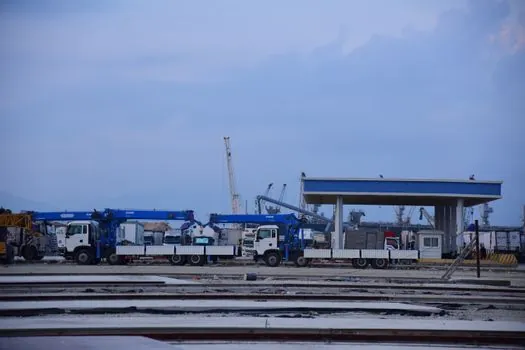
Carrier choice is a function of soil bearing capacity and the spread's average daily cycle. 4x2 Dongfeng chassis with 6-8 t loader cranes are confined to hard-standing pipe yards and municipal tie-ins; their 18-22 t GVW cannot tolerate soft ROW and they typically need a separate stringing truck ahead of them [S2][S6].
For long-distance mainline work, 6x6 and 8x4 carriers with single or tandem rear drive axles are the default: the wider tire print lowers ground pressure to roughly 80-120 kPa on the 25-30 t class, a level that most graded ROW can sustain without matting [S4]. Ford F750-class chassis remain a North American service-yard option but lack the off-road axle geometry for true mainline spreads [S1].
Standards, compliance, and hazardous-area exposure
Pipeline rights-of-way routinely pass through flammable-gas zones (gas transmission) and confined-space tie-in pits, and any internal-combustion carrier crane working in these areas needs to be evaluated against ATEX 2014/34/EU for the European market or IECEx for international projects; electrical components, not the lifting function itself, are the usual compliance gate [S2].
Factory certification pathways are visible at the OEM level: Far East explicitly lists ISO and CE compliance plus an annual output of 2000 crane sets exported globally [S2], while XCMG products on Machmall carry Chinese domestic type approval as the baseline export credential [S4]. Forging traceability on the boom sections typically follows EN 10025 for structural steel, with the upper-works hydraulics rated to ISO 4413 levels on the higher-capacity XCMG units [S4].
Use cases and field-proven configurations
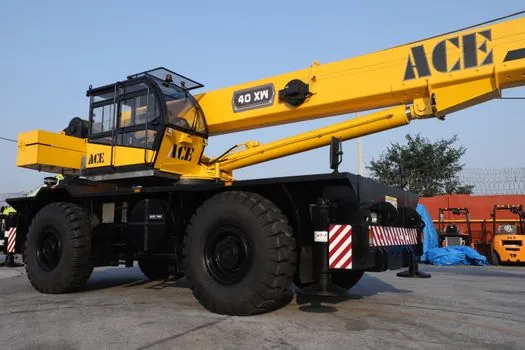
A 12 t truck-mounted crane on a 4x2 chassis is the standard right-of-way helper for stringing pup joints and feeding the lineup crew, and Okorder lists 100 sets/month of this exact class leaving Tianjin [S3]. The Ford F750-class truck crane fits the equivalent North American service-truck role for loading and repositioning materials on graded pads, not for the lift heart of the spread [S1].
Mainline valve setting and scraper-trap installation fall to 25-30 t telescopic units: the XCMG XCT25L5_Y in 5-section configuration is the volume-leader size class for this duty [S4], and the 5-section boom geometry on the XCT60_Y extends reach for over-trench lift work where the ditch side is unreachable. For a detailed spec comparison against other in-house applications, the Truck crane selection for landfill operations: 2026 spec map covers the parallel waste-handling envelope at the 20-40 t class, and the Agricultural Truck Crane Selection piece documents the 6-16 t small-chassis regime that overlaps with Far East's entry-level line [S2].
Limits, failure modes, and what the spec will not solve
Truck cranes in the 12-25 t class cannot pick a 36 in. mainline valve assembly with a 4-6 m hang-off without exceeding 80% of chart at full radius; this is the dominant field failure, and the workaround is staging the valve on cribbing before the final lift. Pipelayers (side-boom cat-track machines) remain the correct tool for live-line lowering, and a truck crane is a poor substitute: a pipeline pump spread run still needs a dedicated pipelayer for the actual cradle-and-lower cycle. [S3]
Side-slope stability is the second hard limit: 25-30 t telescopic units need level 1-2% ground within the outrigger footprint, and slope work above 3% requires crib stacking or a different carrier class entirely. For yard logistics inside the pipe-storage area, a reach truck on the warehouse side and a truck scale at the gate handle the inbound joint inventory that the truck crane will later feed to the spread [S1][S2].
Sourcing, lead time, and what to watch
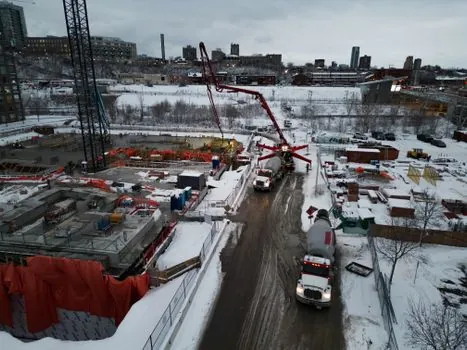
Two trackable signals: Okorder's published 100 sets/month production line for the 12 t construction truck crane out of Tianjin [S3], and Far East Machinery's stated 2000 sets/year export capacity with US$2.5-5 million annual export value [S2]. Both are verifiable throughput figures that procurement can use to sanity-check any quoted lead time against the public production base.
For cross-border pipeline tenders, the practical shortlist narrows to (a) the 12-16 t Far East / Dongfeng / Foton class for entry-level stringing, (b) the 25 t XCMG XCT25L5_Y as the mainline workhorse, and (c) the 60 t XCT60_Y for valve/skid work where reach and chart headroom are binding [S2][S3][S4]. For environmental and hazardous-area reviews, ATEX 2014/34/EU equipment-grouping and IECEx certification status are the two non-negotiable documentation items to confirm at PO, regardless of which OEM on this list fills the order [S2][S4].