
A truck crane is a carrier-mounted, telescoping boom lifting machine with 4-arm to 6-arm jib configurations, working capacities that cluster around 3 t, 5 t, 8 t, 12 t, 16 t, 25 t, 30 t, 50 t, and 60 t classes, and 2026 export listings spanning CE, ISO9001, GJB, CCC, GS, and RoHS compliance [S4][S5].
Buyers in 2026-07 should size the machine against three hard numbers: maximum lift on the shortest radius, axle-group rating of the carrier chassis, and the boom section count that delivers the required combination of tip height and outreach [S1][S2].
Capacity classes and what they actually lift on a job site
Chinese OEM listings on 3 July 2026 show five discrete capacity tiers dominating the export catalogue: light 3-5 t units on small two-axle carriers, mid 8-16 t utility cranes, a 25 t segment represented by the XCMG XCT25L5_Y five-section telescopic, a 30 t band, and a heavy 50-60 t band anchored by the XCT60_Y and the STC500S [S1][S5].
On a Dong Feng chassis the lift envelope is published at 3 t to 25 t using branded boom sets from XCMG, Sany, Li Ford, and Zoomlion, with typical applications covering municipal works, coal-mine equipment moves, landscaping, and over-the-road transport of non-dismantlable loads [S7]. The 25 t XCT25L5_Y posts FOB pricing in the $10,000-$100,000 band, while the 50 t STC500S is sold as negotiable per-piece with a 1-piece MOQ, GS / RoHS / CE / ISO9001:2000 marks, and audited-supplier status since 2010 [S1][S5].
For buyers cross-shopping material-handling fleets, the reach-truck spec field guide treats the warehouse aisle as a sizing problem, whereas a truck crane solves an outdoor-radius problem where ground bearing and outrigger spread are the constraints.
Boom geometry: sections, jib, and the radius-capacity curve
Boom section count drives the radius-capacity trade. KATO and TADANO units on the used-truck market are described as having five-section bars and six-arm-with-jib geometry, allowing four-arm reconfiguration plus two vice-poles and dual drop hangers for fine-load handling [S2].
Five-section booms are the 2026 default in the 25-50 t export class, and the XCT25L5_Y naming convention (-L5) is the OEM shorthand for a five-section arm, distinguishing it from -L4 and -L6 variants that buyers should request on the data plate before signing [S1]. The geometry choice cascades into two field numbers: minimum rated lift at maximum radius, and maximum tip height, both of which are derated by outrigger spread position and by counterweight configuration.
Used-crane suppliers in the 2026-07 secondhand market, including E.K Industry Co., Ltd., list truck cranes alongside crawler cranes, forklifts, and earth-moving equipment, with a typical used-unit stock age of 5-12 years and boom re-certification by the buyer's local third-party [S3].
Carrier chassis and axle loading

The carrier is the hidden sizing variable. Jining Jiaqing Special Vehicle (Group) Co., Ltd. supplies high-altitude operation trucks and truck cranes with ISO9001:2015, ISO45001:2018, and ISO14001 management-system certifications, plus CE and CCC product marks — the same compliance stack that Chinese municipal fleets require for in-service registration [S4].
For the 50 t STC500S the chassis is a multi-axle heavy-duty truck, and axle-group loadings must satisfy the destination country's bridge-formula regulations; Xuzhou Dely Group and similar Jiangsu-based OEMs publish carrier model codes separately from crane model codes so a buyer can match the chassis data plate to the lifting chart [S5][S6]. Dong Feng two-axle carriers are commonly used for 3-12 t crane packages, with three-axle and four-axle carriers entering at 16-25 t and dominating the 30-60 t segment [S7].
Certifications, compliance and what each mark actually certifies
The 2026 export listings carry a layered compliance stack. ISO9001:2015 covers the manufacturer's quality system; ISO9001:2000 appears on legacy data plates; CE marks conformity with the EU Machinery Directive; CCC is the Chinese Compulsory Certification for in-country registration; GS (Geprufte Sicherheit) and RoHS appear on the STC500S listing for German and EU hazardous-substance compliance; and GJB is the Chinese military standard for defence-bid machines [S4][S5].
For EU-bound machines the buyer should also verify the Machinery Directive 2006/42/EC declaration of conformity and the EN 13000 series for crane safety, both of which sit on top of the CE mark. For North American buyers the ANSI B30.5 mobile-crane standard governs in-service inspection intervals, and a Jining Jiaqing or XCMG unit delivered without an OSHA-aligned load-chart decal will need third-party plate replacement on arrival [S4].
Pricing bands and total landed-cost levers in 2026-07
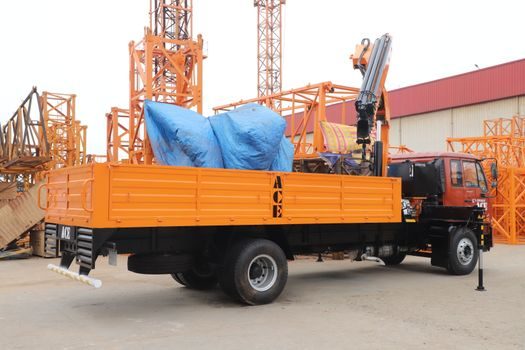
The 2026-07 price spread for new units is wide. XCMG's XCT25L5_Y (25 t, five-section telescopic) is listed at $10,000-$100,000 FOB, with the spread driven by boom-section count, jib inclusion, counterweight mass, and chassis choice [S1]. The XCT60_Y (60 t) and the 50 t STC500S are sold as negotiable or per-piece, reflecting buyer-specific configuration rather than catalogue pricing [S1][S5].
Secondhand units from E.K Industry and similar suppliers typically run 35-60 percent of new list, with age, hours on the upper-structure hour meter, and boom re-certification cost being the three largest landed-cost levers [S3]. For comparison, the tapered-roller-bearing sizing guide treats bearing life as a function of load and speed, the same way a crane's structural life is a function of radius-cycle count — buyers should request both the upper-structure hour meter reading and the chassis odometer.
Cross-border shipping adds a flat $3,000-$8,000 RoRo or container surcharge per unit depending on tonnage, plus destination-country type-approval costs. The truck-mounted crane reference gives a broader category view that pairs with this sizing guide.
Selection workflow: from lift chart to PO in four steps
Step 1 — envelope the lifts. List the heaviest pick, the maximum working radius, and the required tip height for the worst-case job, including any two-block or near-structure picks that demand a short-radius high-capacity chart point [S1][S2].
Step 2 — match capacity class. Pick the smallest class that handles the maximum-radius pick with at least 25 percent margin, then verify that the next-size-down unit cannot meet any single lift [S5]. For mixed-duty fleets this normally lands the choice in the 25-30 t band.
Step 3 — match carrier. Confirm the carrier chassis meets destination axle-load rules and that the upper-structure mounting does not exceed the front-axle load after the crane is removed for road transit [S4][S7].
Step 4 — verify compliance and plate. Insist on the data plate, the load chart in the destination language, the EN 13000 / ANSI B30.5 conformity statement, and a boom-section count matching the seller's quotation [S1][S4].
Two product-categories sit adjacent in the buyer's spreadsheet: the dump-truck for haul-only duty and the truck-mounted crane for combined haul-and-lift, and the decision between them is a function of how often the load requires lifting versus tipping.
Common sizing mistakes and failure modes
Three errors dominate 2026 incident reports in this class. The first is buying a 25 t unit for routine 22-24 t picks at full radius — the load chart collapses sharply past mid-radius, and buyers who read only the headline capacity discover the unit cannot lift 22 t at 12 m radius [S1][S5].
The second is matching a heavy upper structure to a light chassis; XCMG and Sany publish combined unit weights that buyers must cross-check against the carrier's GVM, otherwise the in-service registration fails on axle-load compliance [S1][S7]. The third is ignoring boom re-certification age on used units: a 10-year-old boom with 8,000 upper-structure hours needs NDT re-certification before EU or North American deployment, and the cost is typically 5-8 percent of the used-unit price [S2][S3].
Trackable 2026-07 signals for the next buying window
Three signals are worth watching into Q3 2026: (a) whether XCMG releases an L6-section 25 t variant to match Liebherr's six-section competitors, which would compress the 25-30 t price band; (b) whether Chinese OEMs begin publishing ISO 4309 fatigue-life data on the boom sections, which would let buyers migrate from hour-meter-based to cycle-based re-certification; and (c) the second-hand price spread on STC500S-class 50 t units, which currently leads the negotiation margin in this segment [S1][S3][S5].
For related lifting-handling categories, the truck-scale reference covers the weigh-station side of any haul-and-lift contract, and the reach-truck spec field guide handles the indoor counterpart for warehouse-only operations.