
An outdoor yard tower crane specification is locked when six engineering gates pass simultaneously: max load at maximum radius, free-standing or tied hook height, in-service and out-of-service wind class, base/foundation reactions, fleet CE-certification age, and supplier service radius under a defined Mean Time To Repair [S3][S6].
Outdoor yards differ from dense high-rise sites: ground bearing is usually better, neighbour obstructions are fewer, but the site is often exposed to wind with no shielding walls, and the crane may run for 8-24 months on a single foundation pad before dismantle. That drives the gate set below.
Gate 1: Capacity at Radius, Not Just Nameplate
Nameplate 12-tonne cranes do not all lift 12 tonnes at the tip. The decision-grade number is the load chart — the 2D curve of permissible load vs. working radius [S3][S6]. A 220-tonne wind-power installation crane such as the DaHan DHL3300-220 operates with entirely different envelope parameters than a 6-tonne flat-top used in low-rise residential yards [S6]. For yard work, plot the four worst-case lifts on the chart: max prefabricated module, max radius, max height-to-lift-point, and the closest-radius heaviest component (e.g. a precast column). If any point falls off the curve, the crane is rejected regardless of headline tonnage.
For multiple-radius operations, also confirm two-jib modes or luffing-jib radius derating, because the same crane can change its curve between two-reeve and four-reeve configurations [S3].
Gate 2: Hook Height, Tip Clearance and Site Envelope
Hook height is measured from the working surface (yard slab, rail head, or finished grade) to the underside of the hook at the highest usable radius — not the catalogue "max height" figure, which is usually the structural tower top. Confirm tie positions if the crane climbs above its free-standing height: each tie adds a horizontal force on the host structure that an outdoor yard column or pre-cast yard frame may not be designed for [S1].
Where an overhead bridge crane is already installed in the same yard, separation must be coordinated — a typical overhead bridge crane bay spec references clear headroom of 6-9 m, and the tower crane tip must clear that envelope with the required aviation/swing buffer. Aspire Tower Cranes (SE QLD) documents fleet coverage from low-rise up to 18 storeys, which translates to roughly 60 m hook height under tied configurations [S4].
Gate 3: Wind Class and Site Exposure
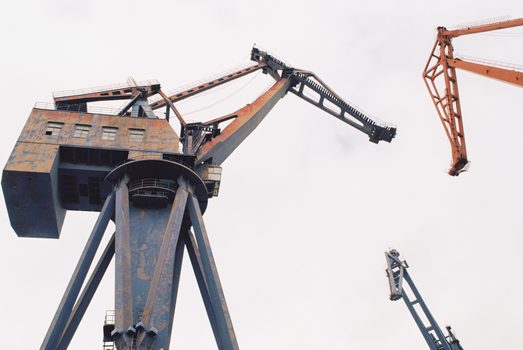
Outdoor yards are typically Category C (open terrain, scattered obstructions) or D (flat unobstructed) per the wind-class tables commonly used in crane OEM load charts. The two numbers to verify are in-service wind speed (the limit at which the crane may continue lifting with a load) and out-of-service wind speed (the limit at which the crane must be placed in free-slew weathervaning or pinned). Most modern CE-marked tower cranes quote an in-service figure around 20 m/s and out-of-service figures of 42-50 m/s, but the exact value is OEM-specific and must appear on the load-chart sheet for the exact configuration being rented [S3][S4].
Coastal yards, hurricane-prone regions, or sites at altitude need the higher-class variant. Forteza Equipo LLC serves the Caribbean, where hurricane exposure drives most specifications to the high-wind class by default [S2].
Gate 4: Foundation Reactions and Pad Design
Tower cranes deliver concentrated vertical load plus a large overturning moment into the base. A typical 8-10 t flat-top in free-standing mode applies vertical reactions of 60-110 tonnes and an overturning moment of 200-400 tm on the foundation pad; ballasted bases on rails scale those figures further. The yard foundation design must be signed off by a structural engineer against the exact load-chart reaction table for the chosen configuration, not against a generic catalog value [S1][S3].
For rented cranes on a contractor's pad, the rental supplier (e.g. Aspire Tower Cranes or Forteza Equipo) typically provides the reaction diagram as part of the site setup package; for purchased units, it must be requested in the RFQ [S2][S4].
Gate 5: CE Mark, Build Year, and Fleet Age
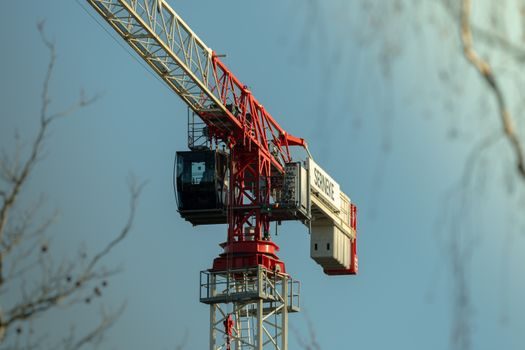
EN 14439 is the harmonized CE standard for tower cranes; OEM self-certification is only valid for limited envelope cases, and most yard-duty units fall under full third-party notified-body certification [S1][S3]. A 2024-2026 build year gives access to the latest EN 13000-series safety logic, modern anemometers with data logging, and current slewing-brake designs; older units (pre-2010) are still legal but increasingly face site-level rejection on telematics and anti-collision integration.
Where telematics, fleet management, or remote diagnostic overlays are required (common in multi-crane yards), confirm the controller supports the required protocol. Aspire explicitly markets modern electrically powered Potain units, which implies current-generation drives and braking [S4]. For fleet managers also specifying material-handling kit, the same selection discipline flows through to the forklift selection gates 2026 and the welded steel mesh selection gates used in the same yard.
Gate 6: Service Radius, MTTR, and Spare-Parts Path
A tower crane in an outdoor yard is only as productive as its mean time to repair. Confirm the supplier's nearest depot, the in-stock critical spares list (slewing motor, trolley winch, slewing-ring bolts, anemometer, limit switches), and the documented MTTR target. SYM Hoist & Tower Crane Equipment publishes an integrated spare-parts catalogue for tower cranes and passenger hoists, which is the kind of inventory depth an outdoor yard should expect to be available from any shortlisted supplier [S1]. Useter Crane maintains a TÜV-certified series alongside its general product line, which functions as a third-party build-quality signal that speeds up yard safety audits [S3].
For Malaysia and SE Asia yards, Techkon Machinery bundles sales and hire for both tower cranes and passenger hoists, simplifying the spare-parts logistics for contractors running mixed vertical-transport fleets [S5].
Configuration Comparison: Flat-Top, Hammerhead, Luffing-Jib

For outdoor yards, the three realistic configurations trade off against four decision criteria: [S1]
1. Overhead clearance to neighbouring structures. Flat-top (topless) cranes have the lowest tip height for a given hook height because the jib and counter-jib sit below the tower top; this is the preferred type for yards near airports, power lines, or other crane paths [S1][S3].
2. Lifting capacity at large radius. Hammerhead (cat-head) designs typically deliver higher tip-radius capacities because the cat-head bracing adds stiffness; favoured for prefabricated-module yards where radius dominates over height [S6].
3. Radius control and tail swing. Luffing-jib cranes allow radius to be varied under load, but the luffing mechanism costs cycle time and adds maintenance. Suited to congested yards where multiple cranes overlap, less common in open yards [S3].
4. Wind exposed area at the top. Luffing-jib presents the lowest windage area when parked, which is why high-wind coastal and island sites (e.g. Forteza's Puerto Rico market) lean toward luffing or compact flat-top designs [S2].
Limits, Failure Modes, and What Tower Cranes Cannot Do
Two failure modes are over-represented in outdoor-yard incidents. First, picking a load at a radius greater than the load chart allows — usually a 2-5% radius overshoot combined with a 1-3% hook-height overshoot, which the operator cannot see from the cabin. Second, ground-bearing failure under the pad or rails, particularly after rainfall raises the water table in clay soils. Both are eliminated by Gate 1 + Gate 4, not by buying a bigger crane. [S2]
Tower cranes are not suited to roving yard work where the lift point moves more than 30-50 m per shift: that is mobile-crane or crawler-crane territory, where the crawler crane spec band covers 50-600 t on tracks with low ground pressure. For small-batch indoor shed lifting, an overhead bridge crane inside the bay remains the better fit; for cross-yard transport of fabricated modules, a gantry crane on rails is cheaper to run over months. The mobile crane envelope is the third option when the yard is short-duration or the lift pattern is irregular.
Two trackable signals for any 2026 outdoor-yard tower-crane RFQ: (a) whether the OEM publishes a digital twin of the load chart for the specific configuration being priced, and (b) whether the rental contract carries a guaranteed MTTR in writing, with a defined spare-parts list and depot distance. Both are increasingly available from the major OEM and dealer channels reviewed above [S1][S3][S4][S5][S6].