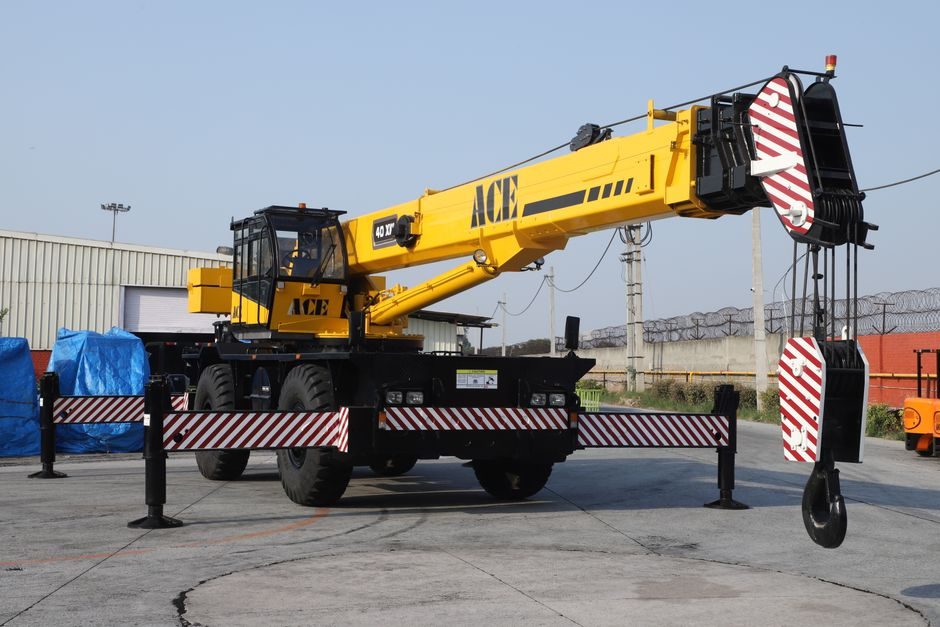
Mobile hydraulic truck-mounted cranes in the 14-20 t load class (Kesla Z14 City, Fassi F215A.0) ride on 3-4 axle carriers and deliver a working height of roughly 8-10 m with the boom retracted, optimized for short-radius road and yard lifts [S1][S2].
Tower cranes, by contrast, anchor a fixed lattice or flat-top mast to a foundation, run a horizontal jib to 40-80 m, and climb the structure as a building rises, lifting 4-40 t at radii measured in tens of metres. Picking between them is fundamentally a decision about radius, height, mobility, and how many set-up hours the site can absorb.
Configuration and Structural Difference
A truck-mounted crane is a folding boom or knuckle arm bolted to a production carrier chassis, fed by a PTO-driven hydraulic pump; the Kesla Z14 City is a Z-boom 14 tonne-metre unit offered in one- or two-extension variants for 14 t loads at 8,080-10,100 mm working height [S1]. The Fassi F215A.0 series mounts a swing-arm to a 3- or 4-axle carrier, lifting 17,840-20,080 kg with an internal-combustion engine and hydraulic stability control [S2]. Total stowed length stays inside the carrier wheelbase, so road transport needs no special permit on most 3-axle configurations.
A tower crane is a vertical mast (pin-connected lattice sections or a flat-top modular box) topped by a counter-jib, operator's cab, and a working jib that slews on a slewing ring. Mast sections are 1.5-3 m square and stack to 30-80 m before climbing; the jib radius dominates working envelope, not boom length. The unit is assembled on site with a separate 50-300 t auxiliary crawler or mobile crane and remains in one footprint for months.
Capacity, Radius and Working Envelope
Truck-mounted crane reach is dominated by the boom: a 14-20 t unit typically delivers its headline load only at 2-3 m radius and tapers to 1-3 t at 8-12 m horizontal reach. The Fassi F215A.0 max load of 20,080 kg (44,268.8 lb) at minimum radius falls to roughly 25-35 % of that figure at full horizontal extension, which is consistent with the published load-moment envelope of a swing-arm class machine [S2].
Tower crane radius is set by the jib, not by the mast. A 60 m jib can lift 4-6 t at the tip while still handling 10-20 t at mid-radius, with the same machine climbing to 40-80 m under-hook height as the building rises. The trade-off is permanent ground occupation: a 6 × 6 m tie-down base plus 30-50 m of counter-jib airspace, often dictating the building's structural core layout.
Who Each Machine Is For — and Who It Is Not
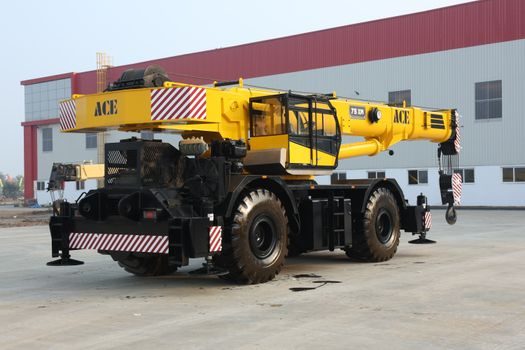
A truck-mounted crane fits a contractor who moves site-to-site daily, loads precast or HVAC units within 12-15 m of a parked carrier, or services industrial clients where setup must finish inside 30 minutes. The Fassi F215A.0 is positioned for construction and recycling-industry handling, with a 3- or 4-axle carrier sized for road registration in most jurisdictions [S2]. It is the wrong tool for sustained high-rise lifting or for any lift above 30 m where a long jib is the cheaper answer.
A tower crane is the correct specification for any building where the tallest lift exceeds 25-30 m under-hook or where daily lift counts above 30 justify the fixed installation. It is the wrong tool for short-term yard work, low-rise residential with truck access, or any site that cannot dedicate a permanent tie-down foundation and a climbing crew.
Selection Criteria Side-by-Side
The headline decision criteria are load at radius, lift height, site mobility, and setup time. Truck-mounted units lead on mobility (drive-on, drive-off), setup time (15-30 minutes), and first cost per tonne of capacity, but trail on radius (8-15 m typical) and maximum lift height (roughly 30 m with full boom elevation). Tower cranes lead on radius (40-80 m jib), under-hook height (up to 200+ m with internal climbing), and per-cycle lift efficiency on a high-rise site, but trail on mobility, site footprint, and assembly cost. [S1]
Cost structure differs sharply: a 20 t class truck-mounted crane depreciates as a road vehicle with a 6-10 year service life and a single operator; a tower crane depreciates on a project basis, requires a dedicated climbing crew, and consumes 40-80 m² of ground that cannot be used for material laydown while the crane is up.
Standards, Safety and Sourcing
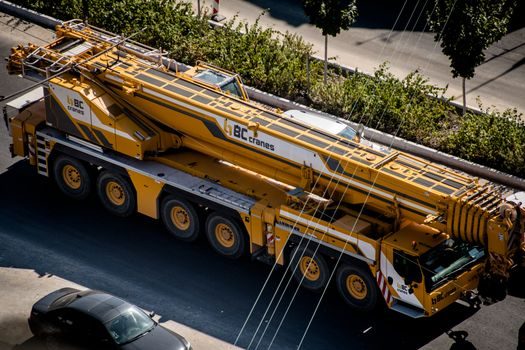
Both machine classes fall under EN 13000 for tower cranes and EN 12999 for loader cranes (the European designation covering truck-mounted loader crane safety, including stability, load-moment limiting, and operator controls). On the Chinese sourcing side, Xuzhou Yingduoli Trading supplies both truck cranes and tower cranes alongside truck-mounted concrete pumps, asphalt pavers, and concrete placing booms from a single Jiangsu channel, illustrating how Chinese OEM hubs now export both categories to the same buyer [S5].
For buyers comparing 2026 options, the practical sourcing path is to spec radius and height first, then carrier class, then load-moment indicator (LMI) and outrigger pad load per square metre on the worst soil case. A second-article spec cut on carrier, boom, and sourcing paths is laid out in the 2026 truck-mounted crane buying guide, which pairs well with this comparison.
Operational Limits and Failure Modes
The most common truck-mounted crane failure mode is over-radius lift: extending the boom past the load chart to chase a 2 m gain in horizontal reach, which loads the outriggers asymmetrically and tips the carrier. A second failure path is soft-ground punch-through under the outrigger pads, controlled by calculating ground bearing pressure (typically 80-150 kPa on timber mats) before every set-up. The Fassi F215A.0's integrated stability control addresses the first; ground prep addresses the second [S2].
Tower crane failure modes are dominated by wind: in-service wind limits are typically 72 km/h (20 m/s) with jib free, and erection climbs are suspended above 50 km/h. Slew-brake wear and tie-down bolt inspection are the recurrent maintenance load items. Both categories demand a qualified rigger/signaller, an LMI or anti-two-block device, and a documented lift plan for any load above 75 % of chart capacity.
The 2026 truck-mounted buying guide linked above remains the working reference for spec boundaries, while tower-crane climbing-cycle lead time is the next independent variable to re-check before final RFQ.