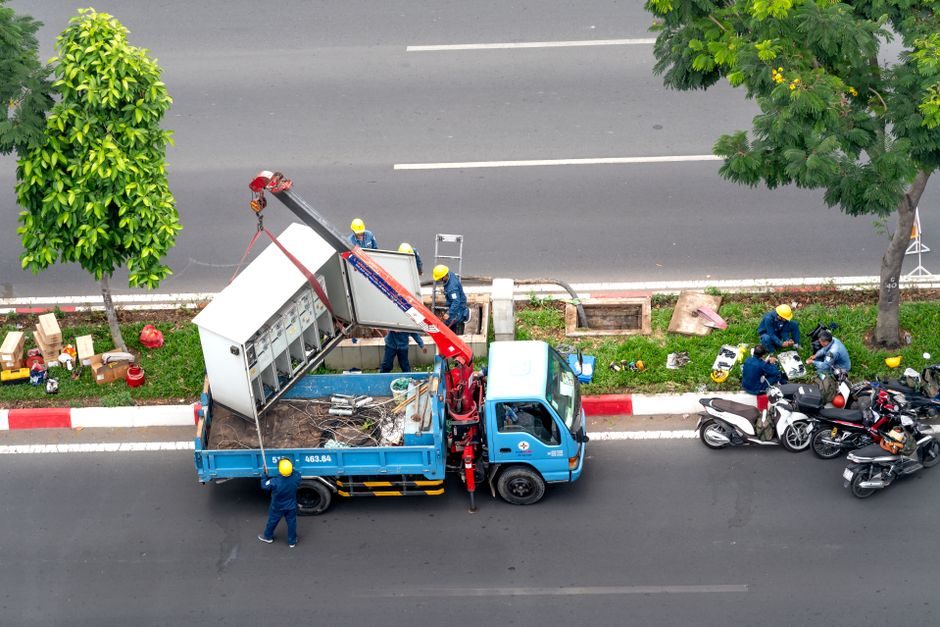
Truck-mounted cranes in 2026 are bought against three hard constraints before any price talk: required lift capacity (tonnes at a given radius), boom type (knuckle swing-arm vs telescopic), and the carrier truck's permissible gross vehicle weight (GVW) under local road rules.
Light-duty Chinese-built units cover 1–16 t lifts on standard Foton chassis [S7], mid-duty European knuckle-boom models from Hiab's X-CLX 1x8 swing-arm series target construction and general handling [S2], and heavy telescopic tower/self-erecting units such as the Saez HT 47 serve construction sites where the crane drives on its own truck base [S1]. Picking the wrong class typically means re-engineering the carrier or losing 30–50% of usable reach on site.
Three Classes Buyers Actually Quote Against
Light utility truck-mounted cranes (1–16 t lift) are built on standard 4×2 or 6×4 cargo-truck chassis from Foton and similar Chinese OEMs, with the crane subframe bolted to the cargo bed; lifting range 1 t, 2 t, 3.2 t, 5 t, 8 t, 10 t, 12 t and 16 t is the published Foton coverage band [S7]. Use case is municipal works, coal-yard logistics, landscaping, and short-radius loading of indivisible loads.
Mid-duty swing-arm (knuckle-boom) loaders such as the Hiab X-CLX 1x8 series sit in the 20–60 t-m class with folding booms that stow compact behind the cab; Hiab lists the X-CLX 1x8 explicitly as a swing-arm / construction / handling product [S2]. Heavy telescopic self-erecting tower-crane-on-truck variants such as the Saez HT 47 are configured as truck-mounted, tower-style and self-erecting, aimed at construction sites that need fast mobilisation without separate crane erection crews [S1]. The 2026 truck-mounted crane market remains segmented along exactly these three lift-class tiers, and most buying errors trace back to crossing the boundaries — for instance, putting a 10 t knuckle boom on a light 8 t GVW chassis.
Boom Geometry Drives Real Reach, Not Catalog Capacity
Knuckle (swing-arm) booms give 270°–360° slewing with a folded profile; on the Hiab X-CLX 1x8 the published spec lists swing-arm configuration, construction duty and handling duty [S2]. Telescopic booms give a straight line-of-sight lift profile with longer vertical reach but a wider tail swing envelope, which matters for congested urban sites and overhead-line work.
Self-erecting tower-crane-on-truck units such as the HT 47 trade pure lift capacity for erection speed — the unit travels on its own carrier and brings itself to working height without a separate erection crane [S1]. For buyers comparing reach numbers at 4 m, 8 m, 12 m and 16 m radii, the rule of thumb is: net capacity at full radius is typically 25–40% of the maximum catalog lift, and a knuckle boom's 8 m reach usually beats a telescopic's 8 m reach by 10–20% in net payload at that radius because of the shorter moment arm [S2]. A clean crawler crane vs truck-mounted crane side-by-side is the fastest way to catch misclassified specs at RFQ stage.
Carrier Chassis and Road-Legal GVW
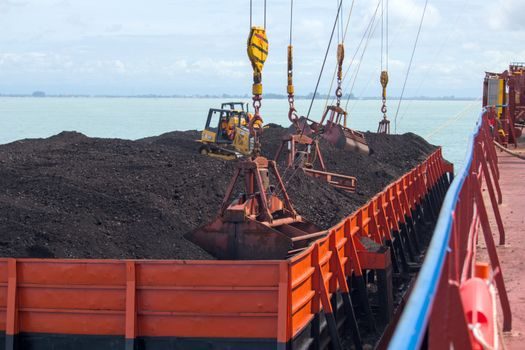
The crane's load moment is only as good as the chassis's front and rear axle ratings. Chinese light-duty units pair with 4×2 / 6×4 cargo chassis in the 8–25 t GVW band [S7]; export listings from Hubei Shenbai Special Purpose Vehicle and similar suppliers confirm that the crane subframe, outriggers, stabilisers and an operator cab or remote-control station are integrated onto a customer-specified or supplier-specified truck base [S4].
For European road registration, the combined vehicle must stay inside the carrier manufacturer's GVW rating and the national axle-load limits (typically 11.5 t per drive axle and 18 t for a tridem in the EU, but the exact figure must be confirmed against the destination country's road rules, not assumed from catalog data). Outrigger spread is the second hidden cost: a wider spread lowers ground-bearing pressure but forces a larger stabiliser footprint, which then pushes the rig out of standard-width lanes. The truck-mounted concrete pump buying logic uses a similar carrier-first methodology and is a useful cross-check when the same chassis vendor is shortlisting both pump and crane bodies.
Selection Criteria: A Side-by-Side Comparison
Across the three main 2026 classes, the decision criteria line up as follows. (1) Lift capacity band: 1–16 t [S7], 20–60 t·m class [S2], and 80+ t telescopic/tower class [S1]. (2) Boom type: straight-telescopic for line-of-sight reach, knuckle swing-arm for tight-radius urban work [S2], self-erecting tower for fast mobilisation [S1]. (3) Carrier integration: standard Chinese cargo chassis [S7], European multi-axle truck base [S2], dedicated heavy truck base for tower-crane-on-truck [S1].
(4) Mobilisation cost: light units are driven to site under their own power, mid knuckle-boom units need a Class C or higher commercial driver depending on GVW, and heavy telescopic/tower units typically need an escort vehicle plus permits for oversize load on public roads. (5) Total cost of ownership over a 7–10 year life is dominated by outrigger maintenance, hydraulic-oil changes, and the boom-section wear pads; the chassis itself is commodity. Buyers who frame their RFQ around these five criteria typically cut the shortlist from 8–10 vendors to 3 within one round, as also seen in the crawler crane buying guide 2026 workflow.
Use Cases That Map Cleanly to Each Class
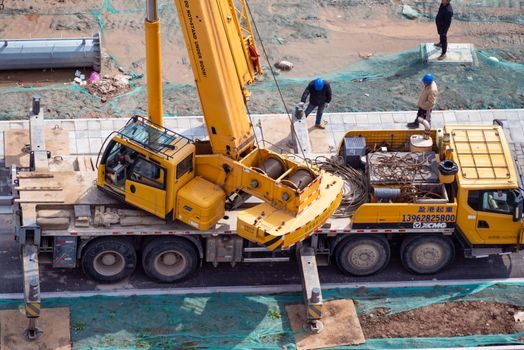
Light 1–16 t Foton-chassis units map to municipal roadworks, landscaping, coal-handling yards, and short-radius loading of machinery that cannot be disassembled [S7]. Mid knuckle-boom X-CLX 1x8-class units map to construction site delivery of palletised loads, roof-truss lifts, and last-mile handling in distribution yards [S2]. Heavy telescopic and self-erecting tower units such as the Saez HT 47 map to mid-rise building sites where the truck-mounted crane substitutes for a static tower crane, traded against pure lift capacity for setup speed [S1].
Common mis-specs include: (a) using a light 3.2 t unit on a job that needs 6 t at 6 m radius — the boom geometry will not deliver the load, the chassis GVW will be exceeded, and the outriggers will not brace the moment; (b) buying a heavy tower-crane-on-truck for a 5 km municipal pipeline job where a light 5 t unit would have run 10 round trips in the same shift; (c) omitting radio-remote vs cab-control at RFQ stage, which forces a redesign once the site layout is finalised. These three failure modes are the same mis-specs that the crawler crane selection: 5 engineering gates article calls out for the crawler side, and the same engineering gates apply on the truck-mounted side.
Sourcing, Pricing and Lead Time
Direct-from-factory sourcing through Chinese B2B platforms such as Made-in-China and Okorder is the dominant 2026 channel for light and mid units; Hubei Shenbai Special Purpose Vehicle Co., Ltd. publishes a refrigerated-truck-and-crane product line and accepts direct RFQs [S4], and Okorder lists a generic truck-mounted/cargo/loader/lorry crane product with Shanghai loading port, TT or LC payment, minimum order 1 unit, and published supply capability of 20 units per month [S5]. European OEM channels (Hiab, Saez and equivalents) carry higher unit prices but shorter commissioning lead times from regional dealers and built-in compliance documentation for EU road registration.
2026 indicative pricing follows the class split: light 1–16 t units from Chinese suppliers typically land in the low-to-mid five-figure USD range, mid knuckle-boom 20–60 t·m units from European OEMs in the mid-to-high five-figure to low-six-figure range, and heavy telescopic / self-erecting tower units in the high six-figure to seven-figure range. Hiab's published price notes for the X-CLX 1x8 explicitly exclude delivery, customs duties, installation and activation charges, and warn that prices are indicative only and may vary by country with changes in raw-material cost and exchange rates [S2] — read this as the contract template every serious vendor uses in 2026. Lead time for Chinese-built light units is typically 30–60 days from PO to ex-factory, and for European mid/heavy units 60–120 days ex-factory, plus 30–60 days shipping to most non-domestic ports.
Standards, Compliance and Operator Certification

The two compliance questions that gate every 2026 truck-mounted crane purchase are: (1) does the combined vehicle meet the destination country's road-vehicle homologation rules, including braking, lighting, axle load and any oversize/overmass permit regime, and (2) does the crane subassembly carry a CE marking for machinery safety (EU) or an equivalent national mark for non-EU markets. Operator certification in most jurisdictions requires a national mobile-crane operator licence, with capacity thresholds set by the issuing authority rather than by the OEM catalog. [S1]
Buyers should also confirm that the outrigger pads and any sub-base plate are rated for the worst-case ground-bearing pressure on site (typical soft-soil working pressure is 50–80 kPa; this is a planning value, not a guarantee and should be checked against the OEM's outrigger data sheet for the specific model). Any documentary claim about specific pressure or load-moment figures from a vendor should be cross-checked against the model-specific data plate, not the marketing brochure. The same discipline that buyers apply to a dump truck or a reach truck — match the data plate, not the brochure — applies unchanged to truck-mounted cranes.
Lock the class (light, mid-knuckle, heavy telescopic/tower) against the heaviest single lift at the worst radius before opening vendor talks; confirm carrier GVW, axle rating and outrigger spread against the same lift case; and require a model-specific load chart, not a class brochure, as a deliverable on the RFQ. A clean RFQ with these three documents typically lands a compliant quote inside two vendor rounds, and the 2026 supply market for truck-mounted crane units is liquid enough that buyers with disciplined specs can expect three or more competing bids per class.