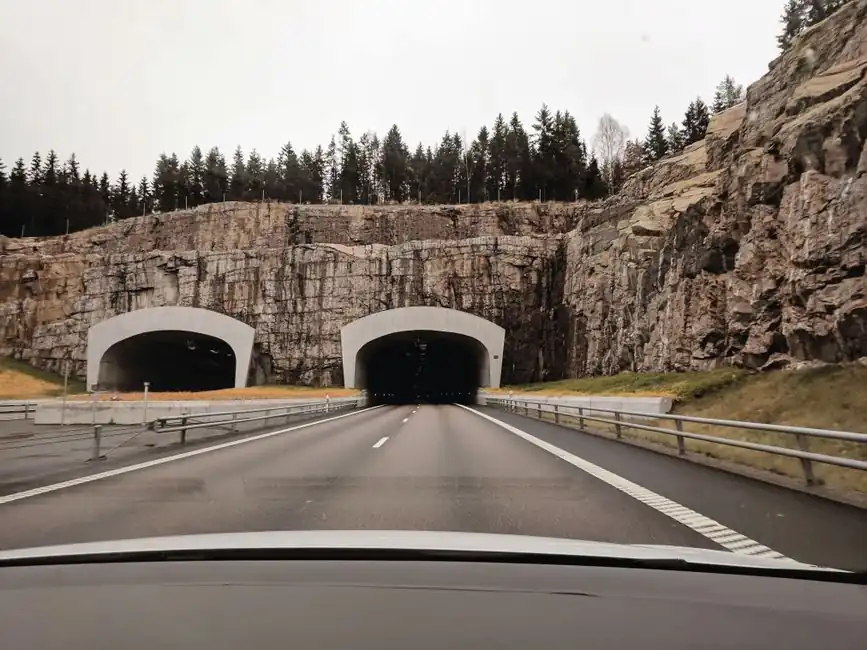
Selecting a cutting tool for a tunnel job starts with the rock, not the brand: uniaxial compressive strength (UCS), brittleness, equivalent quartz content, and Cerchar Abrasivity Index (CAI) drive disc-cutter choice, while grain size and boulder frequency drive soft-ground tooling [S4].
Tunnel boring machines (TBMs) split into hard-rock, mixed-face, and soft-ground (EPB) classes; each class uses a different cutter geometry, opening ratio, and replacement strategy, and the 2026 wear study on the Guadarrama Tunnel confirms that cutter life varies by tool position and rock type even on a single project [S4][S2].
Hard-Rock Disc Cutters: 17-Inch Class for Granite and Gneiss
For abrasive granite and gneiss with UCS in the 50-150 MPa range, double-shield TBMs in the Guadarrama Tunnel (Madrid-Valladolid AVE) used 9.5 m diameter cutterheads fitted with 17-inch disc cutters, achieving 56 km of total hard-rock excavation across four machines at up to 1000 m overburden [S4]. The four tested cutter types (A, B, C, D) showed that wear is governed by drillability, brittleness, abrasivity, equivalent quartz content, UCS, and CAI, with harder and more brittle formations accelerating normal and shear stress at the cutter-rock interface [S4].
Disc cutters are classified by position as gauge, face, and center cutters; gauge cutters sit on the periphery and are mounted obliquely, while face cutters dominate the cutting pattern and center cutters handle the low-velocity core zone [S4]. Hard-ground cutterhead openings fall in the 10-20% range to maintain face support against high in-situ stress, which is the inverse of soft-ground practice [S2]. For an overview of how a marble cutter is rated on similar abrasive stone, the disc-cutter wear framework applies directly: CAI, quartz content, and UCS predict the service interval on granite, marble, and gneiss alike.
Soft-Ground and Mixed-Face Tooling: Scrapers, Bits, and Disc Hybrids
Soft-ground TBMs running in sand, gravel, or stiff clay use cutter teeth, cutter bits, and scrapers mounted weld-on or bolt-on, with cutterhead openings typically 40-60% to let spoil flow into the chamber [S2]. Mixed-face conditions, where softer materials surround cobbles or boulders, require a blend of soft-ground bits and disc cutters so that hard inclusions do not shatter a soft-ground bit array [S2][S5].
Coarse-grain soil projects in Beijing, Shenyang, and Chengdu showed that cobble and boulder ground causes excessive bit wear, bit pull-out, and cutterhead wear-through when spoke-type cutterheads and single disc cutters with inserts are not properly matched to the grain size distribution [S5]. Chain cutters, by contrast, are best suited to soft rock in straight-ahead and downward bench and invert modes, where continuous contact and high removal rate matter more than per-disc indentation force [S6].
Selection Criteria and Comparison Framework
The four decision criteria that drive cutter selection in a tunnel are rock strength (UCS), abrasivity (CAI / equivalent quartz content), ground variability (mixed-face flag), and machine class (open TBM, double-shield, EPB, or roadheader) [S4][S2]. A side-by-side comparison lines the three main cutter families against these criteria:
17-inch disc cutters: best for UCS 50-250 MPa granite, gneiss, and basalt; low opening ratio (10-20%); CAI 2-5 typical; replaced from rear or front depending on face access [S2][S4]. Scraper and pick bits: best for UCS under 25 MPa clay, silt, and sand; high opening ratio (40-60%); limited abrasivity tolerance; cheaper per unit, higher replacement frequency [S2][S5]. Chain cutters: best for soft rock and downward benching in medium-strength formations; continuous cutting action; limited use in mixed-face cobble ground [S6].
For mixed-ground shield TBMs on Line 13 of the Shenzhen Metro, linear cutting tests with constant cross-section disc cutters on five rock types showed that cutting force and rock boreability index shift significantly between strata, so a single cutter geometry rarely covers a mixed alignment without parameter retuning [S3].
Wear Monitoring, Replacement Strategy, and Underground Service
Wear on disc cutters is the gradual reduction of disc diameter from rock-machine interaction, and in TBM hard-rock excavation it is the single largest operational cost line, sometimes high enough to push the project back toward drill-and-blast economics if not managed [S4][S1]. Cutterhead access drives service strategy: face-access machines allow cutter change from inside the shield, while non-access machines require ground stabilization or hyperbaric intervention to reach the face [S2].
Replacement of disc cutters happens from the front of the cutter head or the rear; rear-loaded discs are changed from behind the cutting face, while front-loaded discs need face access or a hyperbaric shift [S2]. On the Sahand University of Technology laboratory simulator, experimental and PFC3D numerical results agreed within 6-14% on abrasion percentage across two wear stages, giving engineers a defensible wear-prediction envelope for planning cutter-change intervals [S1]. Unchecked wear cascades: a worn disc raises the load on adjacent cutters, accelerates cutterhead damage, and can trigger shield parameter instability in uneven soft-hard strata [S1].
Standards, Testing, and Sourcing References
Cerchar Abrasivity Index (CAI) is the standard abrasivity test referenced in disc-cutter selection literature, alongside equivalent quartz content for predicting abrasive wear on granite and gneiss [S4]. UCS testing per ISRM suggested methods and Cerchar testing per ASTM D7625 are the typical laboratory anchors behind the wear-rate inputs used in TBM cutter specification, though the studies reviewed do not pin a specific revision date for these methods [S4].
For a procurement view, construction tools catalogs segment TBM consumables by machine class and ground type, which is the same segmentation used in the cutterhead selection literature. Where the alignment crosses from hard rock into shotcrete, demolition, or invert finishing, the same brand of construction machinery and equipment typically lists compatible diamond and abrasive blades rated for the geological profile already proven on the TBM. For the structural concrete cutting, joint grooving, and invert work that follows the bore, a concrete groove cutter rated for the same CAI class is a sensible cross-spec to keep consumable inventory aligned.
Limitations and Failure Modes to Engineer Around
Wrong-class cutters fail predictably: soft-ground bits in cobble ground pull out and chew the cutterhead face, while hard-rock disc cutters in low-UCS clay bog down with low penetration per revolution and high specific energy [S5][S2]. Mixed-face alignment, where UCS swings more than 50 MPa within a few meters, defeats single-tooling cutterheads and pushes operators toward hybrid cutterheads plus frequent parameter retuning [S3].
Three constraints that catch specifiers off guard: (1) disc-cutter life can drop to the point that drill-and-blast becomes cheaper on highly abrasive, high-UCS rock, so the wear-cost crossover must be checked before committing to a TBM [S4]; (2) underground cutter change requires face access, hyperbaric capability, or ground stabilization, so the geotechnical profile must allow one of these before the machine is ordered [S2]; (3) thermal cycling from liquid nitrogen pre-conditioning or natural groundwater shifts alters rock microcrack density and changes cutting resistance mid-drive, which a static wear model will miss [S4].
Cutter selection for tunnel construction resolves to a four-step loop: log UCS, CAI, and quartz content from the geotechnical baseline; pick disc size and position pattern for the dominant rock class; specify soft-ground bits, scrapers, or chain cutters for the remainder; and lock in a wear-monitoring cadence tied to cutterhead access class. Track next: 2026-2027 field reports from the Guadarrama follow-up TBMs on cutter type D performance in gneiss [S4], and any CAI test-method revisions published by ISRM or ASTM before the next major tender season.
Related analysis: Aluminum Ladder Selection for Masonry Sites: Spec-Driven Picks.