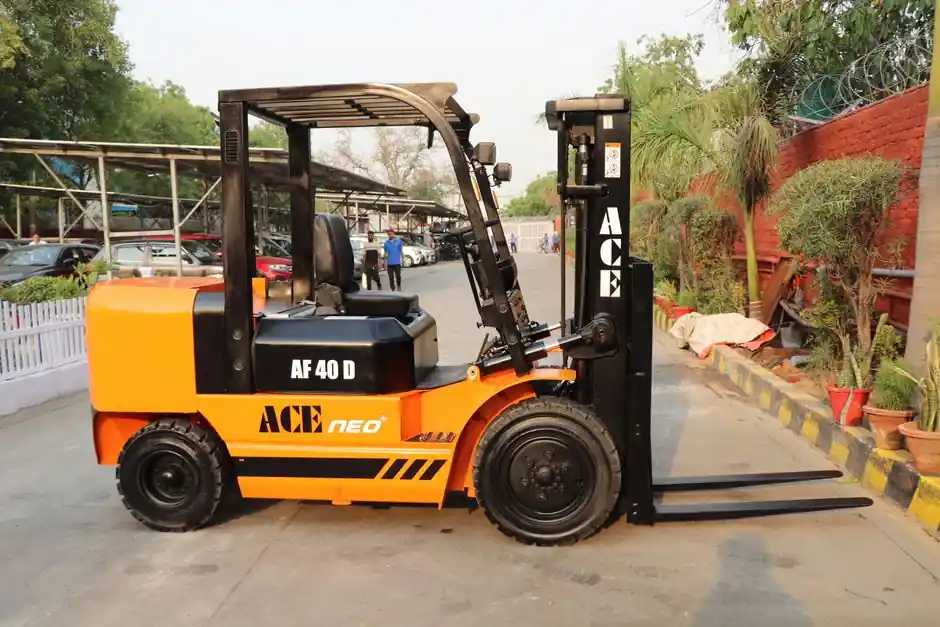
A tunnel jobsite is one of the harshest environments a forklift will ever see: low clearance, wet or dusty air, grade changes on every heading, and ventilation that turns diesel exhaust and battery hydrogen into a real hazard. The maintenance program that works in a flat warehouse will not survive a 3 km drill-and-blast drive, and OSHA treats the truck the same whether it runs in a 40,000 ft² DC or a 40 m² cross-section.
The governing US rule is 29 CFR 1910.178, with three sub-parts that drive tunnel maintenance: 1910.178(q) for industrial-truck maintenance, 1910.178(g) for battery changing and charging, and 1910.178(f) for fuel handling and storage [S1]. On the service-interval side, the 250-hour deep service is the de-facto industry gate, with most manufacturers clustering major work at 250 to 300 operating hours [S9].
Daily inspection gate: fluids, mast, chains, and tires
Daily checks on a tunneling forklift must start before the truck is energized, with the engine or battery isolated, and they cover seven non-driving items: fluid levels (fuel, water, hydraulic), visible damage, tire condition and pressure, general condition, inspection sticker legibility, cab cleanliness, and safety-device function (seatbelt, finger guards) [S2]. On a rough heading, tire-pressure checks move from a weekly to a daily item, because broken rock and rebar slash sidewalls faster than concrete dust alone.
Mast and chain inspection is the single highest-value daily check. The mast is the control hub of the lift system, and chains stretch, pin-shaft wear, and cracked link plates all show up as visible deflection before they show up as a dropped load [S2]. In tunnel work, masts also see salt-laden water and shotcrete rebound, so operators should wipe the chain channels and re-check chain tension at the start of every shift, not just at the 250-hour service.
Electric trucks used for indoor concrete segments or rebar handling add a parallel checklist: no frayed cables, battery restraints locked, electrolyte at proper level, hood latch secure [S2]. Each of those four items has a direct 1910.178(g) link, and a failed restraint in a vibrating heading is how a 1,000 kg battery ends up on the tunnel floor.
Battery charging and hydrogen: 1910.178(g) in a heading
Hydrogen is the silent killer in tunnel battery bays. The OSHA compliance text on 1910.178(g)(2) is explicit: charging areas for forklift batteries need adequate ventilation, and a 1978 letter of interpretation clarified that even a "typical exhaust fan" can be considered adequate only if hydrogen concentration in the fan's intake air stays below the lower flammability limit [S1]. In a tunnel, that ventilation is not free, it is ducted, and it is the same duct that has to clear diesel particulate from the heading.
Three operational rules follow. First, battery changing must be done with the truck parked on a level surface, the charger isolated (lockout/tagout under 29 CFR 1910.147, per CPL 02-00-147) [S1]. Second, eye-wash and body-flushing facilities must be within the work area per 29 CFR 1910.151(c) [S1]. Third, electrolyte top-up should never be done in the heading; it should be done in a designated bay with the ventilation proven by measurement, not assumption.
For diesel and LPG trucks, 1910.178(f) governs fuel handling and storage, and the practical tunnel rule is to keep refueling outside the active heading, with a dedicated refuel bay at the portal or cross-cut. Operators are often the ones doing the refueling themselves, which is permitted but requires the same hazardous-chemical training as a mechanic [S1].
Confined-heading failure modes: brakes, clutches, and diesel soot
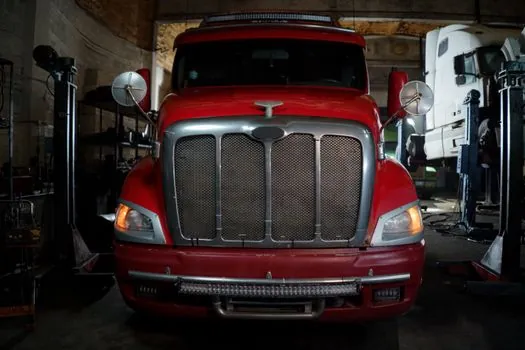
Brake and clutch repair has a specific OSHA guidance letter tied to 29 CFR 1910.1001(f)(3) for asbestos exposure on older trucks, but the modern equivalent is brake dust and diesel particulate. In tunnel air, fine dust migrates into drum-brake assemblies and onto clutch linings, accelerating wear 2 to 3 times over a surface-site truck, in our experience on heading equipment. A 250-hour deep service should include a brake measurement (shoe/drum thickness, or rotor minimum thickness) and a clutch-pedal free-play check, with the spec pulled from the OEM service manual. [S1]
Diesel forklifts in a tunnel need more frequent air-filter and crankcase-ventilation service than the same truck outdoors, because intake air carries shotcrete and silica dust even with ducted supply. Coolant and engine oil should be sampled at 250 hours rather than 500 in tunnel service; used-oil analysis flags coolant in oil (head-gasket early failure) and soot loading (ring wear) before either shows up as a hot engine on grade.
When a failure is structural (cracked mast rail, bent forks, frame crack, hydraulic cylinder scored past OEM limit), do not repair in place. Tag out per 1910.178(q), remove the assembly, and either replace with OEM or escalate to a certified repair shop. Welding on load-bearing forklift structures is a known cause of latent fatigue failures and should follow the OEM weld-procedure spec, not a field expedient.
When a rough terrain forklift is the right tool, and when it is not
Standard warehouse forklifts are wrong for a tunnel heading. A rough-terrain forklift with a diesel engine, 4WD, larger pneumatic tires, and higher ground clearance is the typical tunneling choice, because it can handle muck piles, water, and 15-20% grades. Where it is the wrong tool: low-clearance finished tunnels under 3 m, or segment-handling inside a TBM back-up gantry, where a compact electric or a telehandler is safer and fits the geometry. [S1]
Selection matrix for tunneling lifts, with three decision criteria: (1) ventilation, diesel OK only with catalytic DPF and forced duct ventilation, electric or LPG preferred for low-ventilation headings; (2) ground, rough-terrain pneumatic tires for unfinished headings, cushion tires only on finished concrete slab; (3) load, mast capacity typically 2.5 to 5 t for rebar and segment handling, with a 3 m free-lift minimum for segment stackers.
Spare parts and planned maintenance on a heading
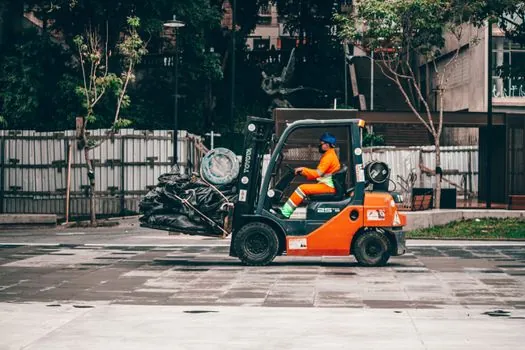
Planned maintenance in tunneling means planned downtime on a planned shift, normally the Sunday night or shift-change window, with the truck on a level pad at the maintenance bay. Standard 250-hour kits (oil, oil filter, fuel filter, air filter, hydraulic return filter) plus wear parts (forks, tires, chains, brake shoes) are staged on site, because lead time on a specialty part in a remote heading is measured in days, not hours [S7].
Documentation is not optional. A maintenance log with hour-meter readings, defect descriptions, and parts replaced is the only defense in an OSHA inspection, and it is the only data set that supports a predictive program later. A CMMS with hour-meter feeds is the practical tool, and pairing operator daily-check slips with mechanic service tickets closes the loop [S3].
For fleet managers comparing this with other heavy equipment, the 250-hour cadence for forklifts sits between compact excavators (often 500-hour major) and skid-steers (often 100-hour first service), and the same hour-meter discipline transfers. See Excavator Service Life: Hours, Component Wear, and Replacement Triggers for the parallel hour-vs-component logic on excavators, which often share the same tunnel heading.
Limitations: where this guidance stops
This article covers US OSHA 1910.178 maintenance and the 250-hour industry interval. EU and UK tunneling sites will work to EN ISO 3691-1 and national mining/tunneling regulations, which differ in operator-licensing and LOTO detail. Underground-classified areas (methane, coal dust) require explosion-protected trucks to IEC 60079 or ATEX 2014/34/EU, not standard industrial trucks, and the maintenance regime changes again. [S1]
Track these signals on a 6-month rolling basis: OEM service-manual revisions for the rough-terrain models in your fleet, any 1910.178 interpretation letters posted by OSHA, and tunnel-air monitoring data showing hydrogen, diesel particulate, and NO2 trends at the battery and refuel bays. If particulate climbs while service intervals stay flat, shorten the 250-hour gate.
Spec-level background on the components involved: pressure transmitter.