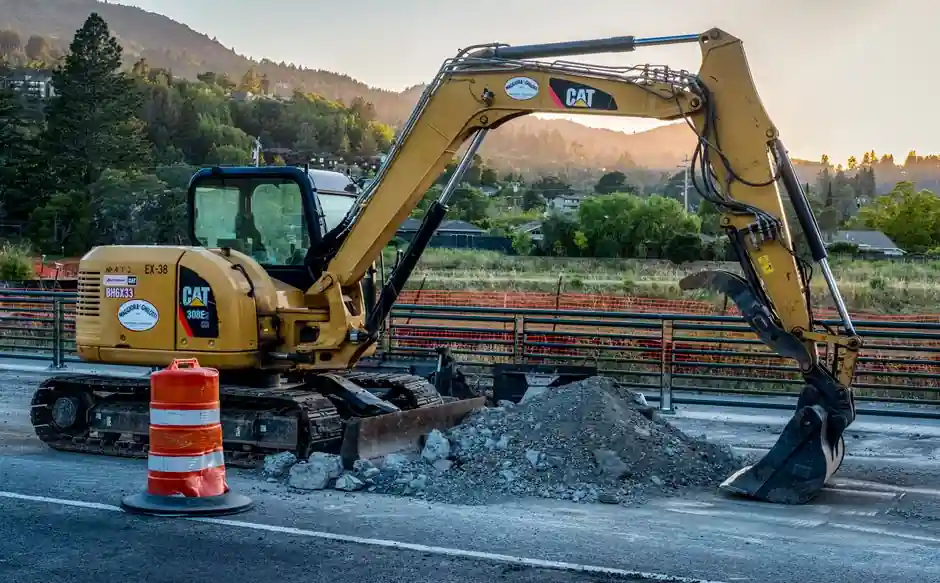
A pre-shift excavator walkaround is a nine-zone visual + functional check, typically 10-15 minutes, completed before every shift, after transport, after maintenance, or when an operator change occurs, per operator-training guidance issued through 2026 [S2][S4]. OSHA 29 CFR 1926.602 governs the safe-operation duty for construction equipment and is the standard cited by US contractors when a competent person is required to verify machine condition before use [S3].
Failure to document a daily pre-use check is the most common audit finding flagged during MSHA and OSHA site visits; digital forms (Cat Inspect, FleetRabbit, mitti) replace paper sheets with timestamped, photo-tagged records, and Cat Inspect specifically supports custom forms for Cat and non-Cat assets via a dealer-set-up account [S1][S2].
The 9 Inspection Zones and What to Look For
The 2026 industry-standard daily checklist divides the machine into nine zones: walkaround, engine compartment, hydraulic system, operator cab, controls/instrumentation, boom-arm-bucket, undercarriage/tracks, fluid levels, and structural integrity, with tracks/wheels and the electrical system added on the long-form versions [S3][S5]. In the walkaround, look for fluid leaks under and around the machine, structural cracks or dents, loose or missing bolts, guards and covers, and confirm level ground placement before mounting [S2].
Under the hood, the engine oil level is read on a dipstick, coolant on the reservoir, fan belts for tension and wear, the air-filter indicator (replace if tripped), the radiator for debris and leaks, and the battery for clean, tight, corrosion-free connections [S2]. The hydraulic zone covers oil level at the sight glass, hoses for leaks/wear/routing, cylinders, fittings, and the tank cap vent [S2][S4].
Boom, Arm, Bucket: Where Welds and Pins Kill Jobsites
The boom, arm/stick, and bucket get the most attention on a daily form because cracks in welds, missing bucket teeth, and worn pivot pins are the highest-frequency structural failures on working excavators [S2][S4]. Inspect boom and arm structure for cracks, damage, and weld defects, the bucket for tooth and side-cutter wear, pivot pins and bushings for grease state and slop, and cylinder pins and retainers for security [S2].
If the machine runs a quick coupler, locking integrity and visible damage are an explicit line item; an unlocked or damaged coupler is an immediate lockout, not a "monitor" item [S2]. Daily greasing of pins and bushings is the lowest-cost action that extends boom-side service life; the deeper wear thresholds (e.g., bushing hour limits, tooth-flip cadence) are covered separately in a service-life triggers guide.
Undercarriage and Tracks: The 40% Cost Zone

Undercarriage components (track pads, links, pins, idlers, rollers, sprockets, frame guards) are included in daily excavator inspection checklists because worn tracks, if not addressed early, can lead to serious mechanical failures [S4][S5]. The four critical undercarriage items are track tension/sag, track-pad wear and missing shoes, seized links, and idler/roller seal leaks [S2][S4].
Track tension is checked with the machine on level ground: too tight accelerates bushing and sprocket wear, too loose lets the track de-track under load. Sprocket tooth profile and idler flat-spotting are visual N/A-or-fail items; any oil weep at a roller or idler seal is logged and escalated, not run to failure [S2].
Cab, Controls, and ROPS/FOPS
The cab zone is a safety-critical check: ROPS/FOPS structure damage or loose mounting, seat and seat-belt condition, steps/handrails/grab handles, windows, wipers/washers, mirrors, and a present, charged fire extinguisher [S2]. The controls row covers joystick and foot-pedal function with no binding, control-pattern selector response, warning lights, gauges (hours, fuel, temperature, oil pressure), horn, and travel alarm/beacon [S2][S5].
A non-functional horn, travel alarm, or beacon is a same-day lockout on most US sites because these items are tied directly to pedestrian-strike and roadway-incident risk. ROPS mounting bolts and visible structural damage are not field-repairable; a damaged ROPS/FOPS structure triggers an immediate out-of-service tag and engineering review [S2].
Daily vs. Quarterly vs. Annual: When to Escalate

Daily checks are visual and operational; a 250-hour or quarterly service adds filter swaps, hydraulic-oil sampling, and detailed torque checks; annual or 2000-hour service is the deep-inspection interval for pumps, swing bearings, and engine compression tests, with mitti placing service at roughly every three months [S3][S4]. Any item marked "fail" or "N/A" on the daily sheet becomes a work-order item, not a deferred note; loose or missing fasteners on the boom or stick escalate the same shift [S2][S5].
Daily checks also run at operator change, after transport to a new site, after any maintenance or repair, and whenever unusual noise, vibration, or performance drift is observed [S4]. For new-machine acceptance, daily checklists are a subset of the broader FAT-to-handover commissioning procedure run before the unit goes on the customer roster.
Paper Sheet vs. Digital Form: What Changes for the Operator
The paper pre-use sheet (project, contractor, make, model, worker name, excavator number, hour meter, initials) covers fuel, engine oil, hydraulic oil, radiator, transmission, slew motor, leaks, and a Yes/No row per system across a 7-day grid [S5]. The digital equivalent (Cat Inspect, FleetRabbit, mitti) adds photo and video capture per finding, automatic cloud-stored timestamp, supervisor notification, and audit-ready export, with Cat Inspect distributing via the App Store and Google Play for both Cat and non-Cat fleets [S1][S3].
Pattern discipline matters more than format: operators should follow the same sequence every shift (start at the cab, move clockwise, then attachments) so no zone is skipped, and high-wear items (bucket teeth, pins, tracks, hydraulic cylinders) get deliberate extra time [S2]. Closing the pre-shift at the end of the prior shift, while the machine is still warm, surfaces leaks and noises that a cold morning start can mask [S2].
Acceptance Criteria and Common Lockout Triggers

Acceptance is binary: every line item is OK, N/A (with reason), or FAIL; any FAIL means the machine does not start the shift. The most frequent lockout triggers across published 2024-2026 checklists are hydraulic-hose weep or abrasion, low hydraulic oil at the sight glass, cracked or missing bucket teeth, ROPS/FOPS damage, non-functional horn or travel alarm, seized track links, and any active engine- or hydraulic-oil leak at a fitting [S2][S4][S5].
Trackable signals to watch over the next quarter: OSHA citation patterns under 29 CFR 1926.602 around pre-use documentation, mobile-form adoption rate on mid-size contractor fleets (currently moving from paper to digital on 3-5 year cycles), and any OEM update to the Cat Inspect form library for next-gen hydraulic-excavator models [S1][S3].
Spec-level background on the components involved: excavator, pressure transmitter, and flow meter.