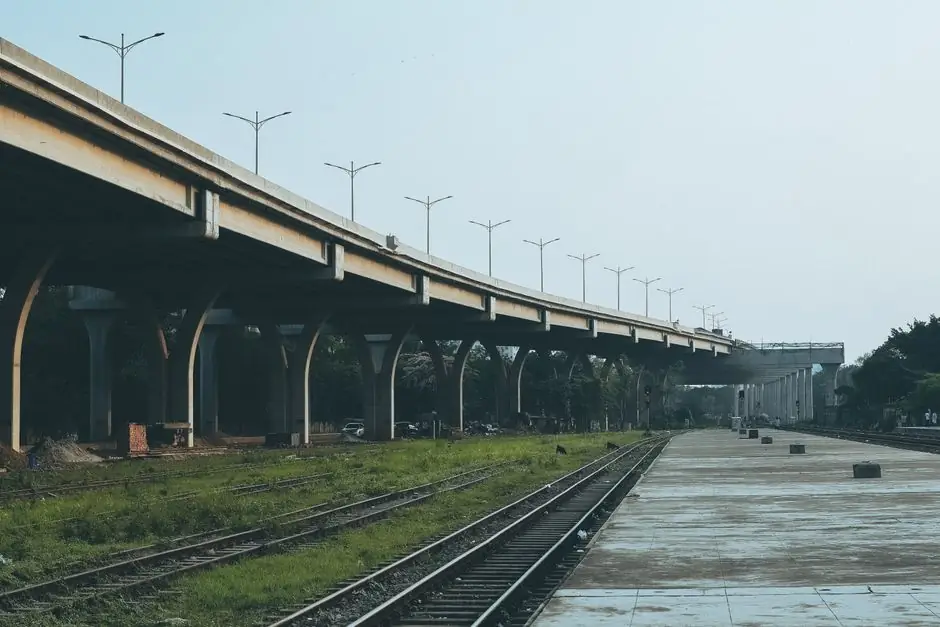
Two equipment families dominate modern bridge soffit work: rope-hung suspended cradles rigged from the deck, and self-propelled truck- or trailer-mounted inspection platforms that cantilever beneath the structure. They overlap in job description but separate cleanly on reach envelope, payload, mobilisation time, and whether the worksite needs a clear lane below.
Indian bridge practice, codified under IRC:SP:35 and IRC:SP:136-2023, treats suspended platforms as the default for cable-stayed and long-span crossings where staging from below is impossible [S3]. US practice, anchored in the National Bridge Inspection Standards that followed the 1967 Silver Bridge collapse, leans heavily on truck-mounted underbridge units for highway spans above roughly 30 ft clearance [S5]. Both approaches are valid; the decision is driven by geometry, not preference.
What Each Machine Actually Is
A suspended platform in bridge service is a modular galvanised steel cradle, typically 2.5-7.5 m long, hung on two wire ropes driven by matched LTD-series electric hoists with an independent safety rope and centrifugal lock [S3]. Capacities run 500-1,000 kg payload, which covers 2-4 workers plus tools and a paint pot. The rigging point sits on the deck edge, pylon head, or a temporary outrigger frame; the cradle travels up, down, or along the soffit on the hoist pair. A truck-mounted truck-mounted crane variant, better described in this role as a bridge inspection unit (BIU), is a vehicle carrying a knuckle or telescopic boom that swings a work platform out and down beneath the deck. Anderson UnderBridge's HPT66 truck-mounted platform, for example, is rated for up to 1,400 lbs (roughly 635 kg) and five crew members, and deploys in under 10 minutes from a single-lane footprint [S1].
Reach, Payload, and Crew Capacity Compared
Reach numbers diverge sharply. Truck-mounted BIUs commonly extend 20-66 ft of platform length with booms reaching up to 72 ft down and 75 ft horizontally beneath the deck [S2]. Trailer- and self-propelled units, such as Anderson's HP35, occupy the lower-reach tier for shorter crossings [S1]. Suspended cradles are limited only by rope length and hoist line pull, so a 60 m drop to a river surface is routine when the deck is accessible [S3]. On payload, BIU cradles win the head-to-head: 1,400 lb / 5-person ratings [S1] exceed the 500-1,000 kg (roughly 1,100-2,200 lb) range cited for suspended cradles, but only on paper; in bridge rigging, the deck-edge anchorage or counterweight frame usually governs, not the hoist [S3]. On crew size, multi-position BIU platforms up to 66 ft long let inspectors walk the soffit without repositioning, whereas a suspended platform requires the whole cradle to traverse [S2].
Site Footprint and Mobilisation Time
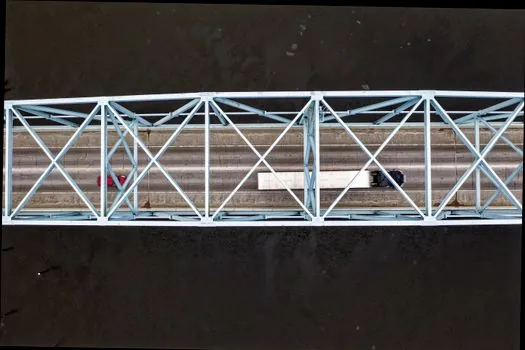
BIUs claim a single-lane footprint on the deck, rotate 180 degrees for full coverage, and deploy in under 10 minutes per the Anderson HPT43 spec sheet [S1]. A bucket truck variant, the entry-level option, parks on the ground or shoulder with one- to three-man buckets reaching 40-60 ft, suited to bridges under 30 ft clearance [S2][S5]. Suspended platforms, by contrast, do not block the deck at all once rigged, but the rigging itself is the engineering: outrigger beams, counterweight, anchorage design, and wind assessment must be calculated per span, not copied from a building façade job [S3]. Mobilisation is therefore hours, not minutes, but repositioning span-to-span on a long viaduct reuses the same crew and cradle without dismantling [S3].
When Each Option Wins
Spec the truck-mounted BIU when the deck can carry the vehicle, the span is below the 60-70 ft BIU envelope, the crew exceeds three workers, and the lane closure window is short. The HPT43 has been used on the Margaret Hunt Hill cable-stay in Dallas, the Chesapeake Bay Bridge-Tunnel, and the Korean Veterans Bridge in Nashville for inspections, concrete repairs, and bearing replacements under that profile [S1]. Spec the suspended platform when the crossing spans water, rail, or live highway with no shoulder access, when the soffit is 20+ m above grade, when stay-cable or pylon work is in scope, and when the job runs span-by-span over a long viaduct [S3]. For bridges under 30 ft of clearance, a bucket truck or manlift is faster and cheaper than either dedicated system [S5]. The truck-mounted concrete pump industry has long used the same deck-loaded vehicle paradigm for similar reasons.
Limitations, Failure Modes, and Standards
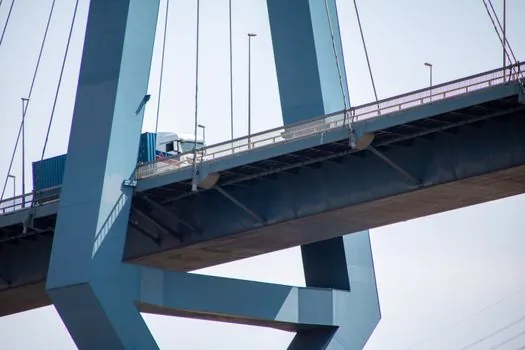
BIUs fail when deck live-load capacity is insufficient, when the crossing lacks a drivable shoulder for the outrigger pad, or when the bridge is a cable-stayed or suspension span with no rigid deck edge to park against [S1][S3]. Suspended platforms fail when rigging anchorage is under-engineered, when wind exceeds the hoist-rated envelope (typically limited operation above 12-15 m/s depending on configuration), or when the deck edge cannot carry the counterweight reaction [S3]. Indian practice references IRC:SP:35 for general bridges and IRC:SP:136-2023 specifically for stay-cable inspection cycles, both of which create the recurring demand that drives equipment selection [S3]. US practice sits under the National Bridge Inspection Standards framework, with platform safety anchored to OSHA working-at-height rules and manufacturer-rated load cases [S5]. For platform suspension hardware specifically, underdeck rail clamp load rating rules are worth checking before specifying any deck-edge rigging.
Decision Matrix: Pick by Job Geometry
For bridges under 30 ft clearance with ground access, a bucket truck (one- to three-man, 40-60 ft reach) is the lowest-cost option [S2][S5]. For 30-70 ft deck-clearance highway bridges with a usable shoulder, a truck-mounted BIU (20-66 ft platform, 1,400 lb / 5-person rating, sub-10-minute deploy) is the productive default [S1][S2]. For long-span, over-water, cable-stayed, or pylon-face work, a suspended cradle (500-1,000 kg payload, unlimited rope-defined reach, span-by-span repositioning) is the only viable answer [S3]. For complex geometries such as pier heads, haunches, and stay-cable anchorages, a special-purpose L-type cradle is required rather than a standard ZLP straight build [S3]. Cost of ownership favours BIUs on short, repeated contracts; suspended platforms win on per-span economics for long viaduct rehabilitation programmes where the rigging is amortised across many spans [S3][S4].
Two signals to track through Q4 2026: OEM releases of BIU models in the 70+ ft platform tier, and any revision activity on IRC:SP:136-2023 or the NBIS framework that would shift inspection-cycle demand for either equipment family. Engineers specifying overhead bridge crane replacement projects alongside soffit work should also verify that the access platform's deck load rating matches the lifting plan.