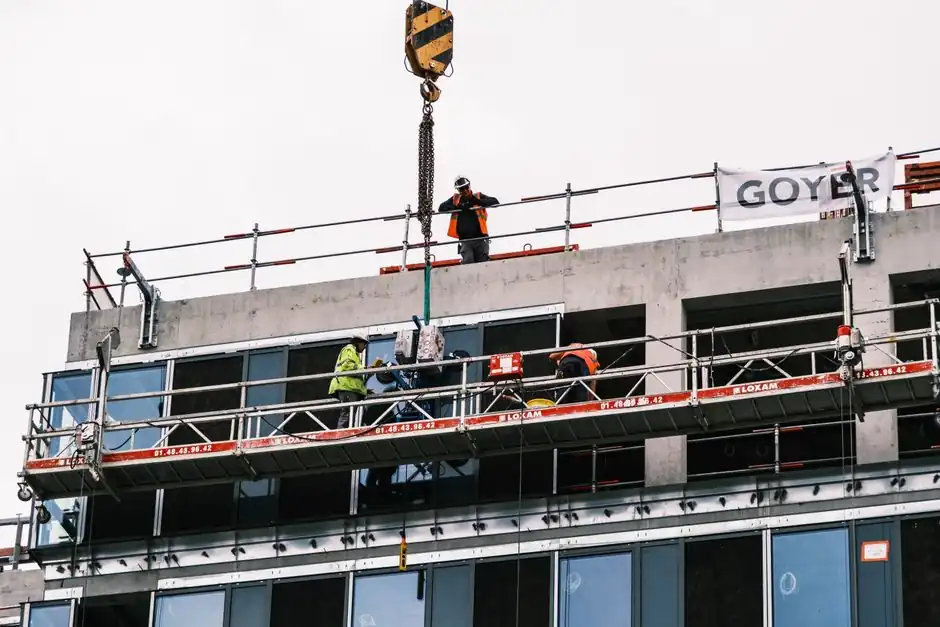
Underdeck suspended platform rail clamp load rating is set by two stacked requirements: the support surface must hold at least 4 times the imposed load, and the clamp itself must be rated to the platform's hoist capacity [S3]. For a typical 20 ft swing stage rated at 1,000 lb per hoist with two 1,000 lb hoists, the rated scaffold load becomes 1,000 lb, and the support must therefore be proven for 4,000 lb at every clamp location [S3][S5].
Tiebacks run in parallel: taut wire-rope tiebacks are sized to 5,000 lb minimum per anchorage to back-stop parapet hooks and counterweighted outriggers against inadvertent fall-off or parapet failure [S5]. On the clamp body, heavy-duty rigging clamps carry 5,000 lb safe working load (SWL) on flange widths from 4 in. to 24 in., with the high-friction Type BY/BYP family reaching 7,524 lb tensile per bolt and 7,733 lb frictional per 2 bolts, all rated to a 5:1 factor of safety with Lloyd's Register Type Approval [S4].
Platform rated capacity: how the numbers are built
Platform rated load is the smaller of hoist capacity and platform structural capacity, evaluated under both even and uneven load distributions [S1][S5]. STROS' modular ZL series makes this explicit: model ZL 6 (6 m length) carries 1,140 kg at even load distribution on the ASTRO end-suspension setup, but drops to 1,084 kg under uneven load distribution on the same setup, and falls to 500 kg on the TITAN stirrup-suspension under uneven distribution, demonstrating how the same deck derates sharply when load is concentrated at one end [S1].
Two-point adjustable suspended platforms must measure at least 20 in. (508 mm) and not more than 36 in. (914 mm) in width, unless specifically designed by a registered design professional [S2]. Once the platform is sized, the rated scaffold load equals the smallest component capacity in the hoist-rope-stirrup chain, and that is the figure that the rail clamp and the support surface must both be matched to [S5].
Support structure rule: the 4x safety factor at the clamp
NYC Building Code 3314.10.2 requires every suspended scaffold support device, including outrigger beams, C-hooks, and parapet clamps, to be supported by surfaces or structures (e.g. roof, parapet) capable of supporting at least four times the load imposed on them by the scaffold operating at the rated load of the hoist [S3]. The support must be inspected prior to installation per Section 3314.4.3.1 [S3].
That 4x multiplier cascades through the system: a 1,000 lb rated stage requires a 4,000 lb-rated support at each clamp; a 1,140 kg (2,513 lb) STROS ZL 6 ASTRO configuration requires roughly 10,052 lb of support capacity at each end-suspension point [S1][S3]. In practice this is why structural engineers, not the scaffold contractor, sign off on the roof or parapet condition before the platform is rigged [S3]. For a primer on how rated loads flow through the access chain, the suspended platform reference lays out the same hoist-to-support logic in generic terms.
Parapet clamp and beam clamp load ratings
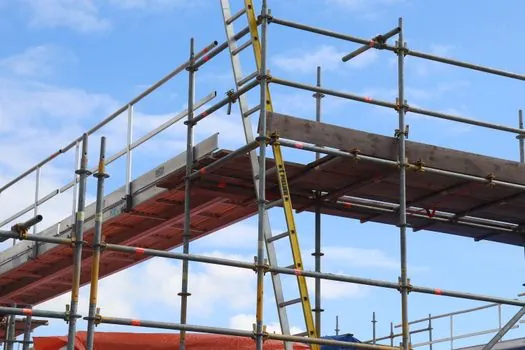
Parapet clamp load rating must equal or exceed the rated hoist capacity or the maximum suspended load on any controlled-descent device attached to it; undersized clamps are a direct fall hazard [S8]. A 5,000 lb SWL rigging clamp covers flange widths from 4 in. to 24 in., which matches the typical range of structural I-beams found on commercial rooftops and bridge underdecks [S4].
Below the 5,000 lb threshold, standard beam clamps (e.g. BeamClamp Type BA/BB at 3/8 in. bolt) carry only 562 lb SWL per bolt, which is enough for pipe supports and conduit hangers but is not appropriate for any suspended access platform [S4]. Specifiers should jump to the BY/BYP family (7,524 lb tensile, 7,733 lb frictional) for any large wide-flange beam, or the BBLN Long Nose variant where load has to be pushed closer to the web [S4]. The 5:1 factor of safety is the rule of thumb across all these models and should be treated as the floor, not the ceiling, of any site-specific derating calculation [S4].
Stirrup, outrigger, and counterweight rules that change the clamp load
The clamp sees different reactions depending on which suspension geometry the platform uses. STROS lists end-suspension and stirrup-suspension as two distinct configurations, and the same ZL 8 platform drops from 1,070 kg (end-suspension, even load) to 775 kg (stirrup-suspension, even load) because the load path moves further outboard [S1]. End suspension concentrates load at the building face; stirrup suspension loads the parapet or roof edge beam more aggressively and therefore demands a higher clamp rating at the same platform weight [S1].
Outrigger beams must be placed perpendicular to the face of the building, and counterweights, when used, must be made of nonflowable material (sand, gravel, masonry, and rolls of roofing felt are explicitly prohibited), must be designed as counterweights, and must be mechanically secured to the outrigger to prevent accidental dislodgment [S3]. Multipoint adjustable suspended scaffolds are not permitted to use counterweights at all; they must be stabilized by direct bolting to the deck [S3]. Tiebacks, where used in place of direct bolting, must be equivalent in strength to the suspension ropes themselves [S3]. A 5,000 lb wire-rope tieback to a structurally sound anchorage is the working minimum for parapet-hook and counterweighted-outrigger systems [S5].
Underdeck specifics: inverted rigging and C-hooks
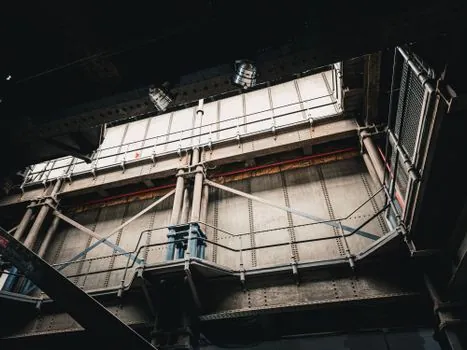
Underdeck work inverts the usual load path: instead of hanging a platform from a parapet, the platform is suspended from the structural deck above via C-hooks, outrigger beams, or purpose-built underdeck beams, and the worker operates below the supporting structure. The 4x support rule still applies, but the supporting member is now a roof deck, bridge soffit, or steel floor beam rather than a parapet wall [S3].
For underdeck bridge and transit work, the C-hook or beam-clamp reaction must be calculated against the deck's own capacity at the local bearing point, not against the global deck rating, because punching shear and local web crippling often govern before global bending does. BeamClamp Type BBLN (Long Nose) is the typical specifier's pick here because it pushes the contact patch closer to the web of a wide-flange beam, which raises the local bearing capacity and matches the geometry of an underdeck girder [S4]. A pipe clamp sized for the same load range uses similar high-friction serrated faces, but its SWL tables are written for vertical piping, not for the angle-loaded shackle forces seen on a suspended stage, so cross-substitution is not safe.
Comparison: standard clamp vs rigging clamp vs high-friction heavy duty
Three product tiers cover almost every underdeck platform rail-clamp scenario, and the choice is driven by load, flange width, and whether the connection is slip-critical. The table below lines them up against the four criteria that actually decide the spec: tensile SWL, frictional SWL, flange-width range, and factor of safety / approval. [S4]
Standard BA/BB (3/8 in. bolt) carries 562 lb tensile SWL per bolt, no published frictional SWL, fits narrow flanges typical of secondary steel, and runs a 5:1 factor of safety; it is correct for pipe supports and light conduit, not for suspended stages [S4]. Rigging Clamp (KRC062) carries 5,000 lb SWL on suspension loads, fits 4 in. to 24 in. flange widths, and runs 5:1 with Lloyd's Register Type Approval; it is the default for parapet hooks and counterweighted outrigger tie-off points [S4][S5]. Type BY/BYP carries 7,524 lb tensile per bolt and 7,733 lb frictional per 2 bolts, fits the same wide-flange range, and is the right pick when the platform hoist approaches 5,000 lb or when the connection is slip-critical under vibration [S4]. The general rule: match the clamp tier to the higher of hoist capacity or maximum suspended load, then check the 4x support multiplier at the deck or parapet [S3][S4][S8].
Inspection, derating, and common failure modes

Clamp load ratings are published SWL figures at new condition; in service they must be derated for corrosion, worn serrations, deformed flanges, missing bolts, and undocumented prior overload. OSHA 1910.66 and Subpart L of 29 CFR 1926 govern the inspection regime on the U.S. side, ANSI A-120.1 covers powered platforms for building maintenance, and the I-14 Window Cleaning Safety Standard applies to facade work specifically [S5]. SAIA's parapet-clamp guidance is explicit: the clamp's load rating must equal or exceed the rated hoist capacity or the maximum suspended load on the controlled descent device, with no exceptions written into the field-install procedure [S8].
The most common failure modes are not bolt shear but clamp slip on a painted or corroded flange, parapet failure under a concentrated clamp reaction, and counterweight displacement on a roof where wind or vibration has worked the mechanical securement loose [S3][S5]. Counterweights made of sand, gravel, masonry, or roofing felt are explicitly disallowed by 3314.10.7 because they migrate, and counterweights must be removed only at disassembly, never during operation [S3]. For underdeck work specifically, the additional failure mode to check is local web crippling at the C-hook bearing point, which a generic suspended platform load table does not capture.
Track the next two signals: any revision to OSHA 1910.66 Subpart L tied to underdeck rigging, and any update to ANSI A-120.1 that formalizes C-hook reaction testing, both of which would directly change the clamp-tier table above. For broader hoisting-load context that crosses over to crane work, the tower crane jib length vs maximum lifting capacity load-chart reading applies the same rated-load-vs-factor-of-safety logic to a different machine.
For component-level specifications, see clamp meter.