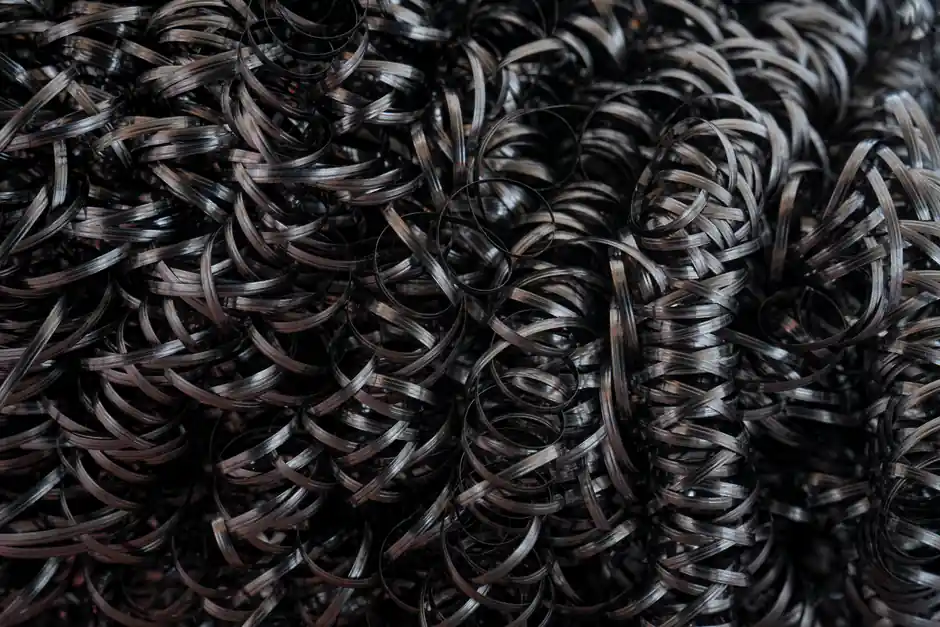
Undulated steel fibers rely on a wave or corrugation pattern for pull-out resistance, while flat-end fibers use a clean rectangular cross-section with a flat or enlarged end face, and a recent fiber-shape overview lists flat-end fibers as one of the main steel macro-fiber shapes where the end geometry helps anchorage [S3].
Both shapes sit inside the broader deformed-fiber family under ASTM A820/A820M and EN 14889-1, where Type I cold-drawn wire is the dominant manufacturing route and the standard simply notes that fibers "may be straight or deformed" [S3].
Anchorage Mechanism by Shape
Flat-end fibers develop pull-out resistance from bearing against the matrix at the squared end plus a small contribution from the rough side surface of the cut wire, and Sika and Iowa State both list flat ends as a recognised macro-fiber anchorage style, not a no-anchor geometry [S3]. Undulated or crimped fibers develop resistance from the continuous wave along their length, which bears against the matrix as the fiber tries to slide straight out, but the bearing area at any given slip is small compared to a hook or a flat end bearing against a crack plane. The shape overview confirms that the end geometry is the dominant anchorage contributor in most cataloged macro-fibers, not the side profile [S3].
Hooked-end fibers, by contrast, rely on a plastic straightening of the bend during pull-out, which absorbs energy and raises peak pull-out load substantially compared with straight or mildly deformed fibers [S2]. Bekaert separates its Type I cold-drawn wire portfolio from Type II cut sheet partly on this point, noting that Type I fibers typically have hooked ends and higher tensile strength, which is exactly the combination that drives anchorage capacity [S5].
Pull-Out Resistance Ranking
Across the three common deformed shapes, peak pull-out load per fiber typically follows the order: multi-directional loop or delta-end > hooked-end > flat-end (enlarged-end) > undulated/crimped > straight, with the differences driven mostly by how much plastic deformation the fiber can absorb before the matrix crushes around it. The Duraflex Delta Loop End product family specifically claims higher pull-out resistance than conventional hooked-end fibers because the loop engages in more than one direction, not because the side profile is wavy [S6]. A 2023 MDPI optimization study on hooked-end fibers confirmed that a reasonable end-hook shape can raise pull-out resistance while also preventing fiber breakage from excessive anchorage stress, which is the failure mode that crimped/undulated fibers tend to hit first [S7].
For industrial floors, slabs on grade, and shotcrete where the dominant demand is crack-width control at moderate stress, undulated fibers are usually a cost-effective option, and the same overview that lists flat-end fibers also lists crimped and corrugated fibers as a common catalog shape for that duty range [S3]. For tunnel segments, precast structural elements, and anchorage zones around headed anchors, flat-end enlarged-end or hooked-end fibers are the consistent specification because the end-bearing component of pull-out resistance is what carries the post-crack residual load, not the side wave [S1].
When Undulated Fibers Are Not the Right Pick
Undulated and crimped fibers should not be specified where the concrete section is thin (cover under roughly 30 mm), where fibers cross a defined anchorage or headed-anchor zone, or where the design relies on residual flexural strength at a specified crack width, because their anchorage degrades faster than hooked-end fibers once the matrix crushes locally around the wave. The PMC study on headed anchors in SFRC specifically tracks how fiber reinforcement redistributes load around a cast-in headed anchor, and the anchorage benefit is only realised when fibers are stiff enough and shaped enough to bridge the breakout cone rather than simply slide through the matrix [S1].
For chemical-anchor and expansion-anchor embedment zones, a deformed steel fiber is essentially acting like micro-rebar, and the end geometry is what arrests crack opening, so an undulated fiber with no enlarged end is generally a poor substitute for a flat-end or hooked-end fiber in those locations; the encyclopedia entry on chemical anchor behaviour and the related note on expansion anchor cone breakout both depend on residual tensile bridging across a propagating crack, which is exactly the loading mode where flat-end and hooked-end fibers outperform undulated shapes. Mixing shapes in a single mix is common and can compensate, but it does not rescue the undulated fibers from their lower per-fiber anchorage.
Wire, Steel, and Manufacturing Reality
Almost all cataloged flat-end, hooked-end, and undulated fibers are produced from cold-drawn wire (ASTM A820 Type I / EN 14889-1 Group I), which is also the most common steel fiber used in precast concrete because the source wire has high tensile strength and tight dimensional tolerance, and the same is true for the carbon steel wire feedstock that feeds most fiber-drawing lines. Cut-sheet (Type II) fibers are an alternative route, but they show up less often as flat-end macro-fibers and more often as straight or mildly deformed shapes for slab reinforcement [S3][S5].
Alloy-steel and silicon-steel variants exist for special duty (corrosion, magnetic, or high-temperature service), but they do not change the anchorage ranking, because pull-out is governed by end geometry and matrix bearing, not by the base alloy steel grade or whether the wire is silicon steel; the only case where steel grade changes the answer is when the fiber itself ruptures before pulling out, which is a failure mode more common in low-ductility straight fibers than in undulated or flat-end deformed fibers [S3].
How to Pick Between Them on a Spec
Use undulated or crimped fibers when the requirement is plastic-shrinkage control, moderate impact resistance, and slab-on-grade crack-width control, and the dosage is in the 20-40 kg/m³ range typical for non-structural floors. Use flat-end (enlarged-end) macro-fibers when the design needs post-crack residual flexural strength in the 1.5-3.0 MPa range at crack widths around 0.5-2.0 mm, and the section is thick enough (cover above 30 mm) to develop end bearing. Use hooked-end or loop-end fibers when the section is structural, when the fiber must bridge a known anchorage or headed-anchor zone, or when impact and fatigue resistance are part of the design basis [S1][S2][S3][S6].
Confirm the choice by checking the manufacturer's declared tensile strength of the base wire, the fiber length-to-diameter (aspect) ratio, and the relevant ASTM A820 Type or EN 14889-1 Group, because the standard classification tells you how the fiber was made while the shape tells you how it anchors, and a spec that lists only one of the two is incomplete [S3]. A 2026 brief on stainless steel procurement makes the same point on a different product family: standard designation and actual alloy grade both have to be on the datasheet, otherwise the buyer is guessing at performance. For steel fibers that means a 1,000-2,000 MPa wire tensile strength range, a 50-80 aspect ratio for macro-fibers, and a clear shape call-out (flat-end, hooked, undulated, or loop), with dosage locked in kg/m³ rather than left as "as required" [S3][S5].
Common Mistakes in the Field
The most common mistake is treating undulated fibers as a cheaper drop-in for hooked-end fibers in structural applications, which under-delivers residual flexural strength at the same dosage and is a recurring issue flagged in fiber-shape selection guidance [S3]. The second most common mistake is specifying fiber shape without also specifying the standard classification, so that a Type II cut sheet is delivered where a Type I cold-drawn wire was assumed, with the result that tensile strength and surface roughness are both lower than the design assumed [S3][S5]. The third is ignoring end-bearing entirely and optimising only on aspect ratio, which pushes the buyer toward long, thin straight or mildly undulated fibers that pull out at low load.
A practical fix is to require the manufacturer to publish both the ASTM A820 Type and the shape (flat-end, hooked, undulated, loop), and to declare a target post-crack residual strength at a specific crack width so that the comparison between shapes is on performance, not on geometry alone [S3].
The next signal worth tracking is whether ASTM A820 or EN 14889-1 move toward standardising multi-directional end shapes (loops, delta ends, enlarged flat ends) the way they currently allow "deformed" as a catch-all, because that shift would formalise the ranking that undulated fibers sit at the bottom of the structural anchorage hierarchy, and would likely raise the minimum wire tensile strength for structural grades in the same revision cycle.