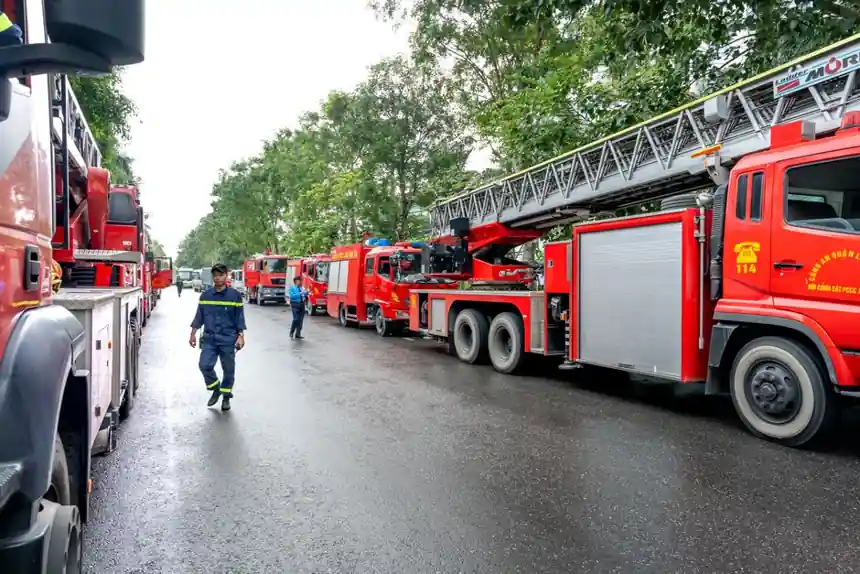
29 CFR 1910.67(c)(2)(ix) and 29 CFR 1926.453(b)(2)(ix) both state: "Upper controls shall be in or beside the platform within easy reach of the operator. Lower controls shall provide for overriding the upper controls. Controls shall be plainly marked as to their function" [S1][S2].
The same rule is repeated almost verbatim in ANSI A92.2-1969 §4.3 and the successor ANSI/SIA A92.2-2001 §4.3, and is restated in current safety programs as "Lower controls must provide for overriding the upper controls" [S1][S5]. Coverage extends to articulating booms, extensible boom platforms primarily designed as personnel carriers, and live-line bare-hand units, which require dual lower and upper controls with the lower station near the boom base [S1][S2].
What "override" means in the valve stack, not the job site
Override is a hardware feature, not a courtesy. On Versalift VST-36/40/47/52-I units, "the lower control station is equipped with a selector valve to override the upper controls," and the platform runs a full-pressure single-stick upper station alongside the manual lower station [S3]. The selector valve is the only component that hands hydraulic authority to one station at a time; a stuck or mis-routed valve is the single most common reason upper controls go dead while lower controls still work, even with the pump and motor sounding normal [S7].
Electric-over-hydraulic and direct-hydraulic stacks both implement override the same way at the directional valve: whichever station is selected gets pilot pressure, and the other station's commands are physically blocked from shifting the work-section spool. The 1991 edition of NFPA 1901 later required aerial devices to operate and support rated tip load over the full operational envelope with stabilizers deployed, and both manual hydraulic and electric-over-hydraulic architectures meet that bar, so the override is engineered at the valve rather than added as software [S4].
Two control architectures, one override rule
Direct hydraulic control ties the operator's lever straight to a valve section that opens or closes flow to a cylinder; an electric-over-hydraulic stack replaces the mechanical link with a solenoid driven by a low-current signal from a lever, paddle, push-button, or joystick, and can feather speed the way a dimmer ramps a lamp [S4]. The override requirement is identical for both: a selector on the lower station hands command to the ground operator, and dual pilot-operated check valves hold the lift cylinders in place when the raise/lower control returns to neutral, replacing the older manual shut-off valve that the operator had to close before anyone could climb the aerial [S4].
Apparatus OEMs mix the two architectures on a single truck: outrigger and turntable functions are commonly manual hydraulic because the runs are short, while platform controls on a tower ladder and creeper controls at the aerial tip are electric-over-hydraulic because running live hydraulic lines up a 100 ft boom is not practical, with the selector and override valve cluster at the turntable [S4]. For aerial work truck buyers, the takeaway is that the override interface, the pilot-check valves, and the labelling rule under 29 CFR 1910.67(c)(2)(ix) do not change with architecture, but the failure modes do.
Compliance criteria a spec sheet must show
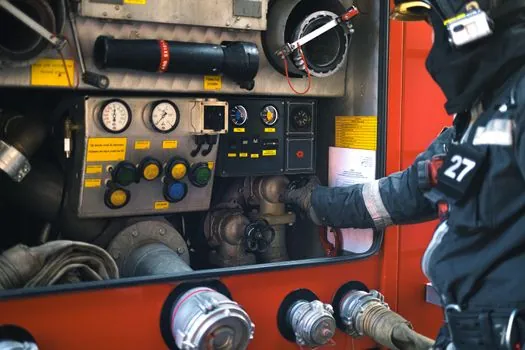
For an articulating or extensible boom primarily designed as personnel carriers, four items have to be visible on the data plate or in the operator's manual: dual controls (upper at platform, lower at base), lower-station override of upper at any time, plainly marked control function, and the ANSI/SIA A92.2 or CAN/CSA-C225 compliance line that the manual must carry [S1][S2][S3]. Live-line bare-hand work adds dual lower and upper controls with the lower station positioned to permit override operation at any time, per 29 CFR 1926.955(e)(12) [S1].
Field-experience failure modes line up with these criteria: "If upper boom controls don't respond but lower controls work and you hear motor sounds, check the upper control valve assembly. Inspect wiring," because the pump, motor, and reservoir are shared and the only thing that can fail selectively is the upper control valve, its wiring harness, or the selector that grants authority [S7].
Comparison: direct hydraulic vs electric-over-hydraulic on the override path
For a specifier comparing the two control stacks against the override requirement: [S3]
Override mechanism: direct hydraulic uses a manual lever linked straight to a valve section; electric-over-hydraulic uses a solenoid driven by a low-current signal from a lever, paddle, push-button, or joystick, with the selector valve handing authority to one station at a time [S4].
Speed control: direct hydraulic is on/off by linkage position; electric-over-hydraulic can feather, behaving like a dimmer on hydraulics, which matters for fine positioning at the platform [S4].
Routing at the boom tip: direct hydraulic needs full-pressure lines run the length of the boom; electric-over-hydraulic only needs signal wire, which is why tower-ladder platform controls and creeper controls at the ladder tip are almost always electric-over-hydraulic [S4].
Failure mode for the override rule: both architectures fail the same way when the selector valve or the upper control valve assembly sticks, which is the typical cause of dead-upper, live-lower symptoms [S7]. For an aerial work platform buyer, the comparison is therefore about installation cost and fine control, not about whether the lower station can override.
Permission rule: when the ground operator is allowed to take over
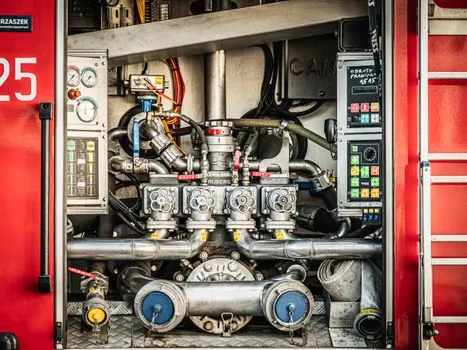
29 CFR 1910.67(c)(2)(ix) closes with: "Lower level controls shall not be operated unless permission has been obtained from the employee in the lift, except in case of emergency" [S1][S2]. That sentence is the procedural twin of the hardware override: the valve is always able to override, but the ground operator is only allowed to act on that ability after getting clearance from the person in the basket, unless the situation is an emergency.
In practice, fire-apparatus training treats the manual override as a rescue tool: an incapacitated or trapped operator at the platform is the textbook emergency that justifies the ground station taking command without verbal clearance [S4]. The labelling rule, controls "plainly marked as to their function," supports that protocol by making the selector and function levers unambiguous under stress [S1][S2][S5].
Limits of the rule and equipment it does not cover
The dual-control and override requirement is scoped to articulating booms and extensible boom platforms primarily designed as personnel carriers; it is not a blanket rule for every device on a truck [S1][S2]. Scissor lifts, order pickers, vertical towers, and aerial ladders are defined separately in 29 CFR 1910.67(a), and 1926.453(a)(1) carries its own effective date of January 22, 1973 for design conformance to ANSI A92.2-1969 [S1][S2].
29 CFR 1910.67(b)(3) excludes firefighting equipment and the vehicles on which aerial devices are mounted, except for the requirement that the vehicle be a stable support [S2]. The override rule still applies to the aerial component on a fire apparatus, but the chassis rules are written under NFPA 1901 rather than 29 CFR 1910.67, and operators should not conflate the two regulatory tracks when auditing a truck.
Specifications and standards to cite in a procurement document
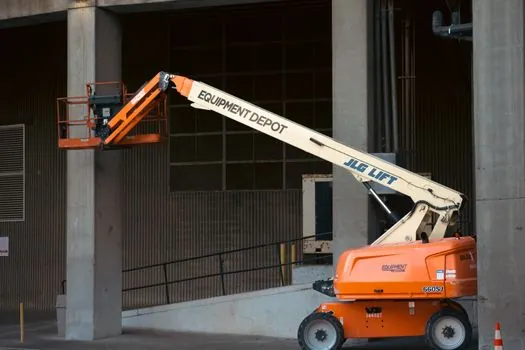
For a procurement or audit document on an aerial work truck with articulating or extensible boom, the spec should call out: conformance to ANSI/SIA A92.2 (current edition) and 29 CFR 1910.67(c)(2)(ix) for dual controls with lower-station override, conformance to 29 CFR 1926.453(b)(2)(ix) for construction use, conformance to 29 CFR 1926.955(e)(12) for live-line bare-hand work, and a clearly labelled selector valve and function levers per ANSI A92.2 §4.3 [S1][S2][S3][S5].
Two trackable signals confirm compliance on a used or new unit: the data plate carries the ANSI/SIA A92.2 or CAN/CSA-C225 compliance line as shown on the Versalift VST-52-I nameplate, and the operator's manual contains the explicit "lower control station is equipped with a selector valve to override the upper controls" statement [S3]. Absence of either item is a flag to send the unit back for documentation before signing the pre-use inspection [S5].
For buyers comparing aerial lift capacities, see Aerial Work Truck Capacity: Personnel vs Material Handling Compared for how the dual-control and override requirement interacts with platform capacity ratings on the same chassis.