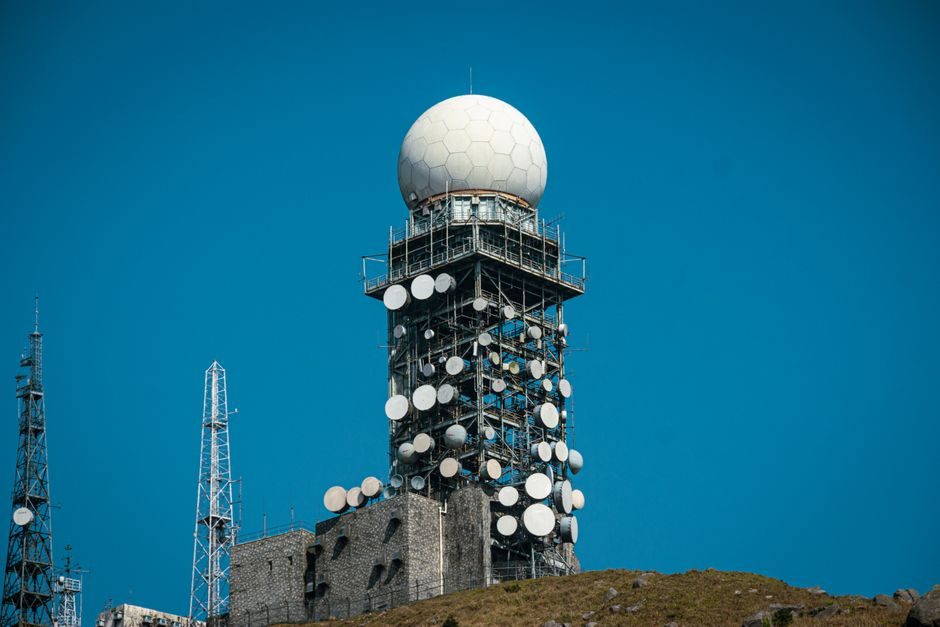
A UV radiometer quantifies solar ultraviolet irradiance at a specific wavelength band, typically weighted to the erythemal action spectrum and reported as a UV index on a 0-15 scale where 0 indicates night and values approaching 15 occur in tropical, high-altitude, or clear-sky conditions [S3].
A weather station is a multi-channel sensor suite that reports ambient air temperature, relative humidity, barometric pressure, wind speed/direction, and rainfall, with 10-minute update intervals common on institutional deployments as shown by Murdoch University's public page (readings on 2026-07-30 at 01:30 WST, 10-minute cadence) [S2]. Hobby builds such as the Utrecht Overvecht station pair an outside "weather hut" with a BME-style combined humidity/temperature/pressure sensor and report values like 19.4 °C and 1005.5 hPa at 20:15 local time on 2026-04-16 [S1].
What Each Instrument Actually Measures
UV radiometers use a photodetector behind a diffuser and a bandpass filter matched to the erythemal action spectrum (CIE 1987) or to a defined UVB/UVA cut; output is a weighted irradiance in mW/m² or a derived UV index where the index equals irradiance/25 mW/m². The 0-15 reporting range is defined for public forecasting and is not a hard physical ceiling, since high-altitude tropical sites can exceed 15 under ozone-minimised conditions [S3].
Weather stations are sensor aggregators, not single instruments. The Utrecht Overvecht page lists three measurands (temperature, humidity, air pressure) plus a lightning detector, all funneled into rrdtool for trending [S1]. Murdoch's institutional deployment extends the list to wind speed/direction, air temperature, relative humidity, air pressure, 24-hour rainfall, and sunrise/sunset times, and renders each as a clickable trend graph [S2]. For a deeper buyer-side cost breakdown of the weather-station class, the Weather Station Price & Cost Guide 2026 maps sensor class, calibration, and total cost of ownership.
Selection Criteria: Pick the Sensor That Matches the Question
Choose a UV radiometer when the user question is "how much UV is hitting this surface right now" — solar resource assessment, polymer degradation studies, photobiology exposure trials, public UV-index reporting, or skin-damage risk communication. The 0-15 index is the public-facing scale used by health agencies worldwide, and a value of 11+ is already classified as "extreme" on the standard WHO/EPA-style banded scale [S3].
Choose a weather station when the user question is "what is the local atmospheric state" — HVAC load calculation, agricultural frost warning, aviation METAR-class reporting, amateur climate logging, or building-envelope commissioning. The Utrecht Overvecht hobbyist installation publishes only three core channels but explicitly notes where limits are: humidity returned NaN, and the lightning detector is blanked because local amateur-radio transmissions create interference [S1]. Murdoch's institutional unit updates every 10 minutes and adds wind and rainfall channels that hobby units often omit [S2].
Overlap, Differences, and a Side-by-Side Comparison
The two instrument classes share only siting and data-handling concerns: both need a clean horizon line, both produce timestamped numeric streams, and both benefit from rrdtool-style time-series backends, as the Utrecht Overvecht build demonstrates [S1]. They diverge on every measurement axis: UV radiometers are single-channel, photometric, cosine-corrected, and need radiometric calibration traceable to a national lab; weather stations are multi-channel, electromechanical, and need periodic humidity-sensor salt-cell recalibration plus anemometer bearing checks. A UV radiometer cannot report a UV index if it is co-located inside a Stevenson screen, and a weather station cannot report erythemal dose no matter how many channels it adds.
Comparison on four procurement-grade criteria:
1) Measurand count: UV radiometer = 1 (weighted UV irradiance or index); weather station = 3-6+ (T, RH, P, wind, rain, optional lightning).
2) Calibration discipline: UV radiometer requires annual or biennial radiometric recertification against a reference lamp; weather station requires hygrometer salt calibration (e.g. 11.3% / 75.3% NaCl) and anemometer spin-test.
3) Update cadence: UV radiometer is typically a 1-second to 1-minute fast logger because cloud-edge transients drive 50-100% swings within seconds; Murdoch's institutional weather station updates every 10 minutes [S2], and the Utrecht hobbyist posts at longer intervals.
4) Use-case fit: UV radiometer for solar-resource, public-health, and materials-degradation work; weather station for microclimate, agriculture, and aviation-grade METAR. For indoor IAQ or welding-fume gas channels, neither suffices, and a dedicated air quality monitor or gas detector becomes the correct spec.
Who Should Buy Which, and Who Should Not
Buy a UV radiometer if you are a solar-PV yield analyst, a dermatologist publishing daily UV-index bulletins, a polymer-compatibility lab running ASTM-grade xenon-arc correlation studies, or a public-health agency mandated to broadcast UV index. The 0-15 scale, with 15 reached in tropical, high-altitude, or clear-sky conditions, is the published public-health metric you need to report against [S3].
Buy a weather station if you are a farmer watching frost windows, a building engineer sizing HVAC, a school running a STEM citizen-science logger like Utrecht Overvecht, or an airport filing METAR. The 10-minute institutional update cadence shown at Murdoch is the de-facto standard for non-research public weather pages [S2].
Do not buy a UV radiometer for general weather logging, and do not buy a weather station to satisfy a UV-index reporting requirement. The instruments are complementary on the same site — a meteorological station can host a UV radiometer as one extra channel — but they are not substitutes. The choice is not "either/or" on cost alone; it is "what is the question," because a UV radiometer cannot tell you it is raining, and a rain gauge cannot tell you the UV index.
Failure Modes, Limits, and Siting Constraints
UV radiometers drift when their diffuser transmittance degrades under UV exposure itself (solar-radiation-induced degradation, or "UV degradation of the UV sensor"); annual factory recertification is the usual mitigation. Cosine response error grows at low solar elevation angles, so a winter sunrise reading under-states true erythemal dose. Shade contamination collapses the reading, and even a partial shadow from a mast or tree can clip 80-90% of the signal [S3].
Weather stations fail on humidity sensor saturation after prolonged 95-100% RH exposure, on anemometer bearing seizure in dusty or coastal salt-air environments, and on rain gauge undercatch in wind. The Utrecht Overvecht page lists two live failure modes: a NaN humidity reading and a suppressed lightning channel due to local RFI from the operator's own amateur radio [S1]. Murdoch's institutional unit covers its failure modes with redundant channels and a 10-minute update guard band [S2].
For an indoor or process-side deployment that needs neither outdoor solar nor full atmospheric coverage, neither class fits; the spec shifts to a flow meter or a pressure transmitter, which is the correct B2B instrument family for pipeline and tank instrumentation.
Standards, Traceability, and Sourcing Signals
UV radiometer traceability is governed by national metrology institutes (NIST, PTB, NPL) via reference UV sources and detector packages, with field calibration typically traceable to a 1,000 W quartz-halogen or deuterium lamp standard. The UV index itself is defined by WHO/EPA/Global Solar UV Index guidance and operationalised in CIE 1987 erythemal weighting, with the 0-15 public reporting range mapped from underlying mW/m² irradiance [S3].
Weather station traceability leans on WMO CIMO Guide chapter 8 for siting and exposure, and on national standards for anemometer, hygrometer, and barometer calibration. Public institutional pages like Murdoch's are a useful procurement signal because they disclose the update cadence, channel list, and trend-archive policy [S2]; hobby pages like Utrecht Overvecht disclose the data-pipeline side (rrdtool) and the siting limitations of a yard enclosed on all four sides [S1]. Trackable signals to watch over the next procurement cycle: any institutional weather page publishing UV index as a new channel, and any UV-radiometer OEM adding native Modbus TCP or Ethernet-APL output for SCADA integration; the underlying radiometric physics — cosine correction, erythemal weighting, 0-15 index range — does not change.
For component-level specifications, see uv radiometer.