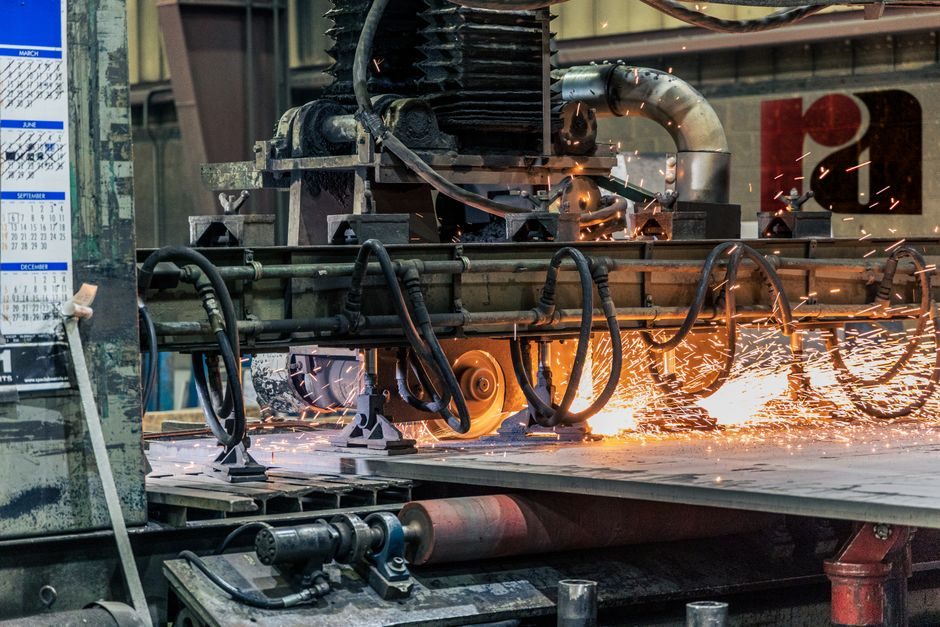
Welding produces a documented cocktail of carbon monoxide, nitrogen dioxide, ozone and metal fumes, and continuous monitoring of CO and NO2 is the baseline protection specified for any enclosed welding bay [S5]. More than 70 distinct welding processes exist, each with a different shielding-gas and fume profile, so a single-gas instrument cannot cover a fabrication shop [S5].
OSHA sets the permissible exposure limit at 50 ppm for CO and 5 ppm for NO2, and the same reference flags nitrogen dioxide as the most acutely hazardous of the common welding by-products because the IDLH sits at 20 ppm [S5]. A correct detector package therefore needs at least an electrochemical CO channel, an NO2 channel, an oxygen cell for confined-space work, and either a photoionization or metal-oxide sensor for the VOC/ozone component.
Why a single-gas instrument is the wrong default for a weld cell
GMAW (Mig) running 100% CO2 shielding can push shop CO above 100 ppm in a poorly ventilated bay within minutes; that same bay usually shows measurable NO2 from the arc and ozone above 0.1 ppm from UV photolysis of oxygen [S5]. A dedicated CO-only or NO2-only instrument therefore catches one hazard while leaving the other two to drift toward its IDLH [S5].
For a fabrication floor with mixed MIG, TIG, stick and flux-cored work, a 4-gas cart with CO/H2S/O2/LEL is also a misfit because it drops NO2 entirely. The right shape is a 4-to-6 sensor pack: CO (0-500 or 0-1000 ppm range), NO2 (0-20 ppm), O2 (0-30%), and either an ozone cell (0-5 ppm) or a PID channel for organic vapours from solvent cleaning adjacent to the weld station [S2][S5].
Sensor technology selection by gas
Electrochemical cells remain the default for CO and NO2 because the target concentrations sit well inside the cell's linear range and the cross-sensitivity to humidity is manageable in a covered shop [S3]. For ozone, both electrochemical and metal-oxide semiconductor options are in production, and HNL Systems lists twelve sensor technologies across its gas-analyzer and monitor line to match the application rather than force one cell type [S3].
Welding-specific nuisance gases matter: NO2 cells cross-react with chlorine and with high NO, and CO cells can be poisoned by silicone if the bay is near a mould-release operation. A spec sheet should list the cross-sensitivity matrix in ppm equivalent; if the vendor cannot supply it, the instrument is not yet weld-bay qualified [S3]. PID lamps for VOC detection typically run 10.6 eV for solvents around the welding bench; 9.8 eV lamps miss toluene and xylene, so the lamp choice must be written into the PO.
Fixed bay monitor versus worker-worn portable
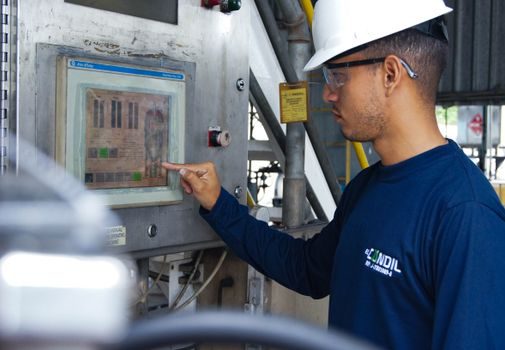
Fixed wall-mounted detectors with 4-20 mA or relay outputs protect the area 24/7 and are the right primary layer for any unmanned welding cell [S4]. Their weakness is the worker who steps between bays, leans into a tank, or enters a confined backing-gas purge: a fixed sensor ten metres away reads 0 ppm while the welder's breathing zone is at 200 ppm CO. That gap is filled by a portable gas detector clipped to the lapel or belt [S4].
For fixed units, mount the head at breathing-zone height (1.5-1.8 m), not at the ceiling: CO is roughly neutral and NO2 is heavier than air, so a high mount samples a cleaner layer. ATO's gas-detector catalog lists CO instruments with selectable 0-500, 0-1000 and 0-2000 ppm ranges at $223.94, and ammonia monitors at 0-50 or 0-100 ppm at $433.99 with diffusion sampling for personal or area use [S2]. A diffusion-sampling portable on the welder and a pumped fixed unit on the wall are complementary, not redundant.
Calibration, bump-test and certification scope
Electrochemical cells drift, and a CO sensor shipped from the factory reading 50 ppm can be 35 ppm at 6 months without a span cal. Welding shops should spec a 30-day bump-test interval and 90-day full-cal interval for CO and NO2; ozone cells need a 7-day bump because of UV-triggered degradation. CEMS-grade analyzers, like the opacity-monitor and continuous-emission systems HNL builds, are calibrated against reference gases traceable to NIST and need a documented drift log [S3].
Certification scope has to match the bay, not the brochure. A unit rated only to general-purpose environments cannot go into a paint-booth-adjacent weld cell where Class I Division 2 groups can appear. Look for IECEx, ATEX 2014/34/EU, or UL 913 markings explicitly listing the groups; absence of the group letter on the nameplate is a hard fail. Singapore-based safety integrators such as Auric Pacific publish fixed and portable detector lines with installation service, useful as a reference for how Asia-Pacific tenders package the cert bundle [S6].
Comparison: fixed area vs portable personal vs multi-gas cart
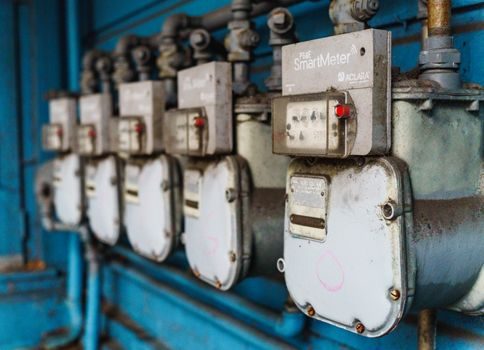
The three architectures line up against the four criteria that drive a welding-floor purchase. (1) Coverage geometry: fixed wall units protect the bay but miss the welder's breathing zone in motion; portable units track the worker; multi-gas carts with pumps cover confined-space purges. (2) Sensor density: portable units typically allow 1-4 sensors; fixed bay units 1-6; multi-gas carts 4-6 plus IR for CO2 if argon/CO2 shielding is used [S3][S4]. (3) Alarm latency: diffusion portables have a 10-30 second T90 response, pumped fixed units 5-15 seconds, pumped carts 3-10 seconds. (4) Cost per point: ATO's NH3 diffusion personal monitor lists at $433.99 for one gas, while a 4-gas wall-mounted fixed detector from typical industrial catalogs runs 3-5x that for four sensors plus the 4-20 mA output board [S2][S4].
For a stand-alone weld cell in a covered shop, the minimum kit is a 3-sensor fixed unit (CO, NO2, O2) at breathing-zone height plus a 4-sensor diffusion portable per welder. For a structural-steel bay with overhead cranes, add a remote sensor head near the crane cab because the operator's CO exposure can exceed the welder's. For tank or vessel fabrication with purge-gas work, add a toxic gas detector with explicit O2 head plus a pumped confined-space monitor before entry [S4][S5].
Common spec failures on welding-floor purchases
Three errors repeat. First, specifying a combustible-gas-only LEL instrument as the welder's primary PPE because "welding is hot work"; an LEL sensor does not see CO or NO2 at their toxic thresholds, so the alarms never fire below the explosive limit [S5]. Second, mounting fixed CO sensors at the ceiling because "smoke rises"; CO does not stratify like smoke, and the breathing zone misses the peak.
Third, ignoring solvent cross-interference. If the weld cell shares ventilation with a parts-washer running mineral spirits, a PID will trip on every solvent burst rather than on the welding fumes, training the welder to ignore it. The fix is a 10.0 eV lamp tuned for the specific VOC, a charcoal filter on the PID inlet, or relocating the parts washer. CETCI's welding-shop guidance explicitly lists CO, NO2 and ozone as the three must-monitor gases and notes that "over 70 different types of welding processes" each produce a different mix, which is why a static single-gas spec fails across a mixed shop [S5]. A wider reading on detector families for plant and personnel safety is in the multi-gas detector reference and the fixed gas detector reference, and complementary combustible gas detector units still belong in the bay for the LEL layer.
Track these signals on the next 60-90 day review: (1) a publish update on IEC 60079-29-2 selection guidance for toxic-gas detectors in fabrication shops, and (2) a vendor-side note on NO2 sensor cross-sensitivity coefficients for chlorinated cleaning agents. For a plant-wide rollout, a chemical-plant gas detector selection: sensor class, range and certification map walks the broader sensor-class decisions, while the compact PLC selection guide: specs, I/O counts and fieldbus match covers the controller side of a fixed-detector loop.