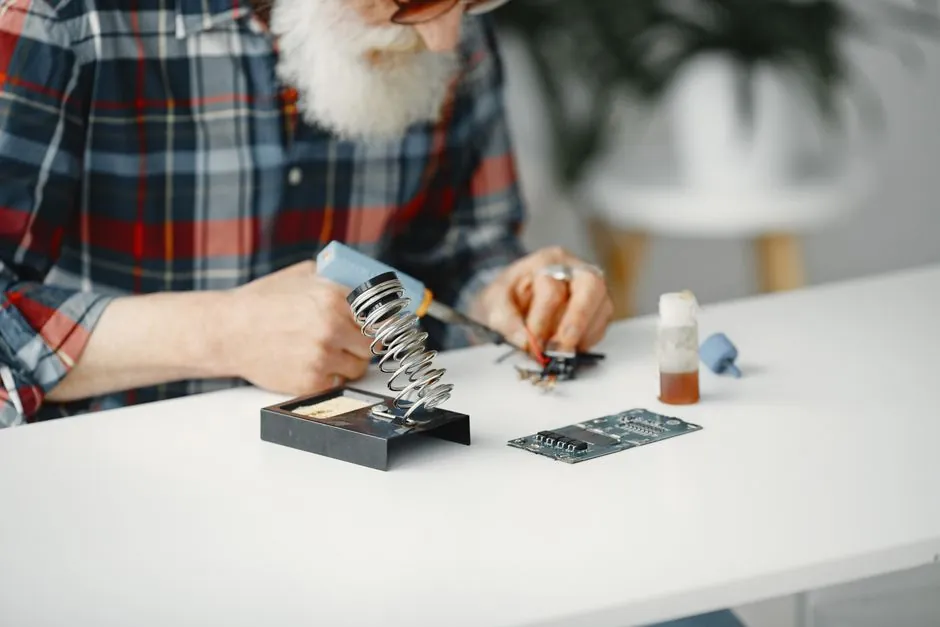
Electronics-grade vacuum packaging is defined by four hard gates: ultimate pressure below 1 mbar, ESD-safe contact surfaces, calibrated dry N2 or Ar backfill at 99.995% purity, and seal-bar temperature held to plus or minus 1.5 degrees C, and any chamber that cannot meet those four is a food sealer, not an electronics packer.
The scope below covers PCB, IC, sensor, connector, and SMT reel packaging for contract manufacturers and export operations, and assumes Class 3 IPC-A-610 acceptance plus J-STD-033 moisture-sensitive device handling as the baseline. A useful primer on the chamber-versus-pump trade-offs is the vacuum packaging machine selection reference; a complementary look at how those chambers integrate with material flow is in material handling and logistics packaging for the downstream pallet and transit side.
Why a Food-Grade Chamber Sealer Fails on PCBs
Most consumer and food-grade chamber units only reach 10 to 30 mbar absolute, and that ceiling is structurally inadequate for desorption of adsorbed moisture from FR-4 laminates and from under-bga and stacked-die cavities [S4]. A sub-mbar PCB line is built around a 316L stainless chamber electropolished to Ra 0.4 micrometres or better, dual-stage rotary vane pumps, and an inline oxygen analyzer with 10 ppm O2 detection limit plus a dew point sensor at minus 70 degrees C [S4]. The same reference notes that calibrated N2 or Ar backfill at 0.5 to 2.0 L/min through mass flow controllers is required for IPC-1601 dry-pack atmospheres, and 99.995% gas purity is the typical floor cited for moisture-sensitive device work [S4].
Static discharge is the other failure mode a food sealer ignores entirely, and Henkelman explicitly flags that electronic components can be damaged by electrostatic discharge during evacuation unless the machine, the bag, and the work surface are ESD-managed [S2]. Minipack-torre's SWING range is one example positioned for non-food work, and the supplier guidance for that line treats the chamber and seal cycle as the design variables rather than the food-grade hygiene surface [S1]. A useful contrast is the spec-by-spec chamber and pump gate methodology in vacuum packaging machine spec gates for e-commerce fulfillment, which uses the same chamber-and-pump framework but against a different risk profile.
Chamber, Pump, and ESD-Surface Trade-offs
The decision tree for an electronics packer is short, and the first branch is chamber material: 316L stainless for any chloride-bearing flux residue, salt-air export, or medical-grade ISO 13485 lines, with 304 acceptable on lid frames and external panels to control cost when the product stream is dry and benign [S4][S5]. The second branch is pump type: a 20 m3/h oil-sealed rotary vane is the workhorse and pulls roughly 100 Pa absolute in 10 to 25 seconds for a 30-litre load, while a 40 m3/h dry claw pump is preferred for any process where oil carry-over would poison the seal or contaminate the part, and 60 to 100 m3/h dry pumps are the floor for continuous-belt and MAP-style machines where cycle time is the bottleneck [S5]. For PCB lines specifically, a 20 m3/h-class pump on a 316L chamber must reach 0.5 mbar or better in 18 seconds, per the calibrated envelope used in one industrial PCB reference [S4].
ESD mitigation is not a chamber option, it is a system constraint, and the practical elements are static-dissipative work surfaces, ionizers over the load zone, ESD-rated bag stock, and a controlled atmosphere that does not itself become a triboelectric charging source during pump-down [S2][S4]. A useful decision matrix: chamber size from 400 by 380 by 75 mm (tabletop) up to 1200 mm length (bulk/continuous) sets the bag envelope, with double-chamber tables typically delivering 50 to 100 percent higher throughput than a single-chamber of the same cycle time by overlapping load and evacuate [S6][S7]. The risk in that range is that a continuous-belt machine built for 60 to 100 m3/h pump displacement is optimized for cycle time, not ultimate vacuum, and is the wrong pick for Class 3 MSD work even if the throughput number looks attractive [S5][S7].
Seal-Bar Heat Profile, Barrier Film, and Dwell
Seal-bar temperature for 60 to 80 micrometre PA/PE multi-layer film is typically 150 to 180 degrees C with a 1.5 to 3.0 second dwell, and the heating element is rated in watts per centimetre of bar, so a 400 mm bar drawing roughly 600 W is typical while high-speed bi-active bars draw around 900 W [S5]. For electronics-grade barrier stock, the laminate is usually 12 micrometre PET over 7 micrometre aluminium foil over 60 micrometre PE, with metallized CPP as the lower-cost alternative, and the seal station must hold plus or minus 1.2 to 1.5 degrees C across the bar to avoid cold-seal leaks in cold chain or burn-through at corners [S4]. PTFE-coated aluminium impulse jaws in the 80 to 220 degrees C envelope, with dwell programmable from 0.3 to 3.0 seconds, are the working configuration on programmable PCB packers [S4].
Chamber-versus-edge-sealer choice on electronics lines is one of the few cases where the chamber wins almost unconditionally: chamber sealers deliver a stronger seal, adjustable vacuum levels, higher moisture protection, and the ability to seal liquids and sensitive components, which is precisely the envelope electronics packaging needs [S3]. Edge sealers can be appropriate for very high throughput, low-moisture consumer goods where bag presentation matters more than ultimate pressure, but they should not be specified for bare PCB, IC tray, or wafer carrier work. The bar count itself is a through-put variable: single-bar chambers seal one bag per cycle, double-bar chambers seal two smaller bags at once, and each additional bar adds a transformer, a heating element, and a control circuit that the budget must absorb [S5].
Acceptance Tests, Leak Detection, and Throughput Targets
Post-pack leak detection on an electronics line is built around two standards, and the choice is driven by the failure cost: ASTM F1140 burst testing pressurizes the pouch to 120 kPa with a 30 second hold to pass, and that is the workhorse test for general PCB and consumer electronics [S4]. For medical-grade PCB assemblies on ISO 13485 lines, ASTM F2391 helium tracer leak testing at 5 percent He mix with mass spectrometer detection down to 5 times 10 to the minus 9 atm cc per second is the gate the line must clear, and any defective pouch is automatically rejected before palletizing [S4]. Promarks' chamber-cycle description matches that envelope: bag into chamber, vacuum drawn to a precise micron-level set point, seal bar fires, chamber refills, sealed product out [S3].
Throughput targets should be written in cycles per minute and bags per shift, not in pump horsepower, and a 1 kW chamber machine with a 20 m3/h pump running 6 cycles per minute draws roughly 6 kWh per operating hour, which is the number to multiply by shift count for total cost of ownership [S5]. Double-chamber layouts typically deliver 50 to 100 percent higher output than a single-chamber of the same cycle time by overlapping load and evacuate, which is why mid-volume electronics contract manufacturers tend to converge on a two-chamber table as the default floor [S6]. For oversized or export-carton work, chamber lengths up to 1200 mm with 60 to 100 m3/h pump capacity and pneumatic door operation define the high-volume end of the envelope [S7]. A vacuum packaging machine selection that ignores those throughput numbers will look correct on paper and bottleneck on the line within a quarter.
For Class 3 electronics, the practical floor is a 316L chamber with a 20 m3/h-class pump, 99.995% N2 backfill, ESD-safe work surfaces, a seal bar held to plus or minus 1.5 degrees C, and ASTM F1140 or F2391 leak test on every cycle, and a working signal to track is whether sub-mbar PCB-class machines shift further into double-chamber tables in 2026 as contract manufacturers chase both Class 3 acceptance and higher bags-per-shift throughput.