
A vertical lift module (VLM) is an enclosed, automated storage unit that delivers trays to an operator at an ergonomic bay, with one vendor's flagship platform scaling from 3,300 mm to 16,100 mm unit height, single-tray payloads to 990 kg, and throughput up to 120 trays per hour [S5].
VLMs sit inside the broader automated-storage landscape covered by VLM selection reference material, and they are now commonly specified alongside conveyors, AGVs, and WMS layers for spare-parts, tooling, and small-component storage, particularly where floor-space recovery is the primary driver [S3][S5].
Operating Envelope: Height, Payload, Throughput
VLM unit height is the single largest determinant of capacity, and the commercially common range spans 3,300 mm to 16,100 mm on a single platform, with the upper end enabling the high-density storage the format is known for [S5].
Trays are the storage primitive: payload per tray commonly extends to 990 kg, and throughput peaks near 120 trays per hour, with a single unit reported to displace manual shelving that would otherwise cover more than 300 m² of floor area [S5]. Dual-delivery configurations, where a second tray is pre-positioned while the first is picked, are documented as a productivity multiplier for higher-throughput duty cycles [S5].
For greenfield specification, the meaningful envelope numbers are height in mm, payload in kg per tray, and trays-per-hour at the delivery bay; these three values drive footprint, structural floor loading, and order-picking headcount planning.
Selection Criteria: Matching the VLM to the Operation
VLM is suited to operations holding thousands of SKUs of small-to-medium parts, with high pick frequency, restricted floor area, and a clean indoor environment; one VLM is reported as equivalent to a 2-5 person picking team in such settings [S5].
VLM is poorly suited to long, oversized, or very heavy pallet loads, very high bay-throughput environments where horizontal carousels or mini-load AS/RS dominate, or operations that cannot accept an enclosed cabinet footprint with ceiling-clearance constraints.
Decision criteria, in priority order for most buyers, are: (1) maximum single-tray payload versus the heaviest part or subassembly to be stored, (2) required peak hourly tray throughput, (3) unit height versus available ceiling and structural slab loading, (4) bay configuration (internal vs external, single vs dual delivery), and (5) WMS/ERP integration pathway [S3][S5].
Configuration Comparison: Internal vs External Bay, Single vs Dual Delivery
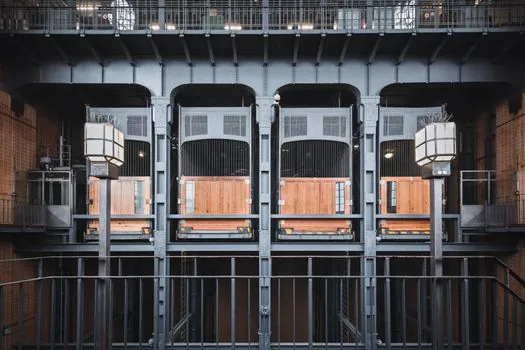
Internal-bay configurations minimise the cabinet footprint, which makes them the default when floor area is the binding constraint; external-bay configurations, where the operator stands outside the storage column, allow faster picking and easier integration with cranes or mechanical manipulators for heavy or bulky trays [S5].
Single-delivery bays are sufficient for lower-throughput duty, while dual-delivery bays, where a queued second tray is pre-staged during the pick cycle, reduce operator wait time and are documented as a productivity enhancer when paired with external-bay layouts [S5].
Comparing the four combinations on three common decision criteria, the layout that best fits a given site becomes visible:
<strong>Internal + single delivery:</strong> lowest footprint, lowest throughput, lowest integration cost; best for small parts stores and limited floor area. <strong>Internal + dual delivery:</strong> modest footprint with reduced wait time; useful when both floor and throughput are constrained. <strong>External + single delivery:</strong> larger footprint with faster pick ergonomics; typical for medium-throughput service parts. <strong>External + dual delivery:</strong> largest footprint, highest throughput, best manipulator/crane compatibility; typical for heavy-tool and spare-parts hubs [S5].
Integration Layer: WMS, ERP, and Controls
Software control is now treated as a primary selection axis, not an accessory, and the WMS layer is expected to expose real-time inventory, user authentication, and pick-traceability data to a host ERP [S3][S5].
One widely deployed WMS stack explicitly covers single or multiple VLMs as a first-class object, with order-batching, replenishment, and slotting rules that have been validated against live operational data in published academic work [S2][S3]. That same stack is positioned to integrate with SAP, Oracle, and Microsoft ERP environments through the VLM vendor's WMS, which is a hard requirement for most plant and DC retrofits [S5].
User authentication, tray-level access control, and full pick/refill traceability are standard WMS features, and visual picking aids (light, laser pointer, put-to-light) are commonly specified for accuracy and ergonomic reasons; the vendor's own material quotes a 2-3 times efficiency multiplier and a claimed 100% picking accuracy when these aids are combined with the WMS [S5].
Site Constraints and Failure Modes
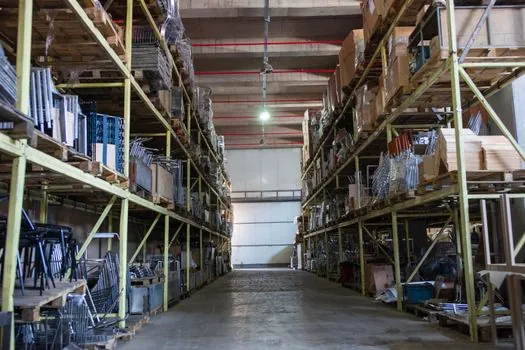
The most common VLM specification errors fall into three buckets: under-sized payload, under-sized height, and ignored ceiling-clearance, all of which force expensive retrofits after installation [S5].
Operational failure modes documented across the installed base include: (a) throughput bottleneck at the bay when single-delivery is specified but pick demand is dual-delivery class, (b) inventory inaccessibility during controller or network outages when no manual override exists, and (c) floor-loading miscalculation when the heaviest tray load is approached late in design [S5][S7].
VLMs also have to be planned against a smart-warehouse framework, where AGV/AMR traffic, conveyor hand-off, and WMS event timing have to be coherent; otherwise a VLM turns into a silo rather than a node in a larger flow, and the broader Industry 4.0 literature treats this integration gap as a recurring root cause of under-performing automated warehouses [S7].
Standards, Sourcing, and Vendor Selection
VLM hardware is generally treated as a CE-marked machine, with safety and electrical-conformity documentation expected at the quotation stage; for sites with food, pharma, or cleanroom adjacency, dust-sealed enclosed storage is itself a control point and is a documented VLM feature [S5].
Buyers should anchor the RFQ on a written spec: required unit height range (mm), maximum single-tray payload (kg), required peak throughput (trays/hour), bay layout (internal/external, single/dual delivery), WMS feature list, and ERP integration method, then require vendors to respond against that spec line by line [S3][S5].
Two practical trackable signals for any VLM evaluation in 2026 are: (1) the WMS layer's published support for multi-VLM order batching under live demand, which has a peer-reviewed operations-research track record [S2][S3], and (2) the vendor's documented maximum unit height and single-tray payload combination, which sets the hard ceiling on what the equipment can ever hold [S5].
Closely related industrial spec work on heavy-equipment selection, such as this crane selection map for mining sites, follows the same line-by-line RFQ discipline that VLM buyers should adopt, and the same applies to adjacent plant-equipment decisions like holding-furnace selection for automotive parts when a VLM sits next to a parts line.
Component reference pages worth checking: electrical automation, and linear module.