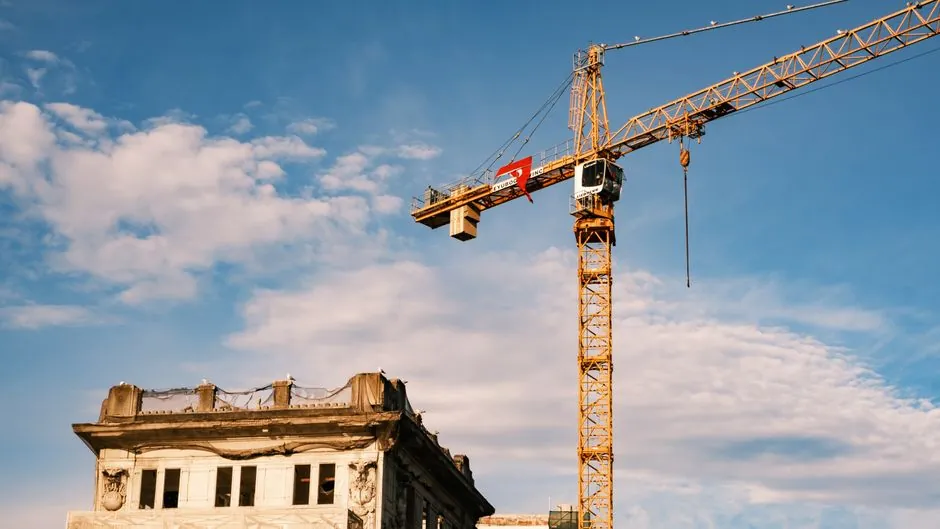
Open-pit and quarry lifting in 2026 is dominated by flat-top and luffing-jib tower cranes with 5 to 100 t and 8 to 18 t maximum load classes respectively, deployed to serve primary jaw crushers, conveyor transfer stations, and mill-shell maintenance bays [S1].
Unlike high-rise construction, mining duty cycles run 20 to 24 hours per day in dust-laden, often corrosive atmospheres, so the spec gates that drive selection (mast height, jib length, foundation base type, anemometer cut-out, and a documented quality system such as ISO 9001 with CE / RoHS / UL / ETL marking) carry more weight than pure tip-capacity marketing [S1][S4].
Where a tower crane fits, and where it does not
A tower crane is a reasonable fit for mining when the load is repetitive, vertically stacked (mill shell, conveyor gallery, cyclone replacement, crusher liner swap), and the lift radius is between roughly 20 and 70 m from a fixed base. In these cases, a flat-top or luffing-jib unit replaces a slow, ground-bound crawler crane and frees the pit floor for haul trucks [S1].
A tower crane is a poor fit for short-radius, mobile pit work (e.g. shovel boom replacement, dragline reeving, or routine truck loading) where a mining dump truck cycle or a mobile crane clears faster. The fixed foundation, climb-up sequence, and 30 to 60 m mast erecting cycle make tower cranes uneconomical below roughly 50 lifts per month on a moving face [S1][S2].
Spec gates that drive mining tower crane selection
Free-standing height governs whether tie-ins or a climbing frame are needed. Open-pit installations typically lock in 40 to 60 m free-standing before the first tie, with foundation bases in the 1.6 to 1.8 m fixing-angle format (P20A class, US $1,000 to US $1,700 per piece on 2026-08 quotations) [S4].
Jib configuration is the second gate. Flat-top (topless) designs save headroom under overhead power lines common at concentrator expansions, while luffing-jib units (e.g. D2520 class, 3 to 6 t at 25 to 50 m radius) let two cranes work in overlap on tight mill sites without slewing interference [S1][S5].
Wind and environmental loading is the third gate. CE-certified wireless anemometers (US $560 to US $580 per piece) are specified as standard, with cut-out thresholds typically set at 72 km/h operational and 100 km/h out-of-service, although OEMs allow site re-calibration. Corrosion-resistant mast sections, galvanized tower bolts, and stainless slew-ring gear covers are the usual countermeasures for sulfide dust and process-water mist [S4][S5].
Head-to-head: flat-top vs luffing-jib vs topkit for mining
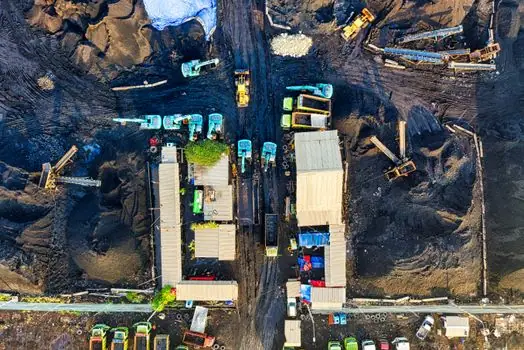
For a one-to-one comparison, three configurations cover the bulk of 2026 mining tower crane orders [S1][S5]:
1. Flat-top (topless) tower crane: max load 5 to 100 t, jib up to 80 m, lowest boom apex (around 5 m above the jib), best for sites with overhead lines or tight multi-crane overlap. Disadvantage: larger counter-jib footprint.
2. Luffing-jib tower crane: max load 8 to 18 t (D2520 example at 3 t tip / 6 t max), jib 25 to 50 m, vertical luffing motion, ideal for tight urban-adjacent mill sites or when two cranes must overlap. Disadvantage: more complex hoist rope reeving, higher maintenance hours per 1,000 lifts.
3. Topkit (cat-head) tower crane: a traditional hammerhead design with a fixed A-frame apex; still widely deployed for quarry face work where the apex height does not interfere with highwall or power lines, and where reeving simplicity matters.
Across cost, headroom, overlap capability, and maintenance hours, flat-top wins on headroom and overlap, luffing-jib wins on radius-to-footprint, and topkit wins on simplicity and lowest spares holding [S1][S5].
Foundation, anchoring, and the parts that decide the spec
The foundation system is the single largest non-crane cost line. Standard P20A 1.6 m fixing angles and 256/290HC mast-section fixing angles list at US $1,000 to US $1,700 per piece, and a typical 40 m free-standing installation needs 4 to 8 such bases plus the foundation leg itself [S4].
Trolley chassis and wire-rope sheaves are the next cost layer, with 500 kg-class trolley chassis at roughly US $600 to US $800 per piece on 2026-08 quotations, and 6 to 8 hole reusable fixing angles commonly stocked as spare parts to cut rebuild downtime during mill shutdowns [S4]. Carbon-brush holders sized for Zoomlion-class drives are catalog items and are typically held in 1:2 ratio per installed crane [S4].
A reliable anemometer cut-out chain is not optional at mining sites. CE-marked wireless units (US $560 to US $580 per piece) feed both the crane PLC and the plant SCADA, so a single sensor failure does not silently disable the wind-speed interlock [S4].
Standards and quality gates to verify before order
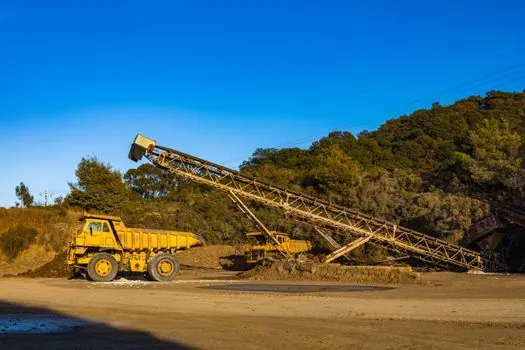
First, confirm the manufacturer's quality system at the certificate level. Reputable 2026 Chinese OEMs hold ISO 9001 plus CE, and top-tier lines additionally carry RoHS, UL, and ETL for North American sites [S1].
Second, verify the machine-level conformity: EN 14439 for tower cranes (the European harmonized standard covering structural design, slewing, and load-chart limits) should be on the nameplate or in the technical file, alongside FEM 1.001 or equivalent for hoisting mechanism classification. Without these, insurance underwriters at mine sites routinely reject the lift plan.
Third, confirm operator and signaling certification. Tower crane operator tickets (e.g. CPCS A04 in the UK, NCCCO in the US, or the equivalent national scheme) are site-mandated and should be cross-checked against the rigger-to-crane ratio on the lift study.
Operating economics and rental versus purchase
For projects under 9 to 12 months, rental dominates. Suppliers such as NIBM Tower Cranes structure their offer around monthly rental with a site-evaluation pass at contract start, equipment assessment, and consulting on crane selection, site planning, and logistics, which is the right entry path when a mining client has only one or two campaigns to run [S3].
For 18 to 24 month mine-life or concentrator builds, purchase becomes competitive once lift counts exceed roughly 600 to 800 cycles per month, because the rental day rate on a 12 t class (e.g. QTZ250 7020 with L68B mast sections) approaches 1.0 to 1.2 percent of capital per 30-day month, the threshold where amortized ownership undercuts rental [S5].
Used units are a third path. A 2019-built 12 t QTZ250 with documented L68B mast sections is a known-good configuration that re-deploys quickly into a quarry, but only if the seller supplies full load-chart binders, slewing-ring NDT records, and a recent rope discard schedule [S5].
Sourcing, vetting, and common failure modes to watch
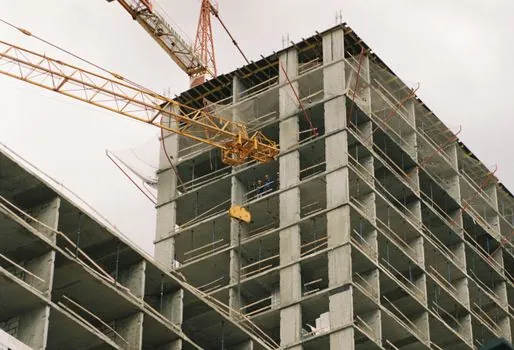
Vetting a new OEM is straightforward if the ask list is tight: ISO 9001 certificate number, CE / UL / ETL file references, list of the last 10 deliveries with client contact, mast-section mill certificates (usually Q345B or equivalent), and a copy of the standard EN 14439 design review [S1][S5].
Three failure modes recur on mining tower crane fleets. (a) Slew-ring bolt loosening from vibration on fixed bases, mitigated by re-torque at 500-hour intervals. (b) Corrosion-driven wire-rove deterioration at the hoist drum, mitigated by monthly lubrication and quarterly visual on the crossover zone. (c) Anemometer ice-load in winter sites, mitigated by heated sensor heads and redundant mechanical wind cups [S4].
Cross-reference adjacent lifting decisions where the same engineering trade-offs apply. The pipeline truck-mounted crane selection: 50 t class, dual drive, 48 m reach note covers mobile alternatives for pipe-yard work, while the jib crane selection guide: capacity, rotation, mount, and spec gates is the right read when the radius is below roughly 10 m and a wall- or column-mounted unit is sufficient. For lighter ancillary equipment, the rebar threading machine selection for steel construction: 2026 spec map covers the rebar prep side of mill builds, a frequent adjacent purchase.
Two trackable signals for the next quarter: any 2026-08 to 2026-10 tender for a 40 m plus free-standing mining tower crane with a 60 m plus jib, and any OEM price move on P20A 1.6 m fixing-angle bases outside the US $1,000 to US $1,700 band. Either will reset the spec gate in the next update.
Component reference pages worth checking: tower crane, and signal tower light.