
FFT vibration analyzers in the 2026 market are split between portable single-axis spot meters (typical 0.5–199.9 mm/s, ISO 10816-class) and 4-channel simultaneous noise-and-vibration platforms with 10 Hz–80 kHz analysis bandwidth, –110 dBV noise floor, and Modbus RTU triggering over RS-485 [S1].
The current portable-vibration-meter category on DirectIndustry lists 53 manufacturers and 102 products, while data-logging variants aggregate 18 manufacturers / 29 products and human-vibration analyzers (ISO 8041-1:2017) sit at 8 manufacturers / 12 products [S2][S3][S5]. The breadth matters: a buyer comparing on spec alone will trip on sensor physics, channel count, and applicable ISO clause.
Frequency Range, Noise Floor, and Channel Count
The first decision cut is bandwidth. The CRY2304 covers 10 Hz to 80 kHz with a –110 dBV noise floor and 4-channel synchronous acquisition, paired with ICP-powered BNC inputs so the same front end handles microphones and accelerometers [S1]. Polytec's VibroScan pushes the other direction — laser-Doppler vibrometry, four-channel, SWIR-capable, and rated for hazardous locations [S4]. For rotating-machinery fault frequencies (1×, 2×, bearing race trains typically 50–500 Hz on small machines, up to several kHz on high-speed spindles), the 80 kHz ceiling of a USB-2.0 FFT front end is comfortably overspec; a laser unit earns its price on non-contact or hot-surface targets [S1][S4].
Channel count drives both price and workflow. A two-channel handheld suffices for spot readings against ISO 10816-3 evaluation zones (Zones A/B/C/D), while a four-channel system is the minimum for cross-axis phase analysis on couplings or for simultaneous acoustic-and-vibration capture in NVH work [S1][S2]. Buyers should treat "multichannel" as 4+ unless the datasheet says otherwise; many catalog entries flag "multichannel" on two-channel hardware.
Sensor Type: Accelerometer, Velocitity Probe, and Non-Contact
Contact piezoelectric accelerometers remain the workhorse — 100 mV/g class units dominate handheld kits, and ICP (IEPE) 4 mA constant-current excitation is the de facto interface on 2026 FFT analyzers, including the CRY2304's BNC inputs [S1]. For low-frequency (sub-10 Hz) structural work, geophone-style velocity probes are still specified because accelerometers integrate noise badly under 1 Hz.
Non-contact options are no longer exotic. Polytec's VibroScan family adds laser vibrometry, balancing, and helicopter-engine monitoring to a single portable chassis, which removes the mass-loading problem on lightweight panels and stops the sensor from changing the thing it's measuring [S4]. For hazardous or high-temperature surfaces (turbine casings, exhaust manifolds), non-contact is the only viable route; budget 5–10× over an equivalent accelerometer channel. Optical encoders and eddy-current probes sit between these poles for shaft-relative vibration on turbomachinery [S1][S4].
Standards Anchor: ISO 10816, ISO 8041, and ISO 2631
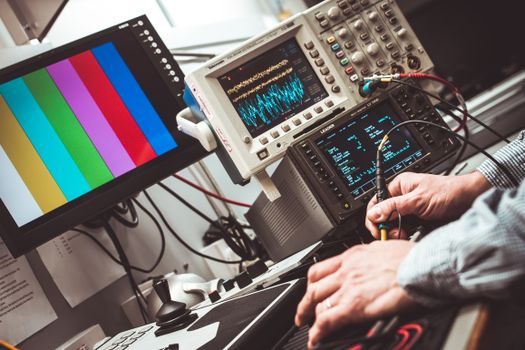
Selection collapses once the governing standard is fixed. For machine-condition monitoring the relevant clauses are ISO 10816-1 (general), -3 (industrial machines), -6 (reciprocating), and -7 (rotodynamic pumps); handheld meters such as the Lutron VB-8100 (ACC 0.5–199.9 m/s², VEL 0.5–199.9 mm/s, DISP 1.999 mm) and BALTECH VP-3407 explicitly cite ISO 10816 conformance [S2]. For human exposure, ISO 8041-1:2017 is the controlling document; SVANTEK's SV 106A six-channel human-vibration meter and Metra's VM31 both declare compliance, and whole-body vs hand-arm selection follows ISO 2631-1/2/5 plus ISO 5349 plus EU Directive 2002/44/EC [S2][S3].
Where bearings are concerned, VDI 3832 (rolling-element bearing condition) appears on condition-monitoring vibration meters, and SKF's production-line bearing vibration analyzer is a specialized offshoot of the same FFT family that probes bearings under load — useful as a reference design but not a portable field instrument [S2][S10].
Selection Matrix: Handheld vs Data-Logger vs Multichannel FFT
For a maintenance engineer choosing between three realistic options, the criteria cut cleanly. A handheld spot meter (Lutron VB-8100, BALTECH VP-3407) covers 0.5–199.9 mm/s velocity, 1.999 mm displacement, runs on 6× AA cells, and weighs under 1 kg; it is the right tool for ISO 10816 spot checks and route-based rounds but cannot store waveform data for trend analysis [S2].
A data-logger vibration meter (PCE Deutschland, Polytec, PRÜFTECHNIK, Adash entries in the 18-vendor list) adds onboard storage and post-survey download, which suits intermittent monitoring on assets that do not justify a permanent system; pricing typically sits 2–4× above a basic handheld [S5]. A multichannel FFT analyzer (CRY2304, Polytec VibroScan) is justified when the buyer needs synchronous 4-channel acquisition, frequency-domain diagnostics beyond overall RMS, or non-contact sensing — and accepts the higher unit cost and PC-tethered workflow [S1][S4]. For condition-monitoring budget planning, the Condition Monitoring System Price and Cost Guide (2026) maps where analyzer hardware sits inside the lifecycle spend.
Data Logging, IO, and Field Integration
2026-vintage portable analyzers now treat data logging and industrial IO as table stakes. The data-logger category explicitly tags 18 manufacturers with 29 products, and the "with data logger" filter returns units from ACOEM, Adash, BALTECH, Hottinger Brüel & Kjaer, Lutron, PRÜFTECHNIK, PCE, Polytec, and SVANTEK, among others [S5]. On the integration side, the CRY2304 exposes 6× 5 V digital outputs, 6× 5 V digital inputs, 6× 12 V digital outputs (each rated 200 mA for load driving), RS-485 with Modbus RTU, and a Windows 7/10 host application — enough to trigger an instrument test, pull a custom dataset, and drive a pass/fail relay on the production line [S1].
Buyers running a route-based program should not over-spec IO; USB-C download and CSV export cover most plant rounds. Buyers integrating to a SCADA or asset-management platform should treat Modbus RTU, OPC-UA, or vendor-native APIs as required, not optional. SKF's bearing-vibration analyzer — used on production lines for half a century — shows the other end of the integration story: fixed test sequences, automated pass/fail, and direct PLC handshake rather than operator post-processing [S1][S10].
Human-Vibration vs Machinery-Vibration: Pick the Right Class
Do not specify a machinery FFT analyzer for hand-arm or whole-body exposure surveys, and do not specify a human-vibration meter for pump monitoring. The two classes have different filters, different weighting (W_h for hand-arm, W_k and W_d for whole-body), and different regulatory anchors: ISO 8041-1:2017 plus EU Directive 2002/44/EC for humans, ISO 10816-3/-6/-7 plus VDI 3832 for machines [S2][S3]. The SV 106A, PCE-VM 31-HAWB, Casella HAVEX, and Larson Davis HVM100 are purpose-built for the human side, with tri-axial accelerometers at the seat pad or tool interface rather than magnetic-mount machine pickups [S3].
The economics also diverge. Hand-arm meters (Pulsar vB, Casella HAVEX) run as single-purpose instruments at a lower price point than the six-channel SV 106A or full SC310 sound-and-vibration module, because the legal exposure limit is a single daily A(8) value rather than a spectrum [S3]. Buyers working across both domains should budget for two instruments, not one compromised one.
Forensic and Diagnostic Capability: Fluke 810, AMS 2140, and Balanset
At the diagnostic end, fault-identification firmware differentiates a $5K handheld from a $25K analyzer. The legacy Fluke 810 vibration tester introduced onboard identification and location of bearing, misalignment, unbalance, and looseness faults with a four-level severity scale — the de facto reference for "automatic diagnosis" in this class [S8]. The AMS 2140 Machinery Health Analyzer, widely referenced in 2026 procurement listings at roughly US$6,155–6,200 per piece, sits a tier above with route-based data collection, deeper waveform capture, and Emerson's CSI-style database [S7].
For balancing-driven buyers, the Balanset portable balancer-and-analyzer combines a single-plane / two-plane field balancer with vibration readout, cutting the truck-roll when an unbalance trip is the suspected root cause [S6]. An engineer with a finite budget should pick diagnostic depth that matches the failure modes on the asset list: bearings and misalignment on fans/pumps are well-served by the Fluke 810 class, while precision balancing on grinding spindles or paper-machine rolls is where the AMS 2140 or a dedicated Hofmann EB 3500 grinder-balancer earns its keep [S2][S7][S8].
When a Handheld Is the Wrong Tool
A portable spot meter is a poor choice for slow-speed machinery (below 600 rpm, where 1× falls under 10 Hz and accelerometer noise floor dominates), for trend-based predictive programs (handhelds do not produce the continuous time-series that statistical alarming needs), and for any measurement where mass loading would change the reading (thin-walled panels, MEMS structures, helicopter blades in flight) [S1][S2][S4]. A handheld is also the wrong tool when the legal record is an ISO 8041-weighted human-exposure value: those measurements require a tri-axial seat-pad or hand-arm fixture, not a magnetic accelerometer on a bearing housing [S3].
The right tool in each case is a low-frequency velocity probe or seismic accelerometer, a permanent vibration data collector tied to an asset-management database, and a laser vibrometer respectively [S1][S4]. For buyers comparing data-collector hardware, the Tachometer Price 2026: Cost Drivers, Sensor Comparison, and Lifecycle Spend guide and the Condition Monitoring System Price and Cost Guide (2026) frame the price band a 2026 analyzer sits inside. Background on how vibration analyzers fit alongside servo and harmonic-control hardware is covered in the Top Servo Drive Companies 2026: Vendor Map, Spec Signals, and Selection Criteria article and the Active Harmonic Filter vs Static Var Generator: Spec Map and Selection Logic comparison.
Shortlist Logic and Trackable Signals
A defensible 2026 shortlist starts with the governing ISO clause (ISO 10816 for machinery, ISO 8041-1:2017 for humans, VDI 3832 for bearings), then filters on frequency range, channel count, sensor class, and IO. A maintenance team running ISO 10816 routes on rotating equipment should standardize on a handheld with displacement and velocity bands (Lutron VB-8100, BALTECH VP-3407), a data logger for intermittent assets, and one multichannel FFT analyzer (CRY2304 class) for shop-floor diagnostics [S1][S2][S5]. Trackable 2026 signals: vendor disclosures of ICP/IEPE support, Modbus RTU or OPC-UA on the IO list, and explicit ISO 10816 / ISO 8041-1:2017 / VDI 3832 citations in the datasheet — these are the markers separating a serious instrument from a rebranded displacement gauge.
The underlying component specifications are covered under vibration analyzer, vibration meter, and vibration sensor.