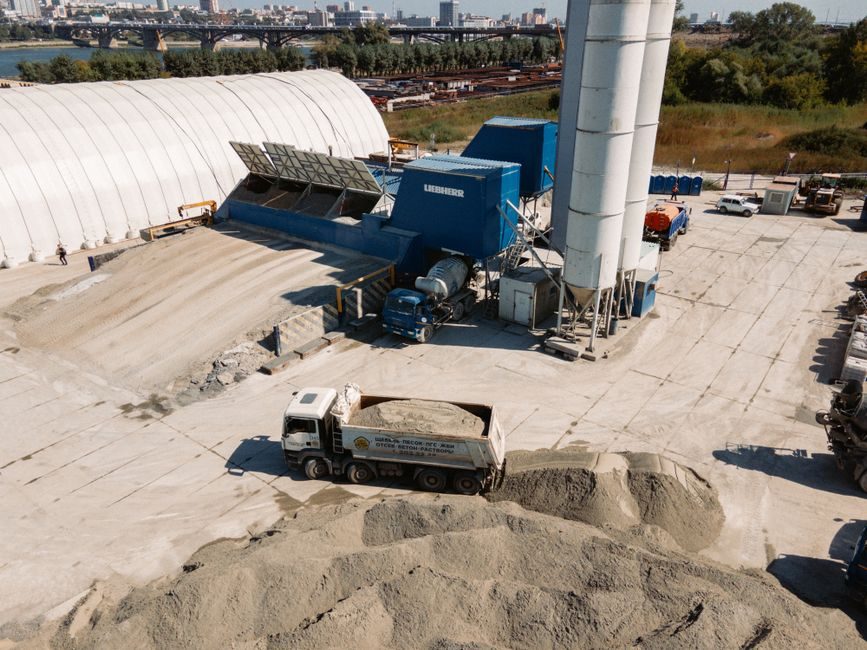
Warehouse construction in 2026 is a three-mortar problem: the floor screed consumes the largest tonnage, the block-work mortar determines wall thermal-mass behaviour, and the anchor grout under racking uprights is a small volume with the highest failure cost. Specifying all three from one generic product line is the single most common cause of slab cracking and rack-pullout callbacks on logistics builds [S3].
Dry-mix mortar — a factory-blended, water-activated powder of cement, sand, and additives — has displaced site-mixed cement:sand on logistics builds because it delivers consistent water-cement ratio and predictable additive dosing. WACKER's 2026 special-applications training explicitly positions dry-mix systems as the only viable route for specifiers who need documented polymer, cellulose-ether, and fibre content per batch [S1].
Floor Screed: EN 13813 Class and Traffic Load
The dominant warehouse floor spec in 2026 is a cementitious self-smoothing screed to EN 13813, class C25–C35 for forklift-only traffic, escalating to C35–C40 with steel-fibre reinforcement where VNA (very narrow aisle) trucks impose point loads above 50 kN per wheel. A 100 mm thick slab at 2.3 t/m³ places roughly 230 kg/m² of screed, and a 5,000 m² box-store fit-out therefore consumes on the order of 1,150 t of dry powder — typically delivered by 30 t bulk-tankers rather than bagged pallets [S2].
For bonded screeds on a structural slab, surface tensile strength must exceed 1.5 N/mm² before the screed is placed, and the screed's own flexural strength at 28 days is the spec most warranty claims turn on. A typical bonded warehouse screed mix delivers 6–9 N/mm² flexural at 28 days when laid at 30–50 mm; unbondened or floating screeds over insulation step down to 4–6 N/mm² and require movement joints at no more than 6 m centres [S1].
Masonry Walls: EN 998-2 and Block Type
Block-work mortar for warehouse perimeter and internal divider walls falls under EN 998-2, with class M5 (≥5 N/mm² compressive) the common minimum for 440 × 215 mm dense concrete block, dropping to M4 for lightweight aerated block where thermal performance drives the wall design. A 100 mm lightweight-block partition typically uses 35–45 kg of dry mortar per m² of wall, against 55–70 kg/m² for a 215 mm dense-block leaf [S3].
For external leaf build-ups that combine thermal insulation with structural duty, a lightweight mortar with a declared dry bulk density below 1,300 kg/m³ avoids cold-bridging the insulation line. Polymer-modified thin-bed mortars (1–3 mm joint) are not a substitute on warehouse blocks: their bond area is too small for the shear loads imposed by racking-fixity detailing, and a 10 mm general-purpose M5 remains the safe default for any wall carrying a structural anchor [S1].
Racking Anchor and Base-Plate Grout
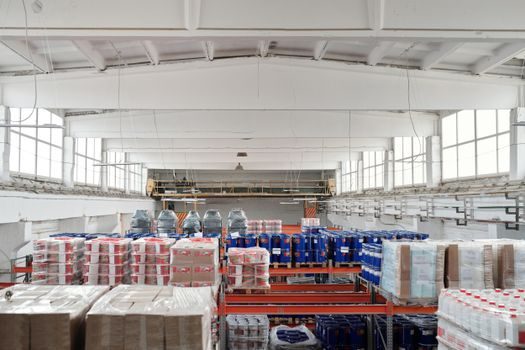
Anchor grout under pallet-rack base plates and mezzanine stanchions is the lowest-volume, highest-consequence product on the warehouse schedule. A dynamic pallet-rack upright under seismic or forklift-impact loading can impose 30 kN of uplift per anchor, and a standard cement:sand site mix is no longer accepted by the major rack OEMs because it cannot guarantee the ≥45 N/mm² compressive strength and ≥8 N/mm² tensile bond to clean concrete that the anchor design assumes [S2].
Use a shrinkage-compensated, polymer-modified cementitious grout with a declared ≥C50 compressive class, pourable but not self-levelling, and with a working time of 30–45 minutes so the upright can be plumbed before initial set. Minimum 25 mm grout thickness under the base plate, with 50 mm preferred for impact-loaded mezzanines — thicknesses above 100 mm must be filled in lifts to avoid thermal-build shrinkage cracking. The same grout family is used for column-base plates under rack-supported mezzanines and for door-frame reveals that take repeated forklift impact [S3].
Production Capacity and Site Logistics
Dry-mortar plant throughput for a single 5,000 m² warehouse build rarely justifies a dedicated on-site batching plant; instead, supply is drawn from a regional dry-mortar plant running a 10–15 t/h automatic line with a bolted cement silo and bulk-storage tanks for sand and additives. Lines in this class deliver annual output above 50,000 t, with daily truck-out capacities that can cover the 1,000+ t of screed a single shed needs within 5 working days [S2].
On-site, the key logistics are silo placement, dust collection, and automatic valve-bag filling for the small-quantity items like anchor grout and tile adhesive that arrive bagged rather than blown. A 60 t bolted cement silo serves a 10–15 t/h line and can be relocated between sites, and screw conveyors with dust collectors on the silo vent keep particulate emissions inside the typical 20 mg/m³ environmental limit. For inner-city retrofits, a 2–3 t/h semi-automatic line in a 20 ft container footprint is a workable alternative where a full-size plant cannot be permitted [S3].
Comparison: Which Mortar Goes Where
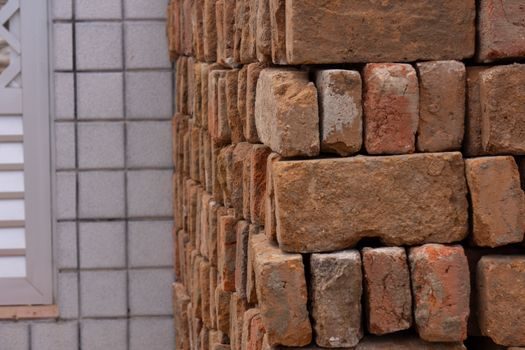
A warehouse typically uses three to five distinct dry-mortar products, each picked to a specific duty cycle. The decision matrix below lines the four main mortar families against the four most common warehouse applications, with the practical trade-off in plain numbers [S1][S3].
Cementitious screed (EN 13813 C25–C40) is the only correct choice for floor screeds above 30 mm — high volume, low unit cost, pumpable, and proven under forklift traffic. Lightweight masonry mortar (EN 998-2 M4 with density <1,300 kg/m³) is correct for aerated-block perimeter walls where thermal performance matters, but it is wrong for any wall carrying rack anchor loads. General-purpose M5 (EN 998-2 M5, density ~1,800 kg/m³) remains the safe default for dense-block partitions, given its 5 N/mm² compressive class and 10 mm joint that delivers a bond area large enough to take shear from rack-fixity detailing. Polymer-modified anchor grout (≥C50, shrinkage-compensated) is the only product that delivers the 8 N/mm² bond strength and 30-minute working time the racking OEMs require for base-plate pours. Across the four applications, screed drives 80% of tonnage, M5 masonry drives 12%, lightweight wall mortar 6%, and anchor grout under 2% — but the anchor grout has the highest unit price and the highest warranty risk, and cutting it is the most common specification error on speculative-build warehouses [S2].
Limitations and Common Failure Modes
Three failure modes dominate warehouse mortar callbacks. First, slab screed cracking from being placed over a substrate that was not mechanically prepared or not primed — the screed debonds, curls at the joints, and the joint pattern migrates up through the surface. Second, lightweight-block walls cracking at window and door reveals because the mortar was not paired with bed-joint reinforcement, typically a 1.5 mm ladder-type mesh every third course. Third, rack base-plate grout failing under uplift because the pour thickness was below the 25 mm minimum or because the grout used was a site-mix rather than a factory-blended shrinkage-compensated product [S3].
All three failure modes are specification errors, not product defects. None of the factory-blended products in current WACKER training or in the standard 10–15 t/h dry-mortar line range can compensate for a substrate that has not been prepared, a block that is not wetted to the correct surface moisture, or a base plate that has not been levelled before the grout pour. Anchor grout has the shortest shelf-life of the family — typically six months in dry storage — and a bag that has been exposed to site humidity for more than a few days must be discarded, not re-blended [S1].
Standards, Sourcing, and Cross-Reference

Dry-mortar selection in the EU and UK sits on three core standards: EN 13813 for screeds, EN 998-2 for masonry mortars, and EN 1504 for the repair and anchoring grouts used under rack base plates. Outside Europe, ASTM C109 (compressive strength on 50 mm cubes) and ASTM C472 (masonry mortar) are the closest equivalents, and a 2026 European specifier exporting a warehouse design should map the EN class to the local standard rather than assume parity. Polymer content, cellulose-ether dosage, and fibre type are declared on the bag and on the plant's mill certificate, and a class-5 N/mm² EN 998-2 mortar with a 0.2% redispersible-polymer addition will deliver measurably better bond on aerated block than a plain M5 of the same compressive class [S1].
Cross-reference to other dry-mortar selection guides on the platform: Dry-Mix Mortar Selection for High-Rise: Strength, Shrinkage, Pump Grade covers the vertical-pump duty cycle that warehouse self-levelling screeds share with high-rise floor builds, and Dry-Mix Mortar Selection for Schools: 2026 Spec Map covers the higher-abrasion public-traffic class that is one step above warehouse forklift duty. For the dust-collection and silo hardware that supplies the on-site plant, the dry-mortar plant and Han Cheng dry-mix mortar plant catalogues document the standard 2–3 t/h containerised and 10–15 t/h site-plant configurations; for the bagged grout side, the dry-mortar storage tank and valve-bag filling product lines cover the 30 t silo-to-site loop.
Component reference pages worth checking: dry mortar, ready mix concrete, and dry type transformer.