
29 CFR 1910.146, the OSHA Permit-Required Confined Spaces standard for general industry, defines a confined space as a space large enough for bodily entry, with limited or restricted means of entry or exit, and not designed for continuous employee occupancy, with examples including tanks, vessels, silos, storage bins, hoppers, vaults, and pits [S1].
The same standard assigns duties to authorized entrants, attendants, and entry supervisors, and it requires acceptable entry conditions before any worker breaks the plane of an opening into the space, but the regulation itself does not specify a colour, width, or material for the barricade tape used to mark the perimeter [S1]. Selection therefore falls to site engineering judgement, informed by common industrial practice: 3 inch (75 mm) wide non-adhesive barricade tape printed with "Danger Confined Space / Do Not Enter" wording, supplied in 500 ft or 1000 ft rolls, with PE or reinforced PP material options at 3 mil, 4 mil, or 5 mil thickness [S4].
What 1910.146 Actually Says About Marking the Entry
1910.146(b) defines "entry" as occurring "as soon as any part of the entrant's body breaks the plane of an opening into the space," and it requires a written entry permit (1910.146(f)) controlling that entry, but the standard does not name a tape product, colour code, or anchorage method [S1].
In practice, sites mark the access point, the attendant station, and the equipment staging area using warning tape so the controlled zone is visible from the approach direction, while the permit, atmospheric testing, and rescue plan carry the legal weight inside the space [S1][S4]. A 2 inch text height option is available when floor-level openings, access ladders, or wide plant walkways require larger visual recognition [S4].
Material and Thickness Options for Short Versus Long Duration
For typical indoor or covered work around tanks, pits, manholes, and similar openings, 3 mil or 4 mil PE tape (including LDPE) is light, quick to pull, and easy to tie around posts, rails, cones, or temporary barrier frames [S2][S4]. A common commercial SKU, 3 inch wide by 1,000 ft long LDPE "Confined Space Entry by Permit Only" yellow tape, lists at roughly $16.59 per roll, putting the material cost in the same range as general-purpose barricade tape [S2].
For outdoor locations, openings near airflow, repeated shift handling, or longer maintenance windows, a 5 mil reinforced PP option gives better resistance when the tape is pulled, re-tied, or exposed to wind, and is the practical choice when a 24 to 72 hour reference perimeter must remain readable without re-tensioning [S4]. Anchoring is by tie, staple, nail, or attachment to post, cone, rail, or barrier frame rather than by adhesive, because the tape must come down cleanly at job end without contaminating the rim of a manhole, hatch, or vessel nozzle [S4].
Colour, Print, and Width Criteria
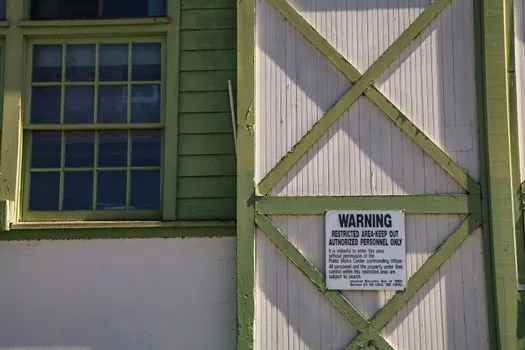
Two colour formats dominate confined space barricade tape: red/white/black "Danger" wording for the restricted opening itself, and yellow/black "Caution" or "Permit Required" wording for the surrounding controlled zone, with the specific print pattern of "Danger Confined Space / Do Not Enter" being more directive than a generic red warning roll [S3][S4]. A warning sign at the access point can carry the same wording in a more permanent format, complementing the tape during the entry window [S5].
The 3 inch (75 mm) width is the de facto standard because it gives enough surface for the repeating high-visibility warning text to stay legible from 3 to 6 m away, the typical worker approach distance at a manhole or hatch [S4]. Narrower 2 inch hazard tape is sold for general work-zone marking, but for floor-level openings and access ladders the wider roll is preferred because the warning text height, often around 2 inch, scales with roll width [S6].
Comparison of the Main Tape Options for Confined Space Use
Four practical options line up against the criteria that matter on a permit job: 3 mil PE, 4 mil PE, 5 mil reinforced PP, and reinforced detectable warning tape for buried utility work. Cost per foot is lowest for 3 mil PE and roughly comparable between 4 mil PE and 5 mil PP, while outdoor durability ranks in the opposite order, with 3 mil PE suited only to short indoor shifts and 5 mil PP holding up across 24 to 72 hour reference perimeters [S2][S4].
Print legibility is similar across all three PE and PP rolls when the warning text height is 2 inch and contrast is red/white/black or yellow/black, but reinforced detectable tapes used for underground utility marking carry a different message set and are not a substitute for the "Danger Confined Space / Do Not Enter" wording required at the access point [S8]. Where the entry point is also adjacent to excavation or buried service work, both products may be deployed: detectable tape below grade for utility protection, and surface barricade tape above grade for entry control [S8].
Limitations and Common Misuses
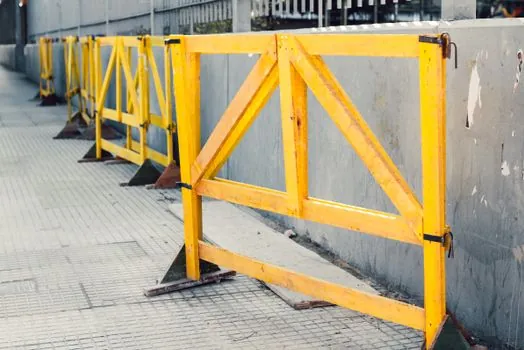
Barricade tape is a visibility control, not a physical barrier; a worker who chooses to step over or duck under the tape has not been prevented from entering, which is why 1910.146 still requires the attendant role, the written permit, and atmospheric testing regardless of how the perimeter is marked [S1]. Tape left in place for more than one work week, or exposed to solvent splash, can lose print contrast and should be re-checked for readability from the approach direction rather than relied on for the next shift [S4].
Using generic red "Danger" tape without the "Confined Space / Do Not Enter" wording dilutes the signal at sites where multiple hazards are taped off, and over-taping an entire room rather than the access point and attendant station wastes material and obscures emergency egress paths [S4][S6]. For plant walkways and access ladders where a more durable message is needed, a printed warning sign at the rim of the opening is the appropriate complement to the perimeter tape [S5].
Selection Checklist and Trackable Signals
A spec-first pick for a typical indoor tank or manhole entry: 3 inch wide, 1,000 ft roll, 3 mil or 4 mil PE or LDPE, "Danger Confined Space / Do Not Enter" or "Confined Space Entry by Permit Only" wording, yellow/black or red/white/black colour, non-adhesive, tied to existing posts or a temporary barrier frame [S2][S4]. For outdoor or multi-shift work, step up to 5 mil reinforced PP, and consider a printed sign at the rim where the perimeter wraps a hatch or ladder [S4][S5].
Two signals to track: OSHA citations under 1910.146 continue to focus on atmospheric testing, permit content, and rescue provision rather than tape selection, so procurement can be driven by site ergonomics and re-use cost; and 5 mil reinforced PP remains the most common spec for refinery and wastewater shutdown work where the perimeter stays up across multiple 12 hour shifts [S1][S4]. For related spec work at chemical and electrical sites, the insulated tool selection spec map and the insulated tools selection spec map follow the same decision-first logic for adjacent PPE categories.
Spec-level background on the components involved: pressure transmitter.