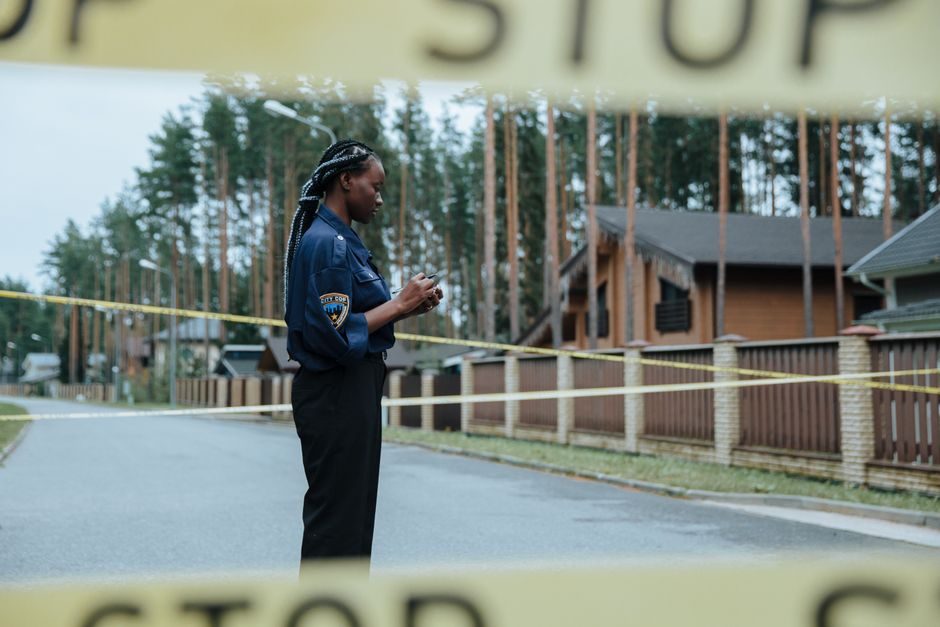
Warning tape is a non-detectable colored polyethylene or PVC film, typically 0.05-0.20 mm thick and 50-300 mm wide, specified as a visual alert for buried utilities, construction perimeters, and live-line marking. Standard color codes align with APWA (American Public Works Association) conventions: red = electric, yellow = gas, blue = water, green = sewer, orange = telecom [S1].
The product is sold by the roll (commonly 100 m or 305 m), with unit cost from under $0.10/m for commodity PE film up to $0.80-1.50/m for reinforced, detectable, or foil-backed variants. Annual global consumption sits in the hundreds of millions of linear meters, and the category is dominated by Chinese and Indian converters supplying construction, utility, and PPE distribution channels.
Material Construction and Mechanical Limits
Polyethylene film at 0.05-0.20 mm gauge delivers tensile strength in the 15-30 N/cm range, with elongation at break typically 150-300% for LDPE and 80-150% for HDPE grades. PVC variants push tensile to 30-50 N/cm but raise low-temperature brittleness: standard PVC warning tape cracks at -10°C to -20°C, while PE grades retain flexibility to -30°C to -40°C [S1].
Maximum service temperature for commodity PE is 70-80°C, beyond which the film softens, distorts, and prints fade. PVC extends that ceiling to 90-100°C. Operating-window cost: a 0.10 mm PE roll at $0.05-0.10/m; a comparable PVC roll at $0.15-0.30/m; a 0.15 mm reinforced PE with foil core (for detectability) at $0.60-1.50/m [S1]. For overhead industrial valve areas where surface temperature regularly exceeds 80°C, tape shifts to fiberglass-reinforced foil or ceramic-coated cloth at $2-5/m.
Color Code, Print Legibility, and UV Degradation
APWA color codes and OSHA 1910.144 color specifications govern red (danger/fire) and yellow (caution) at the 0.05-0.20 mm gauge in use across US municipal utilities, and equivalent schemes operate in Europe (DIN 4844-2 superseded) and Australia. Print legibility relies on surface-printed legends — "CAUTION BURIED ELECTRIC LINE BELOW" — at 25-75 mm character height, fading measurably after 12-24 months of direct UV exposure. [S2]
UV-stabilized grades add 2-4% carbon black or HALS stabilizers, pushing outdoor service life from roughly 6-12 months (commodity PE) to 24-60 months. Even stabilized, color shift exceeds ΔE 3 after 18-24 months in full Arizona/Florida sun, and tape that is supposed to be visible becomes illegible — a documented root cause of third-party strike incidents on re-excavation [S1]. For sites where demarcation must persist 5+ years above ground, specification moves to printed rigid warning sign panels rather than film tape.
Detectable vs Non-Detectable: When GPR Sees It, When It Does Not
Non-detectable PE/PVC tape is electrically transparent and invisible to Ground Penetrating Radar (GPR) and electromagnetic locators — a fundamental limitation. Detection requires either a foil layer (aluminum, 0.02-0.05 mm), stainless steel wire (0.5-1.0 mm), or a metallized PET scrim laminated into the tape core. Detectable-grade warning tape adds $0.40-1.20/m versus the non-detectable baseline [S1].
GPR detection range for a 0.04 mm aluminum-foil tape sits at 0.3-0.6 m in dry sand and drops below 0.2 m in clay-loam because the dielectric contrast between PE (εr ≈ 2.3) and soil (εr ≈ 4-25) is too small. Stainless wire variants are locatable by electromagnetic induction (RadioDetection, Subsite, Schonstedt) at 1.0-2.0 m depending on soil conductivity, and are the default on most US DOT and gas-utility specifications. The decision matrix: detectable tape for any utility burial shallower than 1.5 m in non-cohesive soil; non-detectable acceptable only when paired with tracer wire in the trench.
Buried-Utility vs Surface-Hazard vs High-Temperature Use
Three deployment regimes dominate, and they specify different products. (1) Buried utility demarcation: APWA-color non-detectable PE 0.10 mm at 150-300 mm width, laid 0.3-0.6 m above the utility, lower-cost $0.05-0.10/m; OR detectable foil/wire-grade at 0.15 mm and 150 mm, $0.60-1.50/m. (2) Surface construction/site hazard: barricade tape at 0.03-0.05 mm, 70-100 mm wide, in yellow/black or red/white diagonal stripe, for temporary perimeter marking at $0.02-0.05/m. (3) High-temperature or chemical-exposure: fiberglass-cloth or PTFE-coated tape, 0.20-0.40 mm, rated to 200-260°C, at $2-5/m [S1].
For temporary surface use, pressure transmitter calibration laboratories and instrument-repair shops often outline exclusion zones with 0.05 mm yellow-black barricade tape because replacement cost is trivial. For a refinery pipe rack at 150-200°C, the same yellow-black marking specification must be reissued in fiberglass — the PE/PVC alternatives melt, char, and contribute fuel load in fire scenarios. Mismatched specification is the single most common field failure: commodity warning tape applied near hot surfaces and replaced monthly.
Chemical Resistance, Adhesion, and Adhesive-Backed Variants

Standard PE and PVC tapes are inert to water, dilute acids, and alkalis, but are attacked by aromatic and chlorinated solvents — toluene, xylene, methylene chloride — and by petroleum products over sustained contact. Tensile retention after 30-day gasoline immersion drops to 40-60% for PE and 30-50% for PVC [S1].
Adhesive-backed floor-marking tape (typically 0.10-0.15 mm PVC with rubber or acrylic adhesive, 50-100 mm wide) is a different sub-category: peel adhesion 0.5-2.0 N/cm at 180° on steel, service life 12-36 months on smooth sealed concrete, and shorter (3-12 months) on oily or outdoor-exposed surfaces. Adhesive variants are NOT a substitute for buried-utility warning tape, although distributors sometimes substitute them in error.
Standards, Sourcing, and Common Specification Failures
The relevant standards are ANSI Z535.1-7 (US product safety signs and colors, including barricade-tape color), OSHA 1910.144 (danger and caution colors), and APWA color code for buried utilities. UL 969 is often referenced for marking-and-labeling durability on rigid substrates, but it is NOT a film-tape standard and is routinely miscited in procurement documents [S1].
For facilities comparing per-roll cost across suppliers, the spec gates that actually drive total cost are: (a) detectable vs non-detectable, (b) UV-stabilized vs commodity, (c) temperature rating, and (d) whether the supplier can provide a manufacturer-of-record CoA with film gauge, tensile, and elongation data. Sourcing unbacked tape without a CoA is the most common path to a field-failure claim. For a working B2B catalog covering related demarcation products, the warning sign, warning tape, and instrument-anchored pressure sensor lines share procurement and color-code logic that purchasing teams can audit together.
Trackable signal: detectable-tape price points in 2026 H2 are expected to widen as aluminum and stainless-wire costs normalize — watch the 0.15 mm APWA-red detectable roll benchmark at the 305 m master-roll level; any >10% q-o-q move signals a re-quote cycle for utility contractors. Secondary signal: a tightening of OSHA 1910.144 enforcement on temporary construction-site barricade tape (currently uncalibrated thickness requirement) could push commodity 0.03 mm product out of spec in 12-18 months.
Background reading: Wind Turbine Manufacturing Cost: Component Breakdown and Drivers.