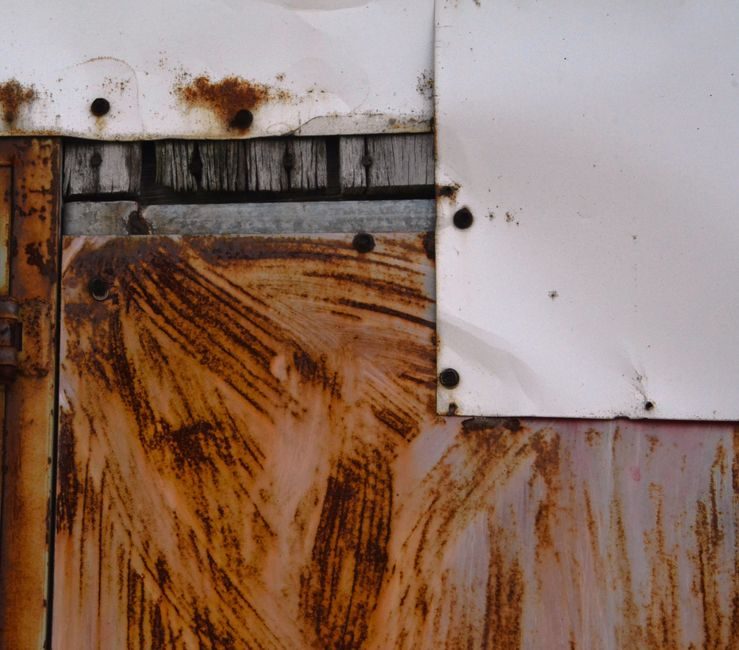
Common designations include ASTM A242, ASTM A588 (Grades A/B/C/K), ASTM A606 Type 4, and EN 10025-5 grades S355J0WP and S355J2W; each carries slightly different alloy minima and impact-toughness requirements, and the choice moves the unit price more than gauge does [S1].
What the price actually includes: alloy surcharge and base steel
Weathering steel is a low-alloy, high-strength product — its self-protecting oxide layer forms because the steel chemistry holds roughly 0.25-0.55% Cu, 0.20-0.65% Cr, and 0.05-0.65% Ni depending on the standard [S1].
Those alloying elements are priced on separate surcharge schedules (typically published monthly by mills), so a buyer comparing two quotes on the same thickness and ASTM grade can still see a 3-8% swing between them based purely on the surcharge reference month. The base iron-and-coke cost component tracks carbon steel plate closely, so weathering's structural premium is almost entirely the alloy delta, not the steelmaking route.
Cost bands by form: plate, coil, and structural sections
For 2026 sourcing, indicative bands (FOB mill China, typical 6-20 mm gauge, ex-mill list before volume discount) cluster as follows when read against the supplier data published on 14 July 2026 [S1] and UK/European plate trackers from 2 July 2026 [S2]:
Hot-rolled plate A588 Gr.B 6-20 mm: roughly 1.20-1.35x the equivalent carbon steel A36 plate on the same gauge, with the gap widening for thinner coils and narrowing for >40 mm heavy plate. Cold-rolled A606 Type 4 coil (1.0-3.0 mm): typically 1.10-1.20x the equivalent hot-rolled carbon coil because the base substrate is itself more expensive; the alloy surcharge is a smaller fraction of the delivered price. Structural H-pile and wide-flange sections to ASTM A588 Gr.K: a 1.15-1.30x premium over A36/A992 sections, since structural mills apply thinner margins on long shapes but the same alloy surcharge applies.
These are working bands, not list prices, and they should be sanity-checked against a live tracker like the Steel price UK board before any RFQ [S2]. Plate is consistently the most expensive form per tonne because plate mills run shorter campaigns on weathering grades than coil mills, and changeover cost is recovered in the quoted price.
Decision criteria: when weathering pays for itself
Weathering steel is a cost decision, not a default. The right comparison is not "weathering vs carbon steel plate at purchase" but "weathering plate vs carbon plate + paint system over service life," because the headline premium recovers in 6-15 years on most bridge and façade applications through eliminated or deferred repaint cycles. [S1]
Specify weathering steel when the structure is: (a) in a wet/dry cycling environment that lets the patina stabilise (typical annual rainfall above ~600 mm, free-draining geometry, no constant moisture contact); (b) accessible enough to inspect but not practical to repaint — typical examples are highway bridges, rail bridges, architectural façades, freight containers, and transmission towers; (c) in an open-rural or low-chloride setting. Do NOT specify it where the structure is in continuous contact with water, buried, in heavy industrial chloride fallout, or in a de-icing salt splash zone — the patina cannot stabilise, corrosion proceeds at near-carbon-steel rates, and the premium is wasted. For those environments, galvanised plate, stainless steel cladding, or a painted carbon-steel system outperforms weathering on life-cycle cost. The same logic disqualifies weathering for indoor architectural use, where the patina never stabilises and weathers unevenly.
Side-by-side: weathering vs carbon vs galvanised vs stainless
For a 10 mm plate buyer comparing four material routes on a 1,000-tonne order, the typical 2026 cost ranking from cheapest to most expensive per delivered tonne is: painted carbon steel A36 (1.0x reference) < hot-dip galvanised A36 (1.05-1.10x) < weathering A588 Gr.B (1.20-1.30x) < stainless steel 304 plate (3.5-4.5x). [S2]
On a 30-year bridge deck cost model, the ranking inverts for most service environments because the painted carbon option carries 2-3 repaint cycles at 15-25% of initial fabric cost each, the galvanised option carries no repaint but a shorter design life in aggressive chloride exposure, and weathering carries essentially zero coating maintenance after the 1-3 year patina stabilisation period. Stainless wins on life-cycle in the most aggressive environments but rarely on initial budget.
For coated-galvanised procurement, coating mass and substrate choice dominate the spec conversation; a working reference is the galvanised coil selection guide, which covers Z-coating weights and spangle control that don't apply to weathering plate but explain the galvanised leg of the comparison.
Standards and what they actually require
ASTM A588 covers high-strength low-alloy structural plate up to 100 mm with a 345 MPa (50 ksi) minimum yield in the most common Grades A and B; the K grade is the version made to a fracture-critical Charpy requirement and commands the highest premium of the A588 family [S1].
ASTM A242 is the older "weathering" specification, now rarely ordered for new plate because A588 has largely superseded it; it still appears on legacy drawings and is occasionally specified for <4.5 mm light sections. ASTM A606 Type 4 is the sheet and coil version — it is what gets cut into roofing and wall cladding, and it tolerates higher cold-form strain than plate grades. EN 10025-5 is the European parallel, with S355J0WP and S355J2W (the W = "weathering") being the usual specified grades; J2 demands a 27J impact at -20 °C and is the safer default for northern European bridgework. None of these standards mandate a surface finish, so a mill can ship hot-rolled, shot-blasted, or pickle-and-oiled at the same nominal price — a meaningful procurement lever on tonnage orders.
Cost drivers engineers forget: lead time, MOQ, and surface
Three line items move weathering-steel project cost more than alloy content does, and none of them appear on a mill list price. [S2]
First, minimum order quantity. The carbon steel plate pricing reference covers the same MOQ dynamic on the baseline carbon route, which is the useful reference when sizing a mixed carbon-and-weathering RFQ. Second, surface condition. A "rust-accelerated" or pre-patinised surface (sometimes sold as "A588 weathering pre-weathered") costs a fixed premium per tonne but eliminates the 1-3 year orange-runoff period that can stain adjacent concrete or paving — a real TCO item for urban architectural projects. Third, lead time. The 2-3 week lead time that the Shandong supplier quotes for stock weathering plate [S1] is genuinely fast by industry standards; comparable European mills quote 6-10 weeks on the same grade because of campaign scheduling.
For fabricated assemblies downstream of plate, lead time and weld-procedure qualification also move the budget — a Q1 2026 working reference for smart hydraulic cylinder manufacturing maps the same "raw-stock → fabricated → commissioned" cost stack that governs weathering bridge fabrications, where the steel is roughly half the fabricated cost.
Total cost of ownership: where the premium earns back

A 30-year TCO on a typical 1,000-tonne weathering bridge deck at 2026 prices recovers the material premium within 12-18 years through eliminated repaint cycles, assuming the structure is in a patina-friendly environment. If the environment is marginal (coastal-influenced, but more than 1 km from the splash zone), design the deck with a 50 mm clear concrete drip edge, free-draining details, and no trapped pockets — the patina must wet and dry to stabilise, and any detail that keeps the steel permanently wet defeats the material. [S2]
For raw-material budgeting specifically, the wider 2026 steel-cost tracker including coil, plate, and rebar bands is in the rebar TCO cost-line reference, which covers the same scrap and energy cost drivers that flow into weathering surcharge calculations. If the project can accept stainless steel cladding for the most exposed members and weathering for the rest, run the cost on that hybrid — it is often the lowest 60-year TCO on aggressive-site bridgework where weathering alone would be borderline. The 1-3 year patina-stabilisation window is the other real cost: specify that period in the maintenance manual and budget for runoff staining control on adjacent finishes, or the project will absorb change-order cost during commissioning.
Spec-level background on the components involved: linear guide.