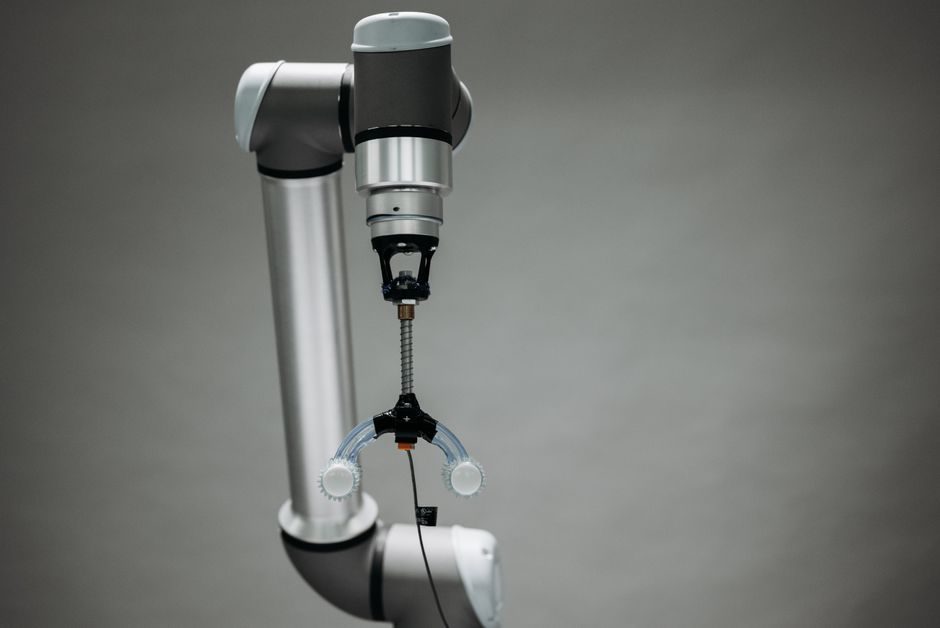
Smart hydraulic cylinders in 2026 are defined by factory-integrated linear position sensors (internal or external) that deliver real-time feedback on piston position, velocity, and stroke endpoints, enabling closed-loop electro-hydraulic control in place of traditional bang-bang valve logic [S2].
Demand is concentrated in refuse, road-building, crane/material-handling, turf-maintenance, and fire-and-rescue equipment — applications where repeatable height, depth, and level control directly affect product quality or operator safety [S2]. For broader context on linear motion hardware, see the hydraulic cylinder and hydraulic actuator reference pages.
What "Smart" Means at the Cylinder Level
A "smart" cylinder incorporates a linear sensor — mounted internally inside the bore or externally on the rod — that produces a high-resolution position and speed signal for the machine controller, replacing hydraulic limit switches and external prox switches on the equipment frame [S2]. Electro-hydraulic control then blends that signal with other machine functions (engine load, tool pressure, machine tilt) to improve efficiency, reduce operator error, and enable precise height/depth control on drilling, cutting, digging, and leveling platforms [S2].
The practical engineering difference is that the sensor feedback lets the proportional valve trim flow to maintain an exact commanded position rather than simply open/close at stroke ends. This requires the cylinder builder to manufacture to tighter positional tolerances, machine the sensor-mounting boss concentric within roughly ±0.1 mm typical, and route cabling through the gland or a sealed port — all tasks that are now part of the standard build sequence at smart-cylinder shops [S2]. The motion-control behaviour of the downstream proportional valve is covered in smart valve positioner reference material.
Diagnostic and Prognostic Stack in 2026
Internal leakage modelling via neural networks and graph-based predictive-maintenance frameworks are the two academic benchmarks dominating the 2024–2026 cylinder-monitoring literature, with faults categorized as internal leakage, external leakage, seal damage, rod scoring, and cavitation — each tied to specific vibration, temperature, and pressure-spectrum signatures [S1].
The peer-reviewed fault-diagnostics review consolidates condition-based maintenance, predictive-maintenance decision-making, and graph-based cognitive maintenance approaches into a single decision framework for hydraulic-cylinder assets in manufacturing and construction machinery [S1]. In practice, plant engineers map cylinder sensor streams (pressure, temperature, position, load) onto three diagnostics layers: rule-based threshold alarms, statistical anomaly detection, and physics-informed neural-network residual models that flag gradual seal wear before catastrophic failure [S1].
Sensor fusion on the cylinder itself — combining rod-position data with chamber-pressure transducers at both ends of stroke — is what enables internal-leakage quantification without cylinder disassembly, a non-trivial step up from vibration-only monitoring that dominated pre-2024 deployments [S1]. For related control-loop components, see the smart camera and smart meter reference pages.
Manufacturing Process Automation
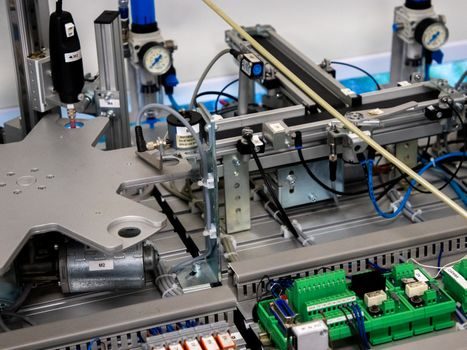
Modern cylinder production is now built around CNC-bored tube machining, robotic weld seam preparation, induction hardening, industrial hard-chrome plating, and laser cladding for rod recovery — a process chain that remanufacturers run alongside OEM production to balance throughput [S3].
Swanson Industries exemplifies the integrated production model: in-house surface-technology lines for industrial chrome plating, induction hardening, laser cladding, and submerged-arc welding feed the same remanufacturing cells that serve OEM-spec cylinder orders, which collapses lead time on repair-and-exchange contracts versus a shop that outsources surface finishing [S3]. Cylinder remanufacturing in this configuration is no longer a separate "repair" trade — it is a parallel production stream with the same metrology, weld-procedure, and inspection discipline as new-build [S3].
Australian custom builder PTE Hydraulics takes a complementary approach — in-house engineering development plus a broad standard-cylinder catalog — so that custom projects can prototype against proven base designs and reuse qualified sub-assemblies rather than designing every cylinder from a blank drawing [S5]. Chinese suppliers, including Changzhou XinHan (founded 1984) and Shandong Hengding Industrial Technology, segment the market by application (dump truck, sanitation, forklift, balers, press, lifting platform) and offer OEM/ODM with single-piece MOQ and per-piece pricing in the US$50–500 band on clamping and flange cylinders [S4][S6].
Smart-Cylinder Selection Criteria
Five decision criteria dominate 2026 smart-cylinder specification: sensor type, controller interface, environment rating, duty cycle, and integration with existing machine CAN-bus or PLC architecture. [S2]
Engineers weighing options should compare across these vectors:
<b>Internal vs external linear sensor.</b> Internal sensors are protected from impact and contamination but require larger bore and add sealing complexity; external sensors are easier to retrofit and service, but exposed to debris, wash-down, and mechanical damage on mobile equipment [S2].
<b>Signal output.</b> Cylinders are available with analog (4–20 mA or 0–10 V), CAN-bus (J1939/CANopen), IO-Link, and discrete PWM outputs — selection is dictated by the host controller, not the cylinder physics.
<b>IP rating and temperature range.</b> Mobile and outdoor applications typically demand IP67 or IP69K and −40 °C to +85 °C operation; indoor industrial presses can usually accept IP65 and 0–60 °C.
<b>Pressure rating and duty cycle.</b> Standard 160–250 bar cylinders with smart feedback are the commodity band; above 350 bar or in continuous high-cycle service, sensor survival becomes the design-driving constraint.
<b>Remanufacturing path.</b> Swanson Industries operates an OEM-authorized service and repair center and offers a cylinder exchange program that provides remanufactured hydraulic cylinders for mining and heavy-industrial applications.
Use Cases and Limits of Embedded Sensing
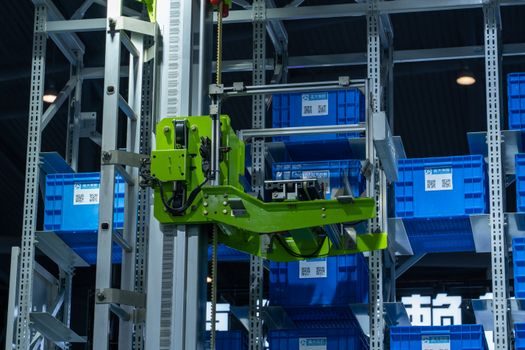
Smart cylinders earn their premium in three use cases: precision agricultural and turf equipment (where boom height, deck level, and reel position must repeat within millimetres across thousands of cycles), refuse and recycling trucks (where packer-plate position controls compaction density), and crane/elevating-platform work where end-of-stroke shock must be eliminated for structural life [S2].
The approach is less justified on simple dump-truck tipping cylinders, single-shot clamping fixtures, and high-speed press cylinders where valve-side control is sufficient and the cost premium of an integrated sensor package cannot be recovered in productivity [S4]. In these applications, a conventional double-acting or single-acting cylinder with limit switches remains the rational spec, and buyers should not be upsold on sensor integration they will not use.
Remanufactured cylinder exchange programs extend the same logic: for mining longwall shields, off-highway construction, and refuse fleets, the smart-feature decision is often made at the equipment-OEM level rather than the cylinder buyer, because the control architecture is locked to a specific sensor protocol [S3]. Related heavy-mobile applications and the platforms that use them are covered in aerial work platform types and classifications: 2026 spec map.
Standards, Sourcing, and Failure Modes
There is no single ISO standard that prescribes "smart" cylinder interface — buyers must specify conformance to ISO 6020 (tele cylinder mounting), ISO 6022 (high-pressure), or manufacturer-specific drawings, then layer sensor-protocol compliance (CANopen DS301/DS404, J1939, IO-Link) on top [S1][S2].
Failure modes documented across the academic and industrial literature concentrate on seal degradation, rod scoring from contaminated fluid, and internal leakage past worn piston seals — and the smart-cylinder value proposition rests on detecting all three before they cause unplanned downtime [S1]. Predictive maintenance systems keyed off position-sensor drift and pressure-transducer trends can extend mean-time-between-overhaul intervals measurably, but only when the sensor stream is continuous and the diagnostic model is retrained on the specific cylinder's duty cycle [S1].
For procurement teams, the most actionable 2026 sourcing signal is that remanufacturing capacity (Swanson's laser-cladding and submerged-arc welding lines being the visible benchmark [S3]) and standard-catalog depth at the supplier (PTE Hydraulics' custom-from-standard model [S5]) now weigh as heavily as price per cylinder in the total-cost-of-ownership calculation. Track these three signals: (1) sensor-protocol standardization across the equipment-OEM fleet, (2) induction-hardening and laser-cladding capacity in the regional remanufacturing base, and (3) predictive-maintenance software that ingests raw cylinder sensor streams without custom middleware.