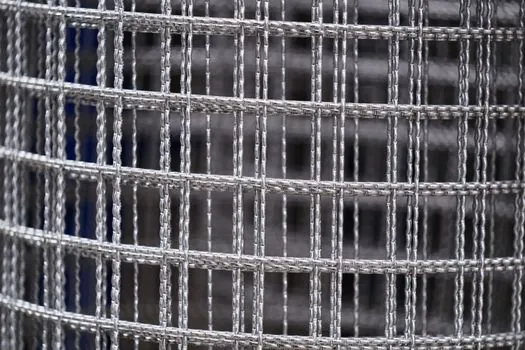
304 and 316L stainless-steel welded mesh panels with wire diameters of 1.0–4.0 mm and openings in the 10x10 to 50x50 mm range dominate cleanroom wall and ceiling-grid specifications, per manufacturer catalogs updated August 2026 [S1][S2][S3][S4].
Open-area ratios of 25–40% are typical for these panels, sized to support HEPA-side return-air plenums and modular partition frames without shedding particulate [S1][S2]. Stainless-steel grade 316L is preferred for biotech and semiconductor suites where ISO 14644-1 Class 5 or cleaner is required and where vapor-phase hydrogen peroxide (VHP) decontamination cycles are routine [S3].
Material Grades and Why 316L Wins for VHP Rooms
316L welded mesh (low-carbon, 2–3% Mo) tolerates repeated VHP exposure without pitting, while standard 304 is widely accepted in dry, non-corrosive ISO Class 7–8 rooms at lower unit cost [S3]. Welded mesh differs from woven or crimped mesh because the cross wires are resistance-welded at every intersection, producing a rigid panel that holds its aperture under dead load, which matters for ceiling-grid spans of 1.2–2.4 m in modular cleanrooms [S1][S2].
Carbon-steel welded mesh is offered with hot-dip galvanizing (zinc coating typically 50–85 µm) for non-clean secondary framing, but galvanic reaction with stainless steel partitions disqualifies it from direct contact in hygienic envelopes [S1][S2]. For walkable ceiling plenums, suppliers list 1,200–2,440 mm panel widths as standard stock items, with 358 high-security fence panels (76.2 x 12.7 mm, 4 mm wire) occasionally repurposed for tamper-resistant service shafts in pharma suites [S2].
Sizing Logic: Wire Diameter, Opening, and Open Area
Common cleanroom-grade welded mesh openings fall into three buckets: 10x10 mm (1.0–2.0 mm wire, 69–25% open area), 25x25 mm (2.0–3.0 mm wire, ~78–79% open area decreasing with wire size), and 50x50 mm (3.0–4.0 mm wire, 84% open area at 3 mm) [S1]. Open area must stay above roughly 25% if the panel doubles as a return-air grille; below 20% the panel behaves as a pressure-drop element rather than a screen, and HVAC balancing becomes unstable [S1].
A practical rule used by process engineers: 1.0 mm wire handles partition skins up to 600 mm unsupported, 2.0 mm wire spans 1,200 mm ceilings, and 3.0 mm wire is the floor for walkable service decks where a 1.5 kN/m² live load is specified [S1][S2]. Wire diameter tolerance is typically ±0.05 mm for stainless grades per ASTM A580 / EN 10088-3 referenced in major mill QA packs [S2][S4].
Surface Finish and Cleanability Gates
Electropolishing reduces Ra from ~0.8 µm (mill finish) to 0.2–0.4 µm, which is the practical ceiling for cleanroom cleanability because smoother surfaces shed biofilm and tolerate IPA, sporicidal, and VHP wipe-downs without harboring residues [S3]. Welded intersections are the weak point: acid pickling after welding removes heat-tint and chromium-depleted zones, restoring the passive layer, and most cleanroom-grade 304/316L mesh ships pre-passivated per ASTM A967 [S3][S4].
PVC-coated welded mesh, while common for outdoor fencing, is generally rejected for cleanroom interior use because the polymer outgases VOCs and particulates that defeat ISO 14644-1 cleanliness targets, even when the coating is rated low-VOC [S1][S2].
Documentation and QA Pack Required for Audit
Buyers should require mill test certificates (EN 10204 3.1) covering wire grade, wire diameter, weld shear strength, and salt-spray results, plus ISO 9001 system certificates and, for EU projects, REACH and RoHS declarations [S2][S4]. UK and EU mills such as Wire Mesh Fabrications Ltd supply ISO-aligned documentation per EN and JIS reference standards for cleanroom builds, while Chinese exporters (Tatall, Fulida) follow the same ASTM/EN/JIS triple reference set [S2][S3][S4].
For comparison: hot-dip galvanized carbon-steel welded mesh (50–85 µm zinc, openings 10x10 to 200x200 mm, wire 1–8 mm) sits at roughly 30–50% of the unit price of 304 stainless in 2026 spot pricing and is appropriate only for non-clean service zones, equipment skids, or anti-bird external mesh on AHU intake louvers [S1][S2].
Installation Pitfalls and Where Projects Fail
Three failure modes recur in cleanroom welded-mesh retrofits: (1) mixing galvanised carbon-steel mesh with stainless-steel framing creates a galvanic cell and rust staining within 12–24 months in VHP-cycled rooms; (2) undersized wire diameter (under 1.0 mm for 25x25 mm opening) deflects under ceiling dead load and cracks welds at panel edges; (3) omitting gasket or continuous seal at panel-to-frame interfaces turns the mesh into a particulate bypass path that defeats HEPA return-air balance [S1][S2][S3].
For modular cleanroom vendors in semiconductor and pharma retrofit work, steel mesh selection for cleanroom service shafts overlaps with the broader grade-and-profile logic used in warehouse steel section specs, and the same edge-protection and weld-quality rules apply whether the panel sits in a cleanroom return-air plenum or a logistics mezzanine.
Quick Selection Matrix
For ISO Class 5–6 semiconductor or aseptic pharma ceilings: 316L welded mesh, 25x25 mm opening, 2.0 mm wire, electropolished, mill cert per EN 10204 3.1 [S3][S4]. For ISO Class 7–8 dry-room partitions: 304 welded mesh, 25x25 mm or 50x50 mm opening, 2.0–3.0 mm wire, pickled and passivated [S1][S3]. For service-shaft anti-rodent or tamper screens: 304 welded mesh, 10x10 mm opening, 1.0–1.6 mm wire, mill finish acceptable [S1][S2].
For non-clean secondary framing, equipment guards, and external AHU intake screens: hot-dip galvanized carbon-steel welded mesh, 50x50 mm opening, 3.0–4.0 mm wire, 50–85 µm zinc coating, kept physically isolated from any stainless surface in the same air-handling envelope [S1][S2]. See mesh belt conveyor reference data for related wire-mesh mechanical properties that inform spanning calculations.
Sourcing Signals to Track in Q4 2026
304 and 316L stainless wire rod price has shown moderate volatility through mid-2026, and spot lead times from major Chinese welded-mesh exporters to EU and North American pharma hubs have been reported in the 4–6 week range as of July 2026 [S2][S3]. UK-based mills (e.g., Wire Mesh Fabrications Ltd) continue to advertise ISO-aligned documentation with stock-and-supply capability for 304/316L welded panels in 1.2 x 2.4 m standard sheets [S4].
Track two verifiable signals: (1) ASTM A580 and EN 10088-3 mill cert availability from shortlisted suppliers, and (2) electropolishing and passivation (ASTM A967) sub-contractor capacity at the panel-fabrication stage, since both are routine pinch points in cleanroom retrofit programs running into late 2026 [S3][S4].
Spec-level background on the components involved: mesh belt conveyor, and alloy steel.