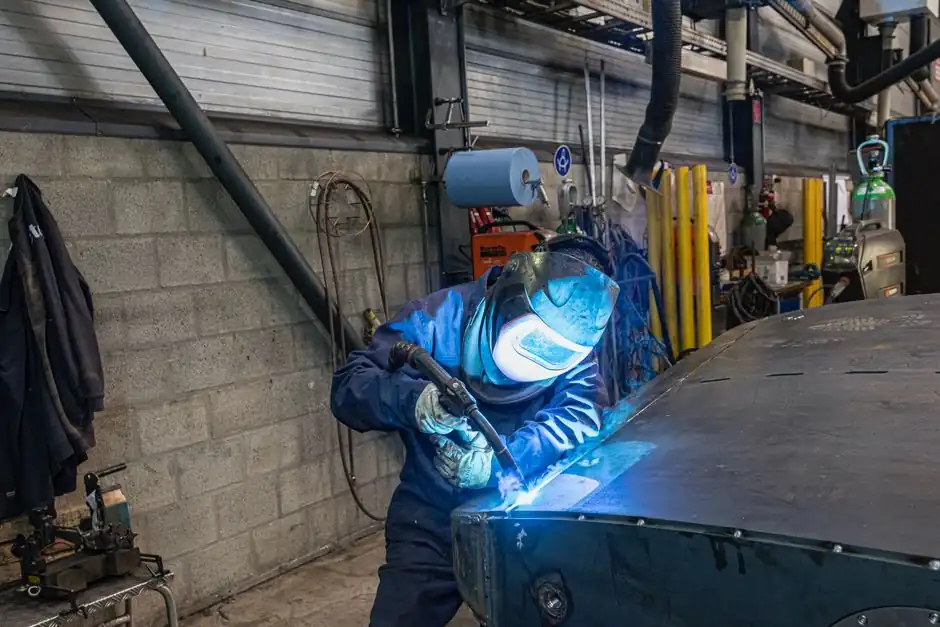
The skilled-trade shortage limits heavy-equipment output because shops cannot convert accepted orders into welded assemblies and machined parts when qualified labor is unavailable. U.S. labor data show about 34,200 machinist openings annually, while the welding gap could reach 330,000 positions by 2028 [S2][S3][S4].
The constraint spans structural fabrication, precision machining, repair, and plant shutdown work, with automation increasing rather than eliminating the need for experienced setup, programming, inspection, and troubleshooting skills [S1][S2].
Where the Capacity Bottleneck Begins
The shortage enters the production system through two linked labor pools: welders who form and join heavy fabrications and machinists who produce dimensional components for those assemblies. In 2024, machinists held about 299,500 U.S. jobs, while approximately 34,200 machinist and tool-and-die-maker openings are projected each year through 2034 [S2].
Those annual openings are mainly replacement demand, not expansion demand. Overall employment in the occupation is projected to decline about 2 percent through 2034, while tool-and-die-maker employment is projected to fall 11 percent, but retirements and exits still require recurring replacement [S2][S4]. The result is a capacity ceiling: machines, buildings, and orders can expand faster than the qualified people able to operate, troubleshoot, and supervise them.
The wider manufacturing market also remains tight. U.S. manufacturing job openings declined from 622,000 in January 2024 to about 462,000 in January 2025, and the ratio of unemployed workers to openings was approximately 0.9 in the cited period [S1]. That ratio means fewer than one available worker per opening, so even lower volume heavy-equipment segments can compete for the same experienced tradespeople.
How Each Missing Trade Stops the Line
Welding shortages reduce output by limiting qualified crews, causing schedule slippage and overtime premiums on work that has already been sold [S3]. The welder shortage can delay infrastructure projects, defer maintenance, and reduce productivity across sectors that depend on welding [S3].
Machinist shortages work through setup and proofing constraints. A modern CNC cell still requires an experienced operator to program it, prove out the first article, detect drift before a production run is scrapped, and correct programming or process errors [S2]. Automating a spindle does not eliminate the need to establish a sound setup, interpret the drawing, and verify the finished geometry.
Heavy-equipment production also depends on overlapping capabilities rather than a single trade. A fabricated frame may be dimensionally correct but unavailable because welding capacity is full; a completed weldment may wait because a pin, bore, housing, or other machined component has no capacity behind it. The production schedule therefore becomes constrained by the least adequately staffed linked operation, not by the nominal cycle time of a single machine.
Welder Capacity Versus Machinist Capacity
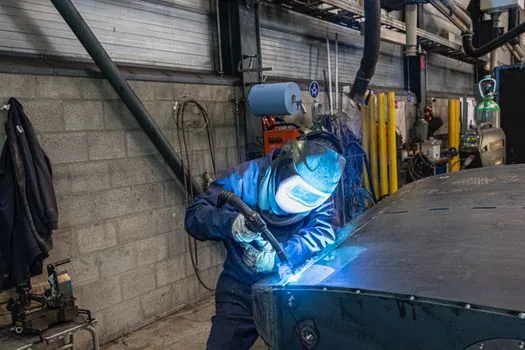
Welders and machinists affect output through different constraints: welding capacity depends on qualified crews, fit-up, procedure control, and access to suitable labor, while machining capacity depends on setup knowledge, machine availability, tooling, and programmers who can prove out work. The comparison below frames their effect on heavy equipment [S2][S3][S6].
The table separates labor scarcity from shop productivity. Welding output can be restricted by poor part fit-up, long setup times, inconsistent material availability, excessive rework, and inefficient handling, none of which is solved merely by adding another welder [S6]. In machining, pallet changers, bar feeders, and robotic load cells can extend the hours covered by one skilled operator, while documented setups preserve knowledge when a senior employee leaves [S4].
Who Needs a Different Capacity Strategy
Heavy-equipment manufacturers with repeat, stable production are candidates for automation because robotic welding and automated machining cells can extend coverage of scarce expertise. Two companies overcame skepticism and embraced automation and robotics to help bridge the skilled-welder shortage [S8].
Heavy-equipment manufacturers with low-volume, high-mix, large-frame, or repair-heavy work should not treat robotic welding as a universal replacement. These products still need technicians who can interpret drawings, establish fit-up, select suitable processes, control distortion, inspect welds, and troubleshoot unusual assemblies. The same distinction applies to machining: an automated cell still needs someone who can prove the setup and manage exceptions [S2].
Buyers should distinguish a genuine capacity shortage from a shop that has workers but weak workflow. If rejected work occurs despite available benches and operators, the constraint may be poor setup documentation, unstable material flow, or excessive rework rather than a headcount deficit [S4][S6]. For procurement planning, the relevant question is not whether a supplier owns enough machines, but whether it can staff the complete sequence from weldment fabrication through final machining and assembly.
Production Risks That Originate Outside Hiring
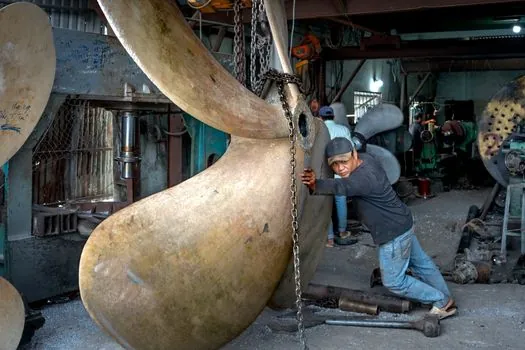
Three operating failures magnify the labor shortage: material shortages interrupt planned work, fit-up defects create rework, and undocumented setup knowledge disappears when an experienced employee retires. The first two consume available welder hours without producing acceptable assemblies, while the last reduces machining capacity when a senior setup specialist leaves [S4][S6].
Skilled labor also performs work that is easy to hide in a capacity calculation. A machinist freed from fetching materials can use the available time to program intricate parts, and a welder who is not searching for consumables or handling material can concentrate on seam quality [S9]. The production loss is therefore not limited to the hours of an absent worker. It includes the skilled hours diverted to material movement, setup preparation, searching, and administrative support.
The welding market data show why headcount alone is a weak metric. The average U.S. welder is over 55 years old, while welding positions paying $80,000 to $150,000 remain difficult to fill [S3]. Pay can improve recruiting, but the development pipeline still depends on shop classes, instructors, certification, and several years of practical training. For machining, long-term on-the-job training and multi-year apprenticeships likewise cannot be compressed to match a sudden order spike [S3][S4].
What Capacity Signals to Track
Heavy-equipment output should be tracked through labor and workflow indicators rather than order backlog alone. The leading indicators are qualified-worker openings, age and retirement exposure, apprenticeship completion, first-article setup time, weld rework rate, machine utilization, and the number of orders rejected because no qualified operator is available [S1][S2][S4][S6].
The most useful near-term test is whether shops can expand staffed hours without increasing defects. Pallet changers, bar feeders, and robotic load cells can make one skilled operator cover more machine hours, but the benefit appears only if setup, material availability, and first-article approval remain controlled [S2][S4]. A plant with rising machine utilization but declining first-pass yield has not solved the bottleneck.
For capital-heavy construction machinery and equipment manufacturers, the shortage is best treated as a capacity-engineering problem: protect skilled time, reduce setup and rework loss, automate repeatable loading or joining, cross-train workers across cells, and document process knowledge before experienced employees leave [S4][S6][S9].
Two trackable signals will show whether the constraint is easing: annual machinist openings falling below the replacement burden of about 34,200, and progress toward closing the projected 330,000-position welding deficit before 2028 [S2][S3]. Until those changes appear in hiring, training, and qualification data, installed machine capacity will overstate the heavy-equipment output that a shop can actually deliver.