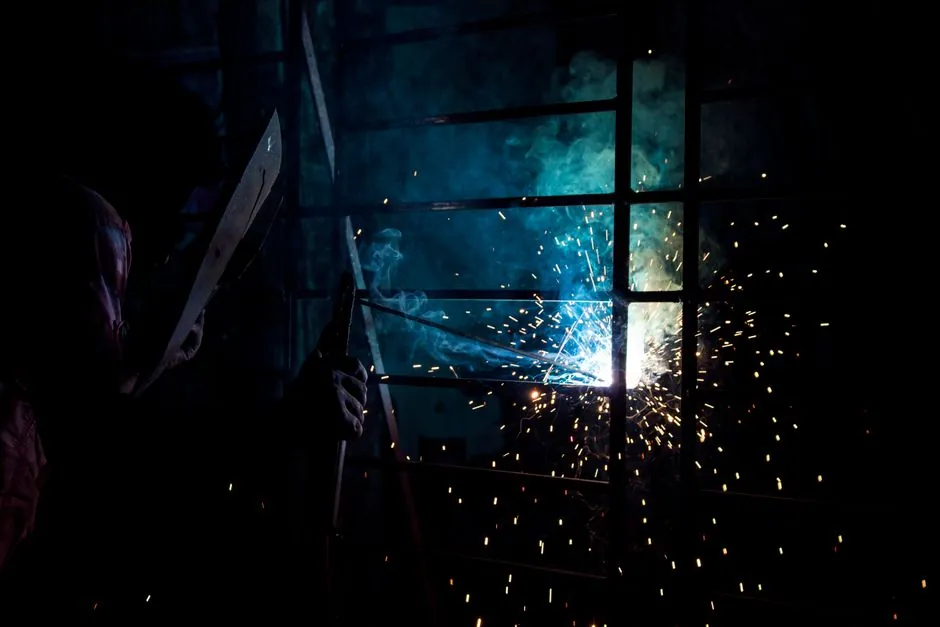
Welding-glove specification is driven by the arc process in use: stick (SMAW) and MIG/MAG tolerate heavier cow split leather, while TIG (argon-arc) demands thinner, more tactile sheepskin to keep finger control on the filler rod, with the OKorder 2026-01 cataloging bull double-layer, multi-layer high-temperature, sheepskin argon-arc, and extended cowhide variants side by side [S1].
Across that same January 2026 SKU set, every entry is a leather glove, none is a disposable nitrile or a coated mechanical glove, which is itself the first selection gate: welding hand protection is a dedicated category, separate from chemical or impact PPE in vendor catalogs such as Intersafe's hand-protection split between Welder Gloves, Mechanical Gloves, Chemical Gloves, Impact Gloves, and Leather Rigger Gloves [S2].
Process-driven selection: stick, MIG/MAG, and TIG do not share a glove
Stick and MIG/MAG welding generate spatter, radiant heat, and short contact with hot workpieces, so the spec typically lands on cow split leather in double- or three-layer construction, with a long gauntlet cuff; the January 2026 OKorder line-up includes "welding gloves bull double-layer double back leather," "A-level natural color with adhesive three-layer welding gloves," and "double-layer split leather welding gloves - short cuff protective welding gloves" as direct matches [S1]. TIG (argon-arc) runs cooler but punishes finger dexterity, and the catalog answers with "welding gloves white sheepskin for argon arc," noted for a seamless index finger to keep rod feeding precise [S1].
If a buyer tries to push a heavy stick glove onto a TIG station, the failure mode is poor rod control and lost arc starts; if they push a thin TIG glove onto stick, the failure is burn-through within minutes. Match the glove to the dominant process, not to a "one size fits all" inventory SKU. The catalog also exposes a tiering logic: "cowhide heat resistant and insulated welding gloves" (top-grain cowhide, sold by the box) sit above the cheaper cow split SKUs in thermal performance, and are the right pick for high heat-flow environments and multi-layer entries [S1].
Leather, lining, and cuff: three material gates that decide comfort and burn time
Cow split leather (the inner split of the hide) is the workhorse: thick, fibrous, abrasion-tolerant, cheaper than top-grain. Top-grain cowhide is denser, smoother, and more heat-resistant per millimetre, which is why vendors position it for "high temperature resistance" in the OKorder 2026 description set [S1]. Sheepskin is softer and thinner, used where dexterity matters more than raw heat mass. These three materials define almost every welding-glove SKU in the current sample, and selection reduces to: heat mass required vs finger sensitivity required.
Lining is the second gate. Fleece-lined entries (e.g. "thickened heat resistant welding gloves with fleece lining abrasion resistant split leather") add comfort and a small thermal buffer for long shifts in cold shops, while unlined variants give better sweat management in warm climates; both are still leather over leather [S1]. Cuff length is the third gate. Short cuffs trade wrist protection for ventilation and are only acceptable on bench TIG; gauntlet (extended) cuffs that cover the forearm are mandatory for overhead stick, for vertical-up pipe, and for any work where slag can drop into the sleeve, with the OKorder "extended cowhide welding gloves" and "extended length welding gloves with heat insulation and puncture resistance" both sized for that envelope [S1].
EN 388 and EN 407: what the standard actually tests
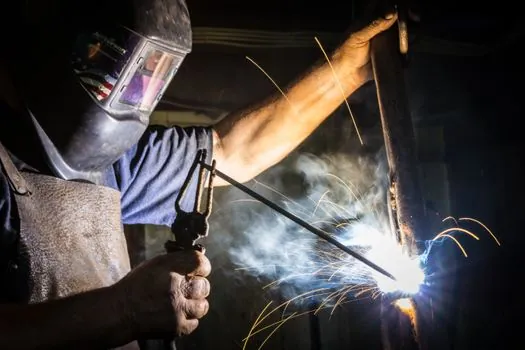
Welding gloves in the EU sit under EN ISO 21420 (general requirements) plus two performance standards: EN 388 (mechanical risks: abrasion, cut, tear, puncture) and EN 407 (thermal risks: contact heat, convective heat, radiant heat, small splashes of molten metal, large mass of molten metal) [S3]. A glove marketed only as "welding leather" without an EN 407 pictogram is not a verified thermal-risk glove; it is a generic leather work glove. EN 407 levels run 0-4 on each of six digits, and a credible stick-welding glove typically posts level 3 or 4 on contact heat and on small splashes of molten metal, while a TIG glove usually trades one level of contact heat for better finger dexterity.
EN 388 mechanical scores are secondary for welding but still relevant for handling hot, sharp stock; the cataloged "extended length welding gloves with heat insulation and puncture resistance" bundle both threat vectors, which is the right framing for pipe and plate work where a burn and a puncture are both possible from the same edge [S1]. Buyers should request the EN 388 + EN 407 pictogram from the mill, not the brochure.
Comparison: glove types against the four decision criteria
Across the January 2026 OKorder sample, the practical comparison on four criteria resolves as follows. (1) Heat resistance: cow split double-layer and top-grain cowhide lead, with multi-layer high-temp variants at the top of the list; sheepskin argon-arc sits lowest. (2) Dexterity: sheepskin argon-arc leads, with seamless index-finger SKUs ahead of standard stitch; double-layer cow split is worst. (3) Cuff coverage: extended cowhide and extended-length insulated models lead at full gauntlet; short-cuff double-layer split is worst, intended for bench work. (4) Abrasion and puncture: top-grain cowhide and the "extended length welding gloves with heat insulation and puncture resistance" SKU lead; thin sheepskin is worst [S1]. The selection rule is then: pick two of (heat, dexterity, coverage) and accept the trade on the third.
When a welding glove is the wrong glove, and what to use instead
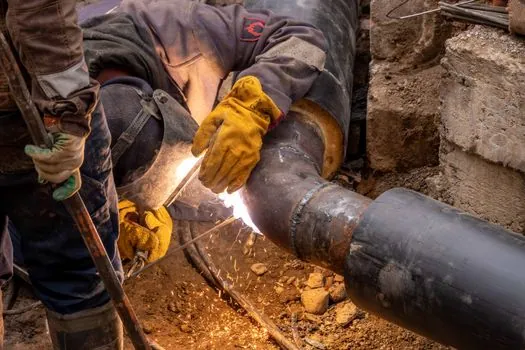
A welding glove is the wrong glove for three common adjacent tasks. Chemical handling on a weld cell (degreasers, pickling paste, coolant) wants a chemical-rated glove, a separate line item in vendor catalogs, with its own polymer and permeation spec; Intersafe lists Chemical Gloves as a standalone hand-protection category, distinct from Welder Gloves, and operators should not swap them [S2]. Impact-heavy work (forging, die change) wants an impact glove, again a separate category, with TPR exoskeleton; this is not a welding glove. Material handling of hot but un-arc'd stock (furnace charging) often wants an aluminized heat-reflective glove or a welding blanket sleeve rather than a leather welder's glove.
Within welding, the right glove also depends on positional work. Overhead and out-of-position stick work need the longest cuff and the thickest leather; flat-down fillet welds tolerate shorter cuffs and lighter leather. The OKorder "welding gloves with canvas cuff full palm extended length abrasion resistant for welding work" lines up with positional stick and pipe, while the "short cuff protective welding gloves" entry is the right pick for bench fixture work where the wrist must move freely [S1].
Sourcing and procurement signals to track
Two signals are worth watching into late 2026. First, EN 407 revision and EN ISO 21420 maintenance cycles continue to clarify how glove-level thermal data must be reported, so any catalog update that adds the six-digit EN 407 pictogram to previously unrated SKUs is a procurement signal to re-spec. Second, the current OKorder sample still lists "1 pair" minimum order quantities on most welding SKUs and "1 box" on top-grain cowhide insulated variants, with TT and LC as accepted payment terms, which is useful for small-shop buyers but points to a fragmentation problem for plant-level standardization [S1]. Trackable next nodes: any vendor move to lot-level EN 407 third-party test reports, and any move to standardize on a single leather grade across an entire welding bay.
For component-level specifications, see safety gloves, welding cutting tool, and fire safety.
See also our earlier report, Line frequency induction furnace selection for telecom enclosures.