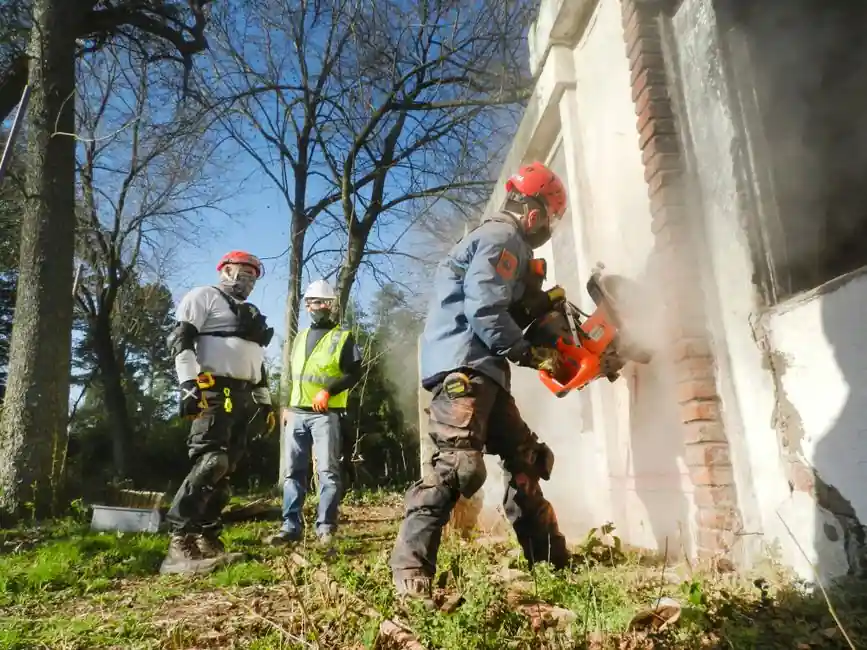
Wet concrete cutting reduced respirable dust concentration by 85% compared with dry cutting in a field study, making water the preferred control where runoff and moisture are manageable [S1].
The decision balances airborne crystalline silica, blade heat, water supply, slurry containment, extraction capacity, and the cutting tool’s wet- or dry-rated configuration [S1][S2][S5].
Dust-Control Performance and the Default Choice
Concrete cutting can convert crystalline silica into airborne respirable dust, so the work method should be selected before blade speed, feed rate, and extraction accessories are finalized [S4]. Wet cutting captures particles at the cut and converts concrete debris into slurry, while dry cutting leaves the extraction system to remove particles after they become airborne [S1][S2].
The measured result was an 85% reduction in respirable dust concentration for wet cutting compared with dry cutting [S1]. A separate industry description places the reduction in concrete dust at about 90% [S3]. These figures establish a large directional advantage for water but should not be treated as a guarantee for every material, machine, or site because the measured outcome depends on water delivery and the test arrangement [S1][S3].
Wet cutting should not be described as dust-free [S5]. Water can reduce airborne respirable dust substantially, but site assessment remains necessary because residual slurry, overspray, runoff, and disturbed sediment can still migrate beyond the blade [S1][S5].
Wet Cutting Benefits, Limits, and Blade Requirements
Wet cutting serves deep, extended, or structural cuts where high dust and blade heat would otherwise require intensive extraction and careful cooling [S4]. Water helps manage heat at the blade and cutting surface while suppressing airborne dust [S5].
Wet cutting reduces harmful concrete dust by about 90% [S3]. The blade must be rated for wet use, and the operator must still observe its specified speed, feed rate, material compatibility, and water-flow requirements [S5].
Depending on the equipment, wet cutting may require an integrated water-delivery system [S5]. Slurry can stain finished surfaces, splashing can obstruct the cut, and runoff can carry cementitious material into drains or occupied areas [S3][S6]. Water is therefore unsuitable where moisture would damage materials, interfere with electrical work, or disrupt building occupants [S2].
Dry Cutting Benefits and Operating Constraints

Dry cutting is appropriate when water is unavailable or unacceptable, the work is short or shallow, and a dust extractor can control the airborne fraction at the source [S2][S4]. It simplifies setup because no pressurized supply or reservoir is required, avoids slurry and splashing, improves visibility of the work surface, and permits faster cleanup [S2].
Dry cutting may be preferred when working with drywall, near electrical wire, in other sensitive areas where moisture is unsafe or disallowed, or overhead [S2]. Use a diamond blade only under the operating conditions specified by its manufacturer, and do not use a wet-only blade for dry cutting [S5].
Dry cutting creates the higher-consequence failure mode in this comparison: greater airborne dust without source suppression [S1][S4]. A cut-off saw used dry should therefore be matched to the material and paired with suitable extraction, rather than treating the absence of slurry as sufficient dust control [S4].
Decision Matrix for Wet and Dry Methods
Against four decisive criteria, wet cutting wins on respirable-dust suppression and blade cooling, dry cutting wins on setup simplicity and moisture-sensitive work, and neither method is automatically superior for every site [S1][S2][S3][S5].
For dust control, wet cutting delivered an 85% measured reduction in respirable dust versus dry cutting [S1]. Water helps manage heat at the blade and cutting surface [S5]. For site logistics, wet cutting requires water delivery and slurry management, while dry cutting removes those requirements [S2][S3]. For blade selection, wet work requires a wet-rated blade and dry work requires a dry-rated blade; physical fit to the saw does not establish approval for the chosen operating condition [S5].
The correct comparison is therefore wet for difficult cuts where dust, heat, and exposed surroundings dominate, and dry for quick work where moisture-sensitive finishes, occupied interiors, overhead access, or the absence of a water supply outweigh the added dust-control burden [S2][S4].
Machine Setup and Work-Site Controls

A wet cut-off machine must deliver water at the point of contact using equipment and a blade approved for that combination [S5]. The operator must manage flow so water reaches the cutting zone without obscuring the cut or creating uncontrolled runoff, while containment protects drains, finishes, electrical equipment, and occupied spaces [S2][S4].
A dry cut-off machine requires source capture connected to suitable extraction rather than allowing dust to travel across the work area [S4]. For indoor use, the work zone should be isolated where practicable, extraction should be matched to the hazard, and residual dust should be cleaned without dry sweeping or compressed-air dispersal [S4]. The practical details of connecting a cut-off saw to a compliant extraction arrangement are covered in Cut-Off Saw Dust Port Setup for Indoor Compliance.
Blade discipline is non-negotiable in either mode: use a wet-rated blade for wet cutting and a dry-rated blade for dry cutting, follow both blade and tool instructions, and manage blade speed, feed rate, material compatibility, and heat within their stated limits [S5].
Application Recommendations by Work Type
For deep slots, long cuts, structural concrete, or cuts beside pedestrians and neighboring properties, use wet cutting with a wet-rated blade and planned slurry containment; the 85% respirable-dust reduction provides the strongest measured case for this method [S1][S4].
For quick indoor cuts in drywall, plaster, tile, stone, or masonry, dry cutting may be cleaner and more convenient when moisture would damage finishes or disrupt occupants [S2]. For channels for electrical or plumbing services, dry cutting avoids introducing water around sensitive work, but extraction remains necessary because convenience does not remove the silica hazard [S2][S4].
For overhead ceiling work, dry cutting is often more comfortable because it avoids falling water and slurry [S2]. For shallow outdoor cuts, dry cutting may be selected only when the extraction arrangement, exclusion zone, and surrounding people can be controlled; otherwise wet cutting provides the stronger dust-control margin [S4].
Standards, Instructions, and Verification

Job-specific requirements for respirable crystalline silica, local exhaust ventilation, personal protective equipment, and work-zone control must be verified for the jurisdiction where the cut occurs [S4][S5]. No jurisdiction, exposure limit, extraction performance class, or water-flow figure should be inferred from the comparative materials because those values were not supplied in the research.
Manufacturer operating instructions remain the controlling technical documents for blade speed, feed rate, material compatibility, water flow, and wet or dry approval [S5]. The decision should be documented with four records: the selected method, the reason for any dry exception, the extraction arrangement for dry work, and the slurry containment plan for wet work [S1][S2][S4].
After work, verify the measurable outcome rather than relying on method labels: inspect for visible airborne dust during cutting, confirm that extracted material is captured where dry cutting was used, and inspect drains and finished surfaces where water was used [S1][S4].