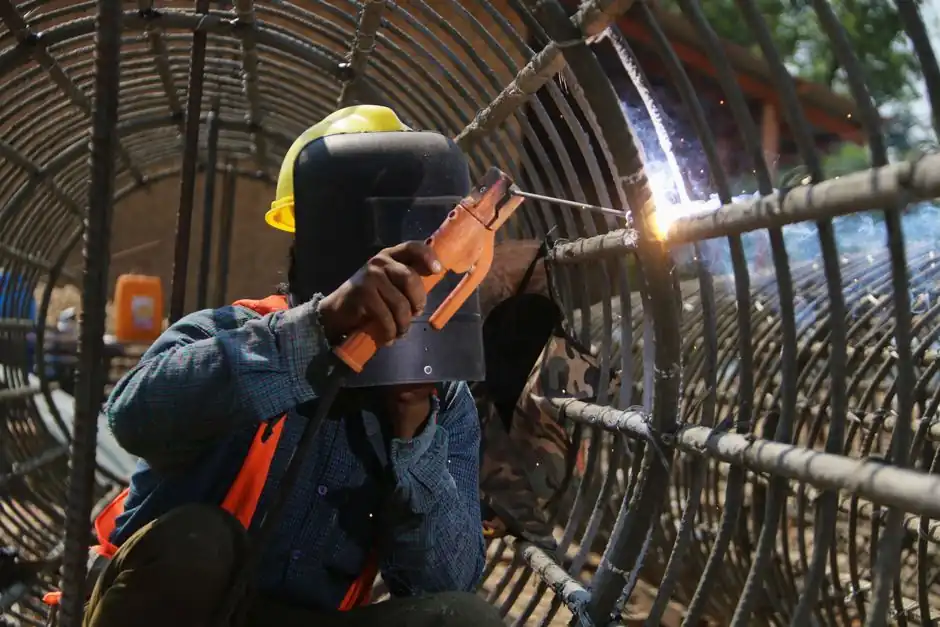
E6010 produces a deep-penetrating DC+ arc, while E7018 provides a smoother arc and higher 70,000 psi minimum tensile strength [S1][S3].
These SMAW electrodes are not interchangeable for every joint: E6010 is intended mainly for pipe root passes, and E7018 for structural fill and cap passes [S2][S3].
Electrode Classification and Base Metal
The “E” identifies a SMAW electrode, “60” or “70” denotes the nominal 60,000 or 70,000 psi tensile-strength class, “1” means all-position use, and the final digit identifies the coating and current requirements [S1][S3]. E6010 has a high-cellulose coating, while E7018 uses an iron-powder, low-hydrogen coating [S1][S3].
In the AWS classification E6010, “60” denotes a tensile strength of 60,000 psi, “1” denotes all-position welding, and “0” denotes a high-cellulose coating [S1]. E7018 is assigned to the 70,000 psi tensile-strength class, giving it the higher-strength classification used for structural work [S3].
E6010 is the better choice when root penetration, downhill pipe welding, vertical-down work, or handling painted or lightly rusty steel matters most [S2][S3]. E7018 is the better choice for fill passes, cap passes, structural steel, and joints where a smooth bead and 70,000 psi class are priorities [S3].
DC+ and AC Machine Compatibility
E6010 operates on direct current electrode positive, or DC+, and does not run on AC [S2][S3]. E7018 runs on DC+ and can also be used on AC, making it the practical choice when the available arc welder is AC-only [S3].
Do not infer that both rods share identical electrical behavior. E6010’s cellulosic coating creates a hot, forceful arc that cuts through contamination, while E7018 creates a slightly softer and quieter arc with low spatter [S1][S4]. On a DC+ machine, set the electrode lead to positive and work lead to negative, the conventional DCEP arrangement for these consumables [S1][S3].
If an AC-only source is mandatory, select E7018 rather than attempting E6010. If the joint is a pipe root pass and only AC is available, E6011 is the relevant cellulose alternative because it accepts AC and DC+ [S2][S3].
Amperage Settings by Electrode Diameter
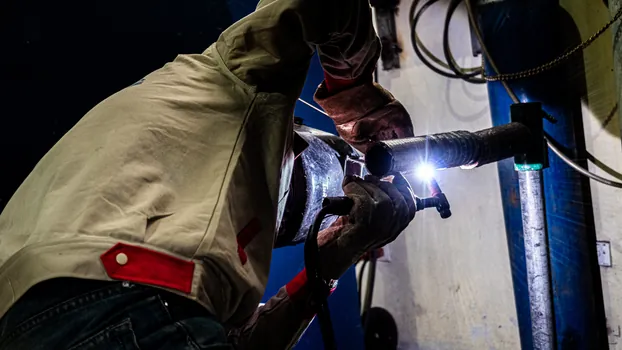
These are general operating bands, not a substitute for the electrode manufacturer’s instructions [S1].
Start within the manufacturer’s range for the selected rod diameter, then adjust for plate thickness, joint design, welding position, travel speed, and base-metal condition. E6010 normally requires a short arc because the cellulosic coating does not tolerate a long, unstable gap well [S3]. E7018 also benefits from a short arc, with a slight drag angle recommended for a stable bead [S3].
Do not transfer E6010 amperage settings directly to E7018 without checking the rod diameter and the E7018 maker’s current range. The research establishes the E6010 bands but does not provide a corresponding E7018 table, so the defensible procedure is to treat the machine setting as a controlled test rather than reuse numbers without qualification.
Comparison Across Weld Requirements
E6010 versus E7018 is primarily a decision about power source, penetration, arc behavior, and joint role. E6010 accepts DC+ only, offers aggressive penetration, and fits pipe root passes; E7018 accepts DC+ or AC, carries a 70,000 psi class, and fits structural fill or cap passes [S1][S3].
The choice becomes direct: choose E6010 for a DC+ root pass on pipe, E7018 for an AC-capable structural fill or cap, and E6011 rather than E6010 when an AC-only machine must weld with a cellulose electrode [S2][S3]. For comparative process capabilities, see AC vs DC stick welding for cast iron.
Position, Surface Condition, and Technique
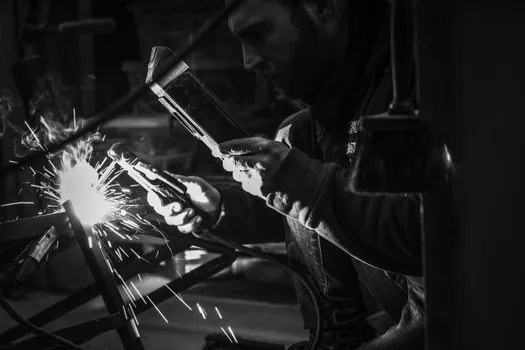
E6010 and E7018 are both all-position electrodes, covering flat, horizontal, vertical, and overhead welding [S1][S3]. E6010’s fast-freezing slag supports vertical-down pipe work and produces a flat, rippled bead with relatively little slag [S2]. Its deep penetration and ability to burn through paint, dirt, or light rust make it useful for field pipe root passes [S1].
E7018 forms a smooth, visually consistent bead with minimal spatter [S3][S4]. E7018 is a low-hydrogen electrode with an iron powder coating [S3]. Wet E7018 coatings can contribute to porosity and hydrogen-induced cracking [S3].
E6010 is the better fit for contaminated steel, vertical-down pipe work, and root passes that need substantial penetration [S1][S3]. E7018 is the better fit for cleaner structural fabrication, fill and cap passes, and work where bead appearance and the higher strength class carry more weight [S3][S4].
Failure Modes and Storage Controls
Using E7018 without adequate moisture control can cause porosity and potential cracking, while using E6010 on an AC machine results in unsuitable operating conditions because the electrode is DC+ only [S3]. Both faults are avoidable by matching the rod to the machine and controlling the coating condition before striking an arc.
Use E6010 within its 40–215 A spread across the four published diameter ranges, and do not exceed the current marked on the electrode package or the manufacturer’s instructions [S1]. For E7018, verify the specified diameter and amperage range on the product label because the research does not supply a universal table. Holding the wrong electrode for too long can overheat the coating, while an undersized current can produce poor fusion and unstable transfer [S1][S3].
Qualification remains the final check. For a coded pipe joint, structural connection, pressure application, or repair, use the approved welding procedure, qualified welder, matching filler-metal specification, and applicable code rather than treating electrode trade names as a complete procedure [S1][S3]. AWS A5.1 governs carbon-steel SMAW electrode classification and minimum mechanical properties cited here [S1].
Before welding, record the rod diameter, machine polarity, amperage, position, base-metal condition, and storage condition, then make a test coupon for the exact joint and verify fusion, bead profile, slag removal, and mechanical requirements.