Centrifugal wheel blast systems, not air-blast cabinets, are the default for high-volume non-ferrous die-cast finishing, with continuous tumble-belt, spinner-hanger, and wire-mesh-belt machine formats matched to part size and complexity [S1].
The media decision is driven by three coupled constraints: substrate hardness (Al, Zn, Mg alloys in the 50-100 HV range), flash and gate-removal energy, and contamination control, since ferrous media can embed iron particles that later cause staining or corrosion on aluminum and zinc surfaces [S3].
Wheel-blast machine formats matched to die-cast geometry
Rosler's RMBD continuous tumble-belt machine, with a high-capacity feed and integral screening system, is sized for small-to-mid die-cast housings, covers, brackets, frames, and handles that can tumble against each other [S1]. For large and complex die castings such as cylinder heads, engine blocks, transmission housings, and turbocharger housings, the RHBD continuous spinner-hanger or RHBE batch spinner-hanger, with overhead Y-rail trolley transport, holds each part in a single orientation and uses a special screening system to remove flashes from the blast media [S1]. Mid-sized, less complex parts like cylinder head covers, oil pans, chassis frame components, and lighting housings typically run on the RDGE continuous wire-mesh belt, where workpieces pass through the blast zone without touching each other [S1]. Single, large components or small batches of smaller parts are processed on the RDT rotary-table machine blasted from above [S1].
The selection logic is purely geometric: ability to tumble, fragility, and exposure geometry drive format, while media chemistry and size handle the surface-engineering problem. For shop-floor definitions of these machine categories, see the shot blasting machine reference page.
Why centrifugal wheels, not compressed-air, for production volumes
Wheel-blast systems propel metallic media at high speeds using mechanical energy from a rotating impeller, giving roughly 5-20x the mass throughput of a comparable air-blast nozzle and a controlled, concentrated blast pattern that can be tuned to part geometry [S9]. Air-blast cabinets and suction-gun setups are still used for low-volume or one-off work; in production die-cast shops the wheel dominates because cycle time, media recycle, and dust collection are integrated, and triple-deck screening classifiers continuously pull out broken or undersized shot to keep the working mix on-spec [S2].
A common shop rule is that the wheel should produce a concentrated, efficient blast pattern so peening or cleaning media cost stays in check, and blast patterns can be adjusted on modern machines [S2]. This matters on die castings because the difference between flash removal and substrate damage is a narrow energy window, and a tunable blast pattern lets the operator land inside that window.
Media chemistry: non-ferrous, stainless, and zinc options
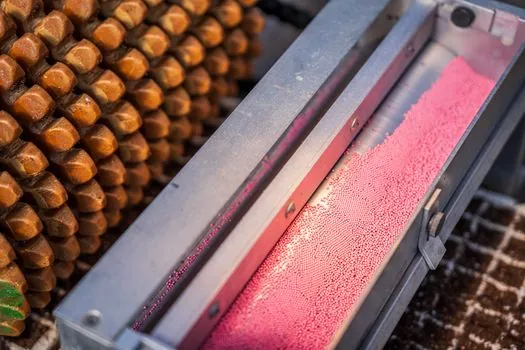
Transmet's Cast Zinc Shot, formulated from ZA4 alloy at 91 Knoop hardness, runs at a density closer to stainless steel than to aluminum cut wire, so it carries enough mass to remove heavier flash on die castings while staying soft enough not to damage the substrate [S3]. On a service-life basis, Transmet cites that Cast Zinc Shot lasts about 4x longer than steel shot, 3x longer than zinc cut wire, and roughly 10,000x longer than glass bead or aluminum oxide in die-cast blast cells, with a bright, evenly textured cosmetic finish [S3].
High-grade stainless steel cut-wire shot is the next step up, deployed mainly with automatic wheel-blast systems where shot consistency, low dust generation, and minimum iron-transfer onto the workpiece are all required [S5]. Conventional steel cut-wire shot is still the workhorse for ferrous descaling and for aluminum die castings where iron contamination is controlled downstream, but on zinc and magnesium it carries a real risk of embedded iron, which can show up as rust spots or as a chemistry issue in any later plating or painting step.
Media size, hardness, and impact energy on Al and Zn substrates
Media diameter and hardness together set the impact energy at the wheel tip, and that is the lever an operator actually turns. For tumblast and tunnel-blast cells running cast iron, common production sizes sit in the 2-3 mm range, with 3 mm shot in tumblasts and 2 mm shot in tunnel-blast machines [S4]. The same 2 mm range carries over to non-ferrous work where the substrate is softer, since smaller-diameter media limit peak impact while still giving the coverage needed to strip flash.
Transmet's hardness argument is the engineering anchor: ZA4 cast zinc at 91 Knoop is below the threshold that damages thin-wall aluminum and zinc die castings, yet still cuts through the heavier flash that softer aluminum-cut-wire or glass-bead media leave behind [S3]. When new alloys with thinner walls come online, the hardness ceiling for blast media is the first spec to revisit, because thinner sections can no longer absorb a high-Knoop impact without deformation [S3].
For peening-style applications on bronze, aluminum, and titanium components, the arc-height chart for shot peening maps part thickness to target intensity, e.g. 0.012N at 1/16 in. thickness down to 0.010C or greater at 7/8 in. and above [S2]. Die castings are normally cleaned, not peened, so the same machines are run at lower intensities to stay on the cleaning side of that window.
Selection criteria: media vs. machine for Al, Zn, Mg die castings
For an engineer choosing media and machine together, four criteria carry most of the decision: substrate hardness, flash and burr load, cosmetic-finish requirement, and iron-contamination sensitivity. Aluminum die castings (typical 60-100 HB) and zinc die castings (typical 80-120 HB) accept a wider media range than magnesium (typically 50-80 HB) [S3].
Stainless steel cut-wire shot is the right pick when the cell is shared between ferrous and non-ferrous work, or where iron contamination is a process risk, and it is most often deployed with an automatic wheel-blast system to keep quality and consistency high [S5]. Cast zinc shot (ZA4, 91 Knoop) is the cleaner pick when the line runs only non-ferrous parts, where flash and gate-removal energy is the bottleneck, and where a bright cosmetic finish matters [S3]. Glass bead and aluminum oxide are reserved for cosmetic or surface-prep work on already-clean castings because of their short service life and high dust load [S3]. Conventional steel cut-wire shot is still the lowest-cost option for iron-tolerant aluminum work, with multiple size and hardness grades available [S6].
Machine-format selection tracks part size and tumbles: continuous tumble-belt for small parts, spinner-hanger for large complex housings, wire-mesh belt for delicate mid-size parts, and rotary table for single-piece or short-batch work [S1]. For a primer on sand blasting machine alternatives, the air-driven path trades throughput for flexibility on prototype and low-volume work.
Process limits and failure modes in non-ferrous cells
The dominant failure modes on non-ferrous die castings are substrate damage from over-hard media, iron contamination from steel shot, and dust loading from over-fine or over-brittle media. Cast zinc at 91 Knoop is engineered to sit below the damage threshold of typical Al and Zn die-cast alloys, while still clearing heavier flash that softer aluminum cut wire cannot [S3]. When a die caster pushes a harder media to gain cycle time, the first visible failure is deformation or peening of thin-wall sections, not improved flash removal [S3].
On the machine side, screening and shot-add discipline is the real failure boundary: triple-deck screening classifiers continuously remove broken or undersized shot media, and a shot-add device replaces shot that becomes too small to dimple the surface [S2]. If that loop is broken, the working mix drifts toward fines, dust load rises, impact energy falls, and the operator compensates by raising wheel speed, which pushes the cell toward substrate damage. The cure is media-chemistry and screening discipline, not higher wheel speed.
Standards, sourcing, and practical next steps
There is no single ISO or ASTM standard that fixes a media grade for non-ferrous die-cast blasting; selection is governed by the cell's substrate, geometry, and downstream finish requirement, with media chemistry (stainless cut wire, ZA4 cast zinc, steel cut wire, glass bead, aluminum oxide) and size (typically 0.4-2.0 mm for production die-cast cells) as the main variables [S1][S3][S5][S6]. Shot-peening intensity, when the same machine is used for peening rather than cleaning, is referenced to SAE and aerospace peening specs via arc-height tables such as the one in [S2].
Two trackable signals for the next planning cycle: (1) NADCA's aluminum-content projection, which has been tracked at a predicted 547 lb per car in 2025, continues to push thin-wall aluminum die castings into new wheel-blast cells, raising the value of media under 100 Knoop [S3]. (2) New die-cast alloys with thinner walls will continue to compress the hardness window for blast media, and any media change should be qualified on a sample run with the screening system engaged to hold the size distribution steady. For a broader look at the shot sleeve and consumable wear parts that share the same wheel-blast supply chain, the related reference is a useful next read.
For related coverage, see ISO 22915 tilt-table stability test for forklifts: scope, parts, and lab workflow.