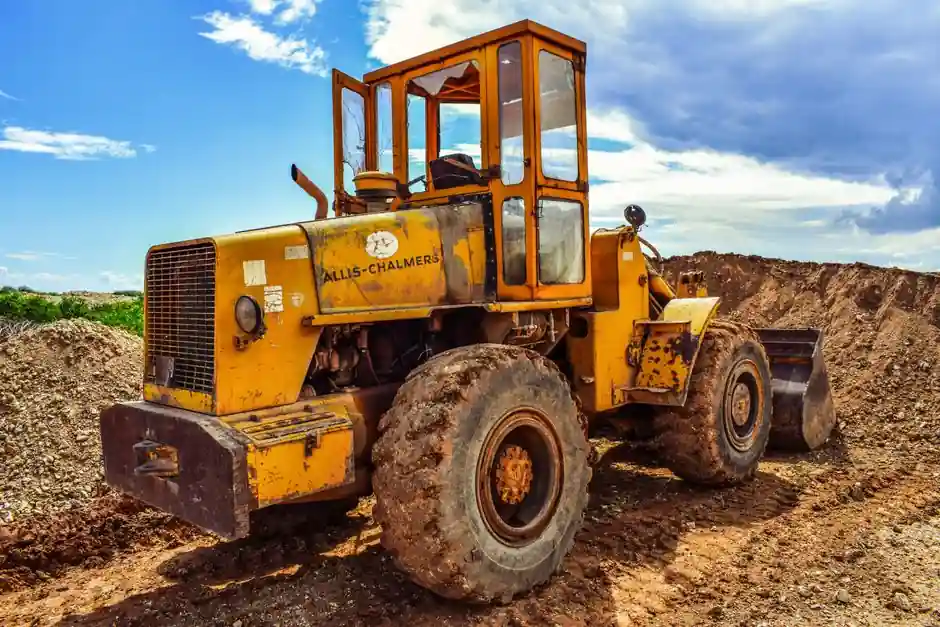
Wheel loaders and backhoe loaders both move material with a front bucket, but a wheel loader carries 1.5-6.0 m³ in a single pass and cycles every 20-30 seconds in a stockpile, while a backhoe loader typically tops out at 0.8-1.5 m³ on the front bucket and adds a rear excavator-style arm for trenching [S1][S2].
For a buyer in 2026, the decision is rarely about raw capability: both machines are mature, both are widely supported, and both share drivetrain and hydraulic platforms. It comes down to which task fills more than half the working day, what ground the machine lives on, and whether a single unit has to cover two job types without a support truck on site [S3][S10].
Core Design and Geometry: Bucket Up Front, and What Sits Behind It
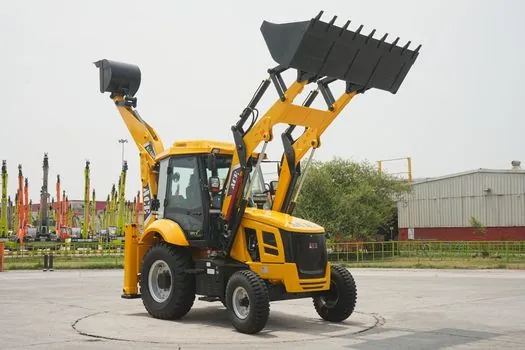
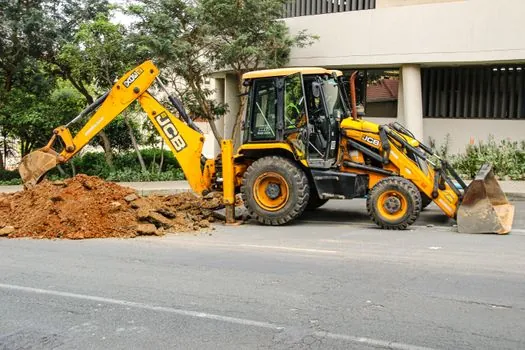
A wheel loader is a single-purpose loading tool: a large front-mounted bucket, a heavy rear counterweight, articulated steering, and four equal-sized wheels for traction under load [S4]. A backhoe loader bolts a smaller front loader on the same chassis and adds a rear-mounted boom, stick, and digging bucket, so one operator can swap between loading and trenching without leaving the cab [S2][S9].
Ground clearance is the visible tell: wheel loaders sit higher and have a longer wheelbase to keep the loaded bucket stable; backhoe loaders run lower for digging stability and to give the rear arm a clean swing arc, which also limits their side-slope work compared with a purpose-built wheel loader [S4][S5].
Operating Weight, Engine Power, and Bucket Capacity
Compact wheel loaders in the 1-3 m³ class typically run 50-110 kW engines with operating weights of 5-9 t, while full-size production wheel loaders span 150-400 kW and 12-30 t plus; backhoe loaders cluster in a much narrower band, around 55-75 kW and 7-10 t operating weight, with a 0.08-0.3 m³ rear bucket [S5][S10].
That tighter envelope is the practical limit of fitting a backhoe arm on the same frame: the rear boom, swing tower, and stabilizers eat into the counterweight budget, so the front bucket cannot grow as large as a dedicated loader's without overloading the front axle [S2][S9].
Productivity, Cycle Time, and Trench Reach
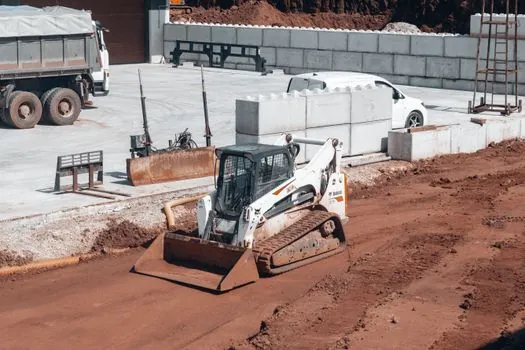
Wheel loaders win the loading cycle: bucket capacities of 3-5 m³, hydraulic times under 6 s for lift and 2 s for dump, and V-cycle truck loading patterns that put a 25 t articulated hauler in and out in under three minutes [S4][S5]. Backhoe loaders, by contrast, manage roughly half the bucket volume and noticeably slower truck-loading pace, but they can dig a 3.5-5.5 m deep, 0.3-0.6 m wide utility trench without a support excavator [S10].
That reach figure is the second key axis in any comparison: where a backhoe loader is rated, a wheel loader is not a substitute, and where a wheel loader is loading trucks for eight hours a day, a backhoe is the wrong tool [S2][S3].
Cost, Maintenance, and Total Ownership
A 1-2 m³ class wheel loader lists in the USD 80,000-150,000 range new, and a comparable backhoe loader sits in the USD 55,000-110,000 band, so the backhoe's two-function pitch carries a 20-35% cost premium over a similarly sized front-only machine, and remains 30-50% cheaper than buying a separate wheel loader plus a 6-8 t mini excavator [S7][S10].
Maintenance tracks the same split: wheel loaders have one hydraulic system, one set of loader-linkage wear parts, and lower hourly owning costs in pure loading duty; backhoe loaders add a second hydraulic circuit, swing gear, and stabilizer cylinders, which is why rental fleets price backhoe loaders roughly 10-20% above an equivalent wheel loader on daily or weekly rates [S7][S9].
Where Each Machine Wins, and Where It Loses
Wheel loaders are the right answer for quarries, aggregate yards, ready-mix plants, large road-building jobs, stockpile rehandling, and ship-loading, anywhere the work is repeated loading cycles into trucks, hoppers, or crushers [S1][S4]. They also handle snow, debris, and feedlot work where bucket volume and lift height matter more than trenching [S4].
Backhoe loaders earn their keep on urban utility installs, small subdivision earthworks, farm trenching for irrigation or drainage, municipal road patching, and rental fleets that need one machine to cover varied daily tickets, exactly the profile of a "Swiss Army Knife" of construction [S5][S6]. They lose when the operator needs 4 m³ per pass, when ground is soft and side-slopes are steep (a low, narrow backhoe is less stable than a wider wheel loader under a heavy load), or when daily digging depth exceeds about 5.5 m, at which point a tracked excavator is the right call [S2][S8][S10].
Operator Skill, Attachments, and Fleet Fit
Wheel loader operation centers on stockpile management: approach angle, heap selection, and tire preservation. Backhoe loader operation adds swing coordination, stabilizer setup, and trench-grade reading, which means new operators need 40-100 hours of seat time to be productive on the backhoe end without over-digging or undercutting [S3][S9].
On attachments, a wheel loader swaps buckets, forks, and snow tools via a quick coupler in under a minute; a backhoe loader shares the front quick coupler but adds a rear-pin interface that takes hydraulic thumbs, breakers, and compaction plates. The two machines do not share rear attachments cleanly, so a fleet that already runs a dedicated excavator will not recover much by adding a backhoe's rear arm [S3][S9].
Selection Matrix: Loading-Dominant vs Mixed-Duty Sites
Across the decision criteria that matter on a bid, wheel loaders lead on bucket capacity, lift height, loading speed, and hourly cost in pure loading duty; backhoe loaders lead on digging depth, jobsite mobility (often road-legal without a lowboy), single-machine capex, and versatility; they are roughly even on engine reliability, parts availability, and resale depth in mainstream markets [S5][S7][S9][S10].
Use this rule: if 70% or more of the working day is loading material into trucks, hoppers, or stockpiles, specify a wheel loader sized so each pass moves the rated payload in 3-4 cycles; if digging, trenching, and small-footprint loading each take meaningful daily hours, and a second machine is not in the budget, specify a backhoe loader and accept the lower front-bucket productivity as the price of having a dig function on board [S3][S6][S8].
Common Spec Sheets and What to Compare on Paper
When two quotes land on a desk, the line items that actually drive the choice are operating weight, engine net power, bucket breakout force, full-turn static tipping load, maximum lift height to pin, and, on backhoe loaders only, maximum digging depth and dipper stick crowd force [S5][S9][S10]. A wheel loader that is 10% heavier but carries 30% more bucket volume will normally win a loading-only bid; a backhoe loader with 1.0-1.5 m³ front and 4.0-4.5 m rear dig depth is the typical 2026 mainstream configuration for municipal and small-contractor buyers [S10].
For buyers comparing a wheel loader to a backhoe loader, also check hydraulic flow at the rear (for breaker and compactor work on the backhoe), steering articulation angle (38-45° is the usual wheel-loader band; backhoes sit lower at 30-35° because of the rear frame), and the warranty terms on the powertrain versus the hydraulics, since most field failures are hydraulic, not engine [S3][S9].
Limits, Failure Modes, and What the Spec Sheet Will Not Tell You
Wheel loaders fail in predictable ways: tire wear on abrasive aggregate, articulation joint play after 6,000-8,000 hours, and bucket-edge loss on shot rock. Backhoe loaders add swing-bearing fatigue, stabilizer outrigger bending on hard-pan digs, and front-axle loading on heavy backfill cycles, because the operator often loads with the backhoe arm folded and the front bucket full, pushing the front axle near its limit [S2][S3][S9].
Two field realities the brochures skip: first, a backhoe loader on soft ground with a deep trench will rut and re-grade the site as it works, so finish-grade crews follow it; second, a wheel loader cannot legally or safely substitute for an excavator on confined utility work, no matter how skilled the operator, because the geometry simply is not there [S2][S5][S8].
What to Watch Through End of 2026
Two spec-sheet items tend to move first when a model year changes: rated engine power (Stage V / EPA Tier 4 Final emission control adds 5-10% to engine price but rarely changes net output), and rear backhoe dig depth, which has crept from 4.0 m to 5.5 m on mainstream backhoe loaders over the past decade [S9][S10].
Trackable signals: OEM telematics reporting on tire-kWh per ton moved (a clean proxy for wheel loader efficiency), and dealer quoting patterns for backhoe loader rear-bucket options, since a richer rear attachment catalog usually predicts whether the OEM sees that segment growing in the next model year [S1][S3].
The underlying component specifications are covered under skid steer loader.
This topic is covered further in Excavator vs Road Roller: 2026 Spec Cut and Job-Site Split.