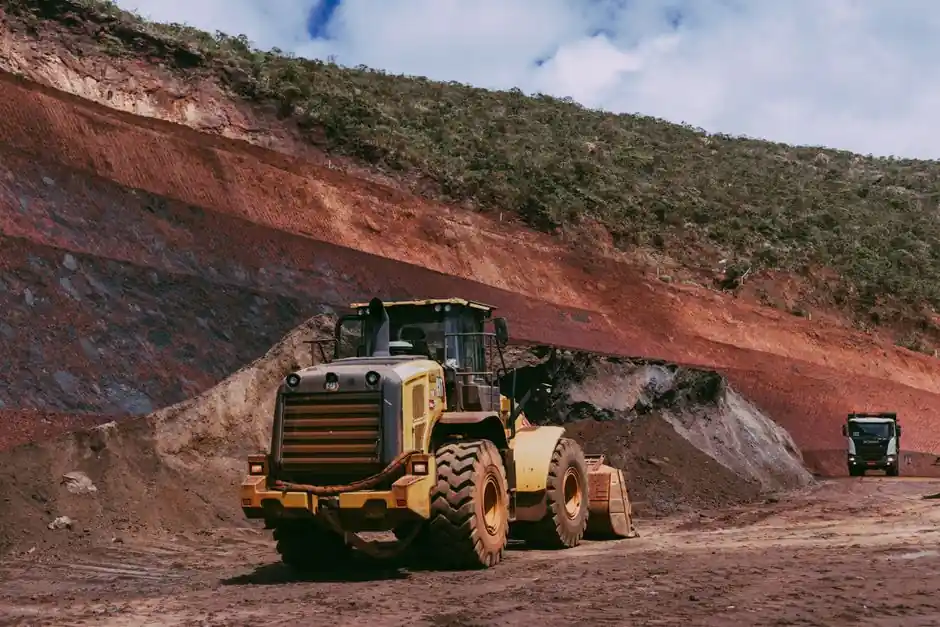
Wheel loaders and motor graders overlap on a haul-road or a subdivision pad, but they are built around different jobs: articulated loaders maximise bucket volume and cycle time, while motor graders exist to put a flat, true surface on the ground [S1][S2].
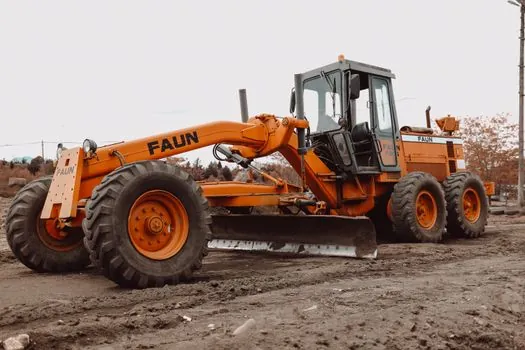
Operating weights for compact wheel loaders typically land in the 3–6 t class with bucket capacities of 0.6–1.5 m³, while mid-size motor graders run 12–19 t with 3.66–4.27 m moldboards and 360° blade rotation [S8].
Steering Geometry and Ground Disturbance
Wheel loaders steer through an articulated frame joint, which lets the front and rear axles track along the same arc and protects finished surfaces from scuffing, a measurable advantage on lawns, paved yards, and finished asphalt [S1][S5].
Motor graders use a long wheelbase and articulated frame as well, but the steering purpose is different: the operator needs slow, precise arc control to drag the moldboard across a lift without leaving washboard ripples, so travel speeds during cut typically stay below 8 km/h even though the machine can road at 0–40 km/h [S8].
For a contractor moving pallets of pavers across a finished plaza, the articulated wheel loader is the right tool. For a foreman chasing a 10 mm grade tolerance on a 300 m subdivision road, the motor grader is the only credible answer [S2][S5].
Cutting Tool: Bucket vs Moldboard
Wheel loader productivity scales with bucket capacity, breakout force, and travel speed between dig and dump, with 0.6–1.5 m³ compact buckets and higher travel speeds giving the loader its tonnage-per-hour advantage on stockpile and truck-loading cycles [S1][S3].
Motor graders carry a 3.66–4.27 m moldboard with 360° rotation, and the working variable is blade down-pressure combined with forward speed; daily fine-grading output is commonly reported at 2,000–4,000 m² per shift, against a road roller's 600–1,200 m² per 200–300 mm lift in compaction duty [S8].
For digging, backfilling trenches, or ripping root mats, a wheel loader with a toothed bucket wins. For shaving high spots, cutting ditches, or maintaining a crowned gravel road, the motor grader's moldboard geometry and drawbar pull are the productivity lever [S2][S8].
Travel Speed, Transport, and Cycle Time
Wheel loaders run faster between loading and dump points, and on articulated models travel efficiency across a 50–200 m haul is a documented reason fleets pick them over skid steers for aggregate handling and jobsite logistics [S1][S5].
Motor graders trade that speed for precision: their 0–40 km/h working range includes a low end close to zero, which is what allows an operator to feather a blade across a finish surface without gouging, and the same envelope lets the machine self-drive to a nearby site at road speeds [S8].
For truck-loading at a crusher, the wheel loader's higher travel speed and larger bucket drive higher tonnes-per-hour. For spreading a windrow of base rock across 2 km of road, the motor grader's reach and accuracy drive the productivity number [S2][S3].
Operator Comfort, Visibility, and Cab
Wheel loaders deliver larger cab space, lower vibration, smoother ride, and better forward visibility on long shifts, with articulated steering producing a noticeably calmer ride than the differential steering of a skid steer class machine [S1][S5].
Motor grader cabs sit rearward of the front axle and above the articulation joint, with a direct line of sight down to the moldboard and to both front and rear tires, a layout that supports the fine-grading tolerance the machine is specified to deliver [S2][S8].
For an operator running 8–10 h shifts, the wheel loader cab reduces fatigue on truck-loading cycles; for an operator dialing in cross-slope on a motorway, the grader cab's sight lines to the blade and tires are the productivity feature [S1][S2].
Use-Case Fit: Who Each Machine Is For
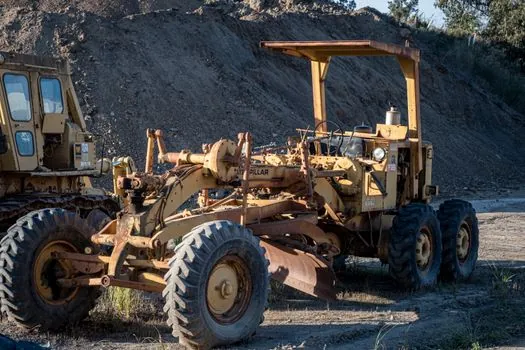
Spec a wheel loader when the dominant cycle is dig-load-haul-dump, the surface is firm, and the material is loose aggregate, soil, or chip. Spec a motor grader when the dominant task is cut-fill to elevation, fine-grading to tolerance, ditch cutting, or snow removal on long rural routes [S2][S8].
On a subdivision earthworks package the loader handles the structural fill and base-rock loading, the grader then shapes the roadbox to design grade before the roller compacts. The two machines are complementary on most road jobs, not substitutes [S2][S8].
For a quarry or aggregate yard with no fine-grading demand, the wheel loader alone covers truck loading, stockpile management, and feed to a crusher; a motor grader on that site is rarely justified [S1][S3].
Limitations and Failure Modes
Wheel loaders lose traction on soft, muddy, or uneven ground, and they slip on slopes where a tracked undercarriage would still hold; a small wheel loader can also run out of tip-load margin before the bucket is full on dense material [S3][S4].
Motor graders are mechanically inefficient below about 1.5 km/h and cannot rotate inside their own footprint, so they struggle on confined pads, backfill inside a building footprint, or anywhere a zero-radius turn is needed; they also cannot dig effectively against a vertical face the way a loader bucket can [S2][S3].
For landscaping and finished-surface work, both machine types outscore a skid steer on surface protection, but the loader still beats the grader on travel speed while the grader still beats the loader on precision [S1][S5].
Decision Matrix at a Glance
Bucket vs moldboard: wheel loaders deliver 0.6–1.5 m³ per pass on compact models, motor graders deliver 3.66–4.27 m of cut width per pass. Daily output: motor graders cover 2,000–4,000 m² of fine grading per shift against a compaction-focused roller's 600–1,200 m² per lift [S8].
Steering: articulated loaders protect finished surfaces; motor graders use the same articulation concept but for cut control, not surface protection. Operating weight: compact loaders sit 3–6 t, mid-size graders 12–19 t, which matters for transport permits and ground-bearing pressure [S1][S8].
Selection rule: pick the wheel loader for high-volume truck loading, stockpile management, and aggregate handling on firm ground; pick the motor grader for roadbed finish, ditch work, and any task where a 10 mm-grade tolerance is a contract requirement. For an earthworks package, plan to run both on the same crew, the loader on bulk cycles and the grader on finish passes [S2][S3][S8].
For a closer head-to-head against another earthmoving tool, the wheel loader vs bulldozer spec cut walks through the dozer's edge in soft ground and push-loading duty. Track a borrow-pit ground-pressure table, a moldboard-down-pressure table in kPa, and a cab-ergonomics comparison for the operator shift before sign-off on the next delivery.
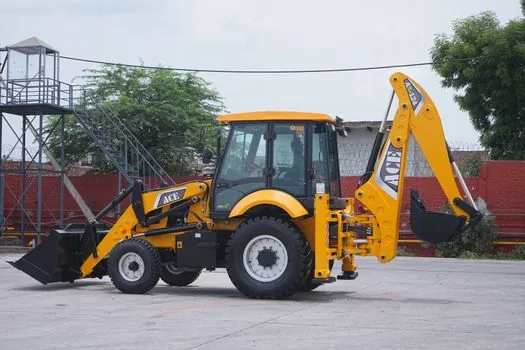
Spec-level background on the components involved: backhoe loader.