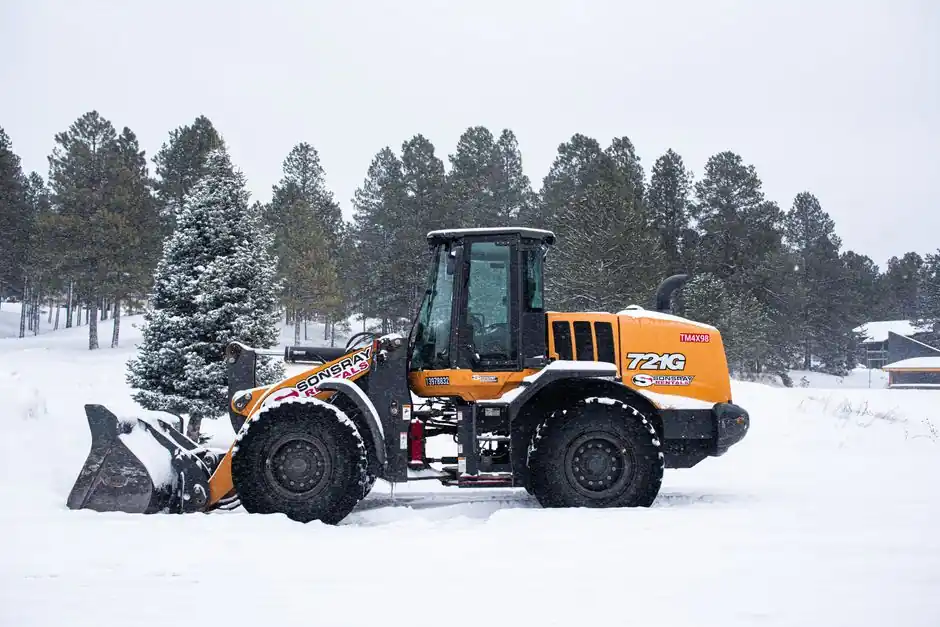
A wheel loader is a carrier built around a hydraulic front bucket and four large pneumatic tires, with an articulated frame for tight turning; a bulldozer is a pusher built around a front-mounted steel blade and continuous tracks, often paired with a rear ripper. The two machines share diesel powertrains and a hydraulic system, but their locomotion, ground pressure, and implement geometry make them complementary rather than substitutable on a 2026 job site [S1][S3][S7].
The decision rarely hinges on engine horsepower alone. Cycle distance, material density, slope, finish tolerance, and the availability of truck haulers drive the choice far more than peak kW, which is why a fleet manager evaluating a wheel loader against a bulldozer should start with duty profile, not spec sheet.
Undercarriage and Ground Pressure: Why Tracks Beat Wheels on Soft Ground
Bulldozers run on continuous steel tracks that spread machine mass across a large footprint, dropping ground pressure into the 0.4-0.7 bar range typical for mid-size crawler dozens and giving stable traction on mud, clay, or loose fill [S1][S3]. Wheel loaders run on four large pneumatic tires, which concentrate load through contact patches measured in square centimeters rather than square meters, producing ground pressures roughly 4-8x higher than a tracked dozer of equivalent operating weight [S1].
The practical consequence is terrain-driven: dozers hold grade and push force on slopes and soft subgrade where a wheeled machine would sink, lose tractive effort, or churn the surface. Wheel loaders repay that limitation with road speed, often 35-40 km/h versus 6-12 km/h for crawlers, and the ability to self-transport between pads without lowboy trailers [S2][S3][S6]. For an operation that must move between quarries, batch plants, and stockpile yards on public or paved roads, that self-mobility alone can change the equipment economics.
Implement Geometry: Bucket and Lift Arms vs Blade and Ripper
A wheel loader's primary tool is a bucket on a parallel-link or Z-bar lift arm, with a hinge pin height that determines how high the machine can load a haul truck; modern 3-5 m³ class loaders typically hinge at 3.5-4.3 m, enough to clear the sideboards of a standard on-highway dump truck [S1][S5]. The same machine accepts forks, grapples, brooms, and snow blades through a quick-coupler, turning a single prime mover into a year-round utility asset for agriculture, recycling, and stockyard work [S2][S3][S5].
A bulldozer's primary tool is a steel blade, available in straight, angle, and universal (U) configurations; U-blades move the largest volume per pass for soft soils, while angle blades cut ditches and windrow material off to one side [S6]. High-end dozens add a rear-mounted single- or multi-shank ripper for breaking hardpan, frozen ground, or soft rock before the blade pass, a capability no wheel loader bucket can match without extensive machine stress [S1][S3][S6]. The blade itself tilts, angles, and lifts via hydraulic cylinders tuned for sustained lateral force rather than vertical lift.
Hydraulic Tuning: Lift-and-Dump Cycles vs Sustained Push Force
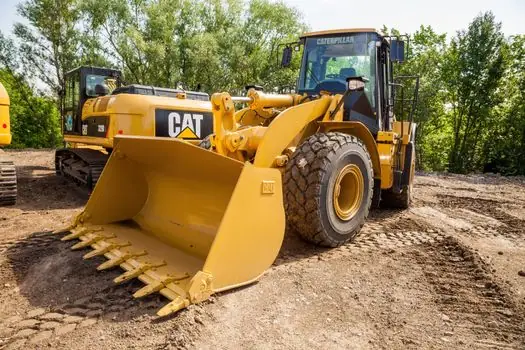
Wheel loader hydraulics are sized for cycle speed: lift, tilt, and dump in 10-15 seconds, with breakout force engineered to peel a loaded bucket out of a stockpile. Bulldozer hydraulics are sized for sustained push: large-bore tilt and lift cylinders hold the blade at grade under continuous load without pressure spikes that would stall a wheel loader's pump [S1][S3].
The mismatch shows up fast in the field. Running a wheel loader in continuous push mode, for example backfilling a trench by shoving material rather than carrying it, generates heat in the transmission and excessive wear on the drive tires, with one manufacturer guidance explicitly warning that prolonged pushover work stresses wheel loader hydraulic systems and tires beyond their design envelope [S2]. Conversely, asking a dozer to load trucks bucket-by-bucket is mechanically possible but throughput-poor, since a dozer cannot carry material in its blade.
Selection Criteria: Distance, Material, Slope, Finish Tolerance
Four criteria decide the equipment call on a real project, and the right answer flips when any one of them changes. [S2]
First, haul distance. Under roughly 30 m of push or carry, a dozer is often faster because it can blade material directly; above that distance, a wheel loader wins because it can scoop, transport, and dump in a single cycle without multiple push passes [S6][S7].
Second, material type. Free-flowing aggregates, sand, gravel, and demolition debris favor a loader bucket with teeth or a bolt-on cutting edge. Sticky clay, shot rock, root mats, and timber slash favor a dozer blade, which can hold a mixed load against its moldboard without the material dropping out the way it would from a curled bucket [S2][S5][S6].
Third, slope and traction. On grades above roughly 30% or subgrade with low bearing capacity, a tracked dozer holds the line; a wheel loader will spin tires and require a push dozer as an assist, which defeats the cost case [S1][S3].
Fourth, finish tolerance. Final grading to within centimeters on a road subgrade or pad calls for a dozer with a fine-grade capable blade, often paired with machine-control GNSS on larger units. Wheel loader buckets cannot trim a surface to that tolerance without a skilled operator and several rework passes [S3][S6].
Decision Matrix: Wheel Loader vs Bulldozer by Duty
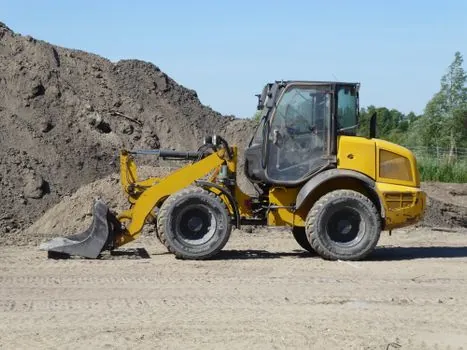
Stacked against each other on the four most common decision drivers, the comparison is direct.
For a quarry or aggregate yard loading 30-ton haul trucks on a hard, level pad, the wheel loader wins on cycle time and fuel per ton, with typical loader bucket payloads in the 3-6 m³ range matched to truck body volumes [S5][S7]. For mine overburden removal or land clearing on a soft or steep site, the dozer wins on traction, blade volume per pass, and the ability to fit a ripper to break ground ahead of the push [S1][S3][S6].
For road building subgrade work, the dozer's fine-grade capability and sustained push force make it the primary tool, with a wheel loader brought in only for truck loading at the cut face [S3][S6]. For an agricultural operation moving silage or grain into storage, the wheel loader's attachment range (forks, buckets, grapples) and road speed make it the only practical choice, since a dozer cannot legally or economically self-transport on public roads in most jurisdictions [S2][S7].
Limitations, Failure Modes, and Misuse Costs
The dominant failure mode on wheel loaders pushed into dozer duty is tire and final-drive wear: a wheel loader that spends shifts bulldozing a fill pad rather than load-and-carry will see tire life fall and driveline temperatures climb, with one manufacturer explicitly warning that "wheel loaders are not designed for continuous pushing operations" and that prolonged pushover work causes "excessive stress wear on their hydraulic systems and tires" [S2].
The dominant failure mode on dozens pulled into loader duty is undercarriage wear combined with slow cycle times: a dozer used to spot-load trucks spends most of its shift stationary with the blade curled, which loads one track more than the other and accelerates bushing and sprocket wear without moving material productively [S3][S6]. Both failure modes are well-known, yet contractors continue to misuse either machine on the wrong duty, typically because the right machine is not on site.
Standards, Sourcing, and 2026 Specification Watch
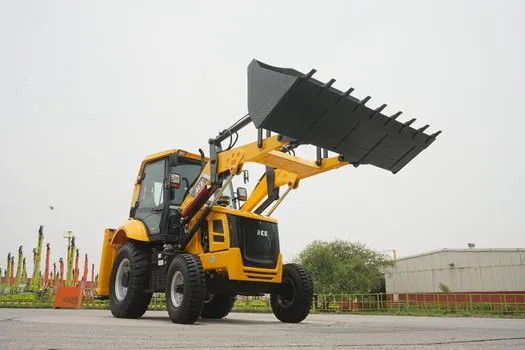
No single ISO or SAE standard dictates wheel loader vs bulldozer selection, but a few referenced documents shape the spec floor buyers should demand. Engine emissions compliance under regional rules (EU Stage V, US EPA Tier 4 Final, China NR4) is the baseline for any diesel prime mover delivered in 2026, and operators should confirm the nameplate rating rather than assume parity [S6][S8]. Undercarriage life on dozens is governed by ISO 6747 for terminology and ISO 7131 for crawler machines, which buyers can cite when comparing specifications across brands [S3].
For attachment interchangeability on wheel loaders, the ISO 23727 interface standard defines the coupler geometry and hydraulic line connections; specifying an ISO 23727-compliant quick-coupler up front lets a buyer swap forks, buckets, and grapples without custom hydraulics [S3]. For dozer blades, blade capacity is commonly given in cubic meters heaped or struck, with U-blades on a 20-ton class dozer typically in the 4.5-6.5 m³ heaped range and S-blades roughly 30% smaller, useful when comparing competitive bids line by line [S6]. Buyers sourcing from China should also reference the 2026 supplier guidance at Excavator vs Road Roller: 2026 Spec Cut and Job-Site Split for the related earthmoving category, and consider the broader wheel loader reference page for bucket geometry and lift-curve detail when finalizing the spec.
Track the next two signals before ordering: (1) whether a site has shifted from push-dozing to load-and-carry by adding a wheel loader fleet at the cut face, which would tell you the dozer-only fleet is underperforming on haul distance, and (2) whether ripper-equipped dozens are being specced for a project, since the presence of a ripper on the bid list confirms the ground is hard enough to need ground-engagement tools that a wheel loader bucket cannot replicate.
Spec-level background on the components involved: backhoe loader.