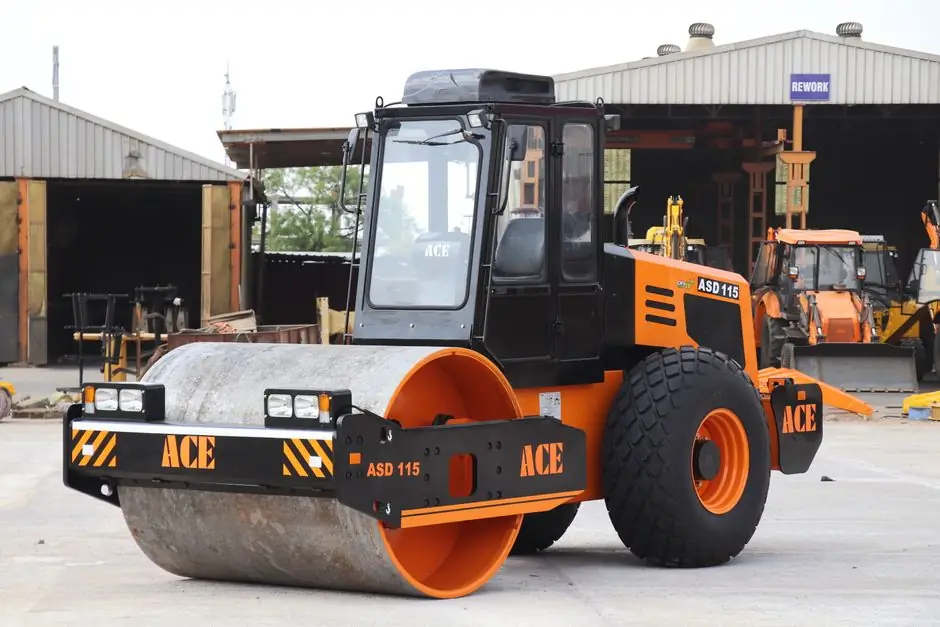
An excavator is a 360-degree hydraulic digging and loading machine with operating weights commonly spanning 1 tonne mini-class up to 100+ tonne mining-class, while a road roller is a single-purpose compactor that hits density targets through static linear load and dynamic vibration, typically 25-50 Hz depending on lift thickness and material [S3][S4].
The two machines rarely substitute for each other on a real site: an excavator's primary function is below-grade work (dig, trench, load, demolish), and a roller's primary function is density achievement on subgrade, sub-base, or asphalt lifts. Procurement teams that try to compress the role of either machine usually pay for it in rework, low Proctor hits, or premature undercarriage wear [S4][S5].
Working Principle and Machine Architecture
An excavator digs via a hydraulically actuated boom, stick, and bucket mounted on a rotating upper structure, giving a full 360-degree swing and a digging depth that scales with boom length: compact 1-2 tonne minis reach roughly 2-2.5 m, while 30-tonne class machines commonly dig past 7 m. Power is delivered from a diesel engine through hydraulic pumps to boom, stick, bucket, swing, and track motors, with bucket breakout force commonly in the 100-300 kN range on 20-30 t production-class units [S3].
A road roller applies static weight and dynamic vibration through one or more drums to compact soil, aggregate, or asphalt. Single-drum vibratory rollers carry the compactive effort in one steel drum plus drive tires; tandem rollers split the effort across two vibrating drums for asphalt finishing; pneumatic-tire rollers use rubber tires for kneading action on bituminous layers. Walk-behind plates start near 100 kg, ride-on tandem rollers commonly land between 1,200 kg and 14,000 kg, and large single-drum soil compactors exceed 20,000 kg [S4].
Selection Criteria: Job Type Drives the Decision
Specify an excavator when the task is below-grade: foundation digging, utility trenching, river dredging, demolition loading, or slope cutting on a road job site. The dominant decision gates are bucket breakout force (kN), dig depth (m), engine power (kW), and the ability to swap attachments such as augers, breakers, and vibratory compaction plates on the rear stick [S3][S4].
Specify a road roller when the task centres on hitting a target density: Proctor or Modified Proctor percentages for sub-base and subgrade, or a specified air-void content on asphalt lifts. The decision gates are drum width, static linear load (kg/cm), dynamic force (kN), frequency (Hz), and amplitude (mm). On cohesive soils a padfoot or sheepsfoot drum shears the layer to drive out air; on granular soils a smooth drum with high amplitude achieves the required relative density [S4].
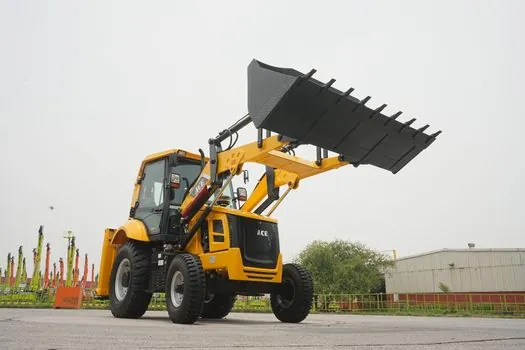
For mixed job sites that need both, fleets typically run one or more excavators feeding loading shovels or dump trucks, plus a roller train (sometimes preceded by a paver on surfacing work) rather than substituting one machine for the other [S3][S4]. On backhoe-loader-led utility jobs, the same logic holds: the loader backfills, the roller hits density, and neither replaces the other.
Compaction Capability and Undercarriage Stress
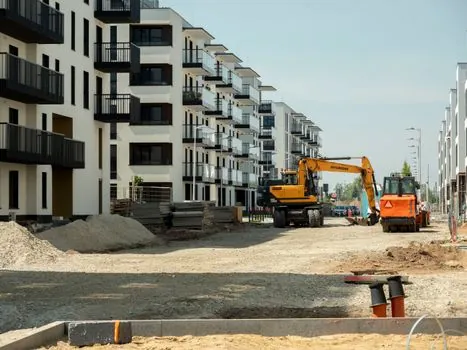
On granular soils, a smooth drum with high amplitude achieves the required relative density; vibratory frequency typically sits between 25 Hz and 50 Hz depending on lift thickness and material [S4]. An excavator or backhoe equipped with an attachment vibratory roller is increasingly used for trench backfill and shoulder work, where the boom reach lets the operator compact in places a ride-on roller cannot access, and the hydraulic drive holds frequency steady under variable load [S2]. Plate compactors fill the same access role at lower output, typically 100-200 kg class walk-behind units for sidewalks, footpaths, landscaping, driveways, and minor repair work [S2].
Underneath both machines, the undercarriage tells a different story. Bulldozer and excavator track rollers look similar but are not interchangeable: bulldozers generate continuous forward thrust as the blade pushes against soil, so the roller train experiences repeated longitudinal loading with vibration and impact. Excavators create changing loads as the boom, arm, and bucket dig, lift, swing, and reposition, so the centre of gravity shifts and some rollers see greater vertical pressure while others go lightly loaded. The same logic applies to a road roller's rubber-tire or steel-drum ground-contact parts: load direction, not outside diameter, drives the design [S1][S5].
Decision Matrix: Criteria Side by Side
The core decision between an excavator and a road roller comes down to four hard criteria, and lining them up removes most of the guesswork on the 2026 buying floor: [S4]
Primary function: excavator equals dig, trench, load, demolish; road roller equals compact to a specified density percentage. Operating weight class: excavator spans 1-100+ t with engine power 20-160 kW across mini to 30 t production; road roller spans roughly 0.1-20+ t with engine power typically 10-120 kW depending on drum configuration. Ground-contact mechanism: excavator uses a steel track chain on rollers, idlers, and a sprocket, with load path that shifts under swing and dig; road roller uses a static-plus-vibratory drum or pneumatic tires, with load path that stays vertical under the drum axis. Output metric: excavator output is rated in m³/h or tonnes per cycle for the bucket; road roller output is rated in m²/h or linear metres per pass to a target density at a given lift thickness [S3][S4].
For trench backfill and utility work under 4 m depth, a backhoe loader with a vibratory plate compactor attachment will frequently outperform a stand-alone roller on access, while a ride-on tandem handles the open lane. For highway subgrade on cohesive soil, a 12-20 t single-drum padfoot roller at 28-35 Hz and 1.5-2.0 mm amplitude is the default choice; an excavator on the same lift is misapplied equipment.
Limitations, Failure Modes, and Cross-Compatibility
Track rollers for a bulldozer and an excavator are not interchangeable even when outside diameter, flange profile, and shaft diameter match, because the load paths are different: a bulldozer roller's internal bushing and seal package is sized for sustained longitudinal blade resistance, while an excavator roller's package is sized for the vertical, lateral, and shifting loads that come with swing and dig cycles. Forcing the swap typically shows up as flange wear, seal failure, chain misalignment, or localised spalling within a few hundred hours [S1][S5].
On the compactor side, a plate compactor is the wrong tool once area, lift thickness, or material moves out of the light-and-medium range: it produces uneven results in large spaces and forces the operator to make many more passes to hit the same density that a vibratory roller reaches in a single lift [S2]. Likewise, a ride-on roller is the wrong tool for a 300 mm wide trench where the boom of a backhoe or mini-excavator can place an attachment drum precisely. Pairing the wrong machine to the lift usually costs more in time and fuel than running the correct dedicated machine [S2][S4].
Beginner-operator pathways also reflect the same split: roller operators focus on compaction quality, moisture, and lift thickness monitoring, while excavator operators focus on dig geometry, swing clearance, and load control, and crews are staffed separately on real road and subdivision jobs [S6].
Sourcing, Standards, and Field Checks
Spec sheets from Chinese export channels such as Shandong Davoo Machinery, Weifang Yishan Heavy Machinery, Jining China Power Machinery, and Massbetter Industrial show both categories shipping from the same OEM base, with backhoe-loader export units in the 50-100 hp diesel class and torque-converter drivetrains, and rollers in single-drum, tandem, and pneumatic-tire configurations in matching weight classes [S4].
For daily field checks, the inspection list is the same logic on both machines: engine oil and coolant, hydraulic fluid, drum surface and tire condition on rollers, water spray nozzles and tank levels for asphalt work, vibration system functionality, plus undercarriage inspection (track tension, roller flange wear, idler seal leakage) on tracked excavators and bulldozers [S7]. Density verification on the roller side still relies on Proctor or Modified Proctor reference, nuclear or sand-cone field tests, and on asphalt lifts a specified air-void target measured from cores.
For buyers building a mixed fleet, the safe rule is to specify each machine against its own dominant load path, not against a shared duty cycle: an excavator against bucket breakout force, dig depth, and undercarriage life under variable swing load, and a road roller against drum static linear load, vibratory frequency, amplitude, and the density percentage the spec requires [S3][S4][S5]. For a deeper frame of reference on roller types and undercarriage parts, see the road roller, excavator, and roller bearing encyclopedia entries.
Trackable signals for the next buying cycle: whether OEM published 2026 price lists converge between excavator and roller categories in the Chinese export channel, and whether the undercarriage wear data from mixed-fleet operators confirms or breaks the not-interchangeable rule for rollers across more machine classes [S1][S4].
Related analysis: Solar Cell OEM vs ODM Manufacturing: 2026 Spec, Cost, and IP Trade-Offs.