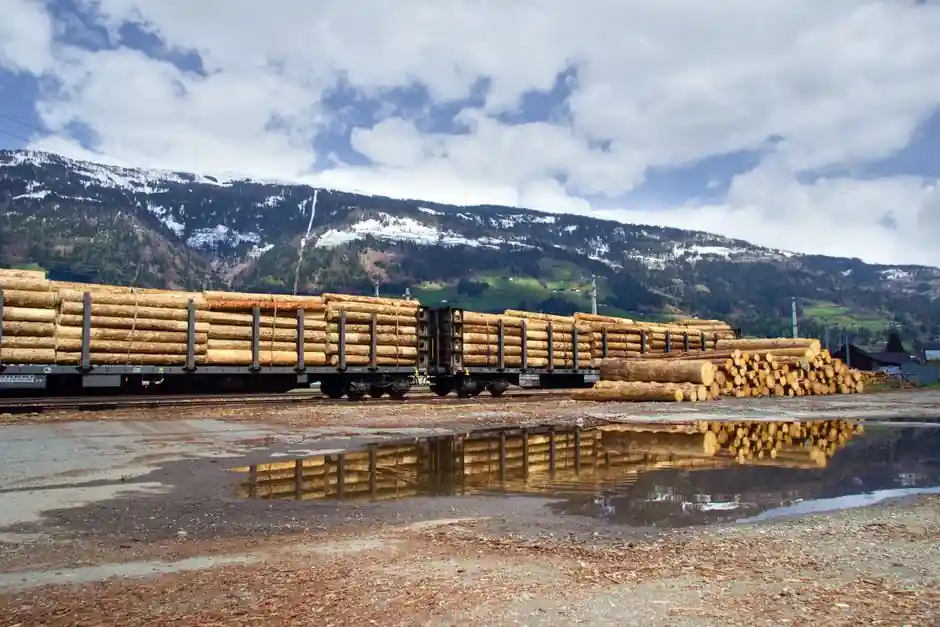
Forestry fleets running forwarders, harvesters, and chip trucks on remote cut blocks see a recurring tank spec: an ISO 20 ft tank container in the 14,000-26,000 L range, paired with a smaller unit for diesel exhaust fluid and a third for boiler/process water at the landing.
Per current forestry equipment guidance [S1], above-ground steel and plastic tanks dominate small-volume on-site fuel duty, while ISO frame tanks and flexitanks split the long-haul and intermodal lanes, with the right pick driven by fuel class, road access, and the certification thresholds of the jurisdiction the truck enters [S2].
Diesel and AdBlue: the primary duty pair
Diesel for forwarders and skidders stays the highest-volume liquid on a forestry contract, and 316L stainless tank containers are the default for routine diesel haul because the grade tolerates biodiesel blends up to B20 without internal coating failure [S1]. AdBlue (ISO 22241, 32.5% urea in deionised water) is a separate, smaller tank: it is corrosive to carbon steel and to aluminium, so the AdBlue tank must be a dedicated stainless unit or an IBC tank lined with a urea-compatible polymer, never a fuel-diesel swap body [S1].
Pairing rules from WorkSafe NZ are explicit: a stationary container system holding more than 60,000 L of a Class 3.1 substance (which includes diesel) triggers fixed fire-fighting equipment, and any liquid hazardous-substance tank above the regulation's threshold quantity needs secondary containment plus a compliance certificate under the Health and Safety at Work (Hazardous Substances) Regulations 2017 [S2]. On a forestry landing that usually means a bunded hardstand of 110% of the largest tank, not an extra tank.
Process water, dust suppression, and tannin-bearing extract loads
Forestry landings consume water for dust suppression on gravel roads and for chip-pile conditioning, typically 5,000-12,000 L per shift. For non-hazardous water duty, a rubber-lined carbon steel tank container is the cheapest spec and tolerates the routine freeze-thaw seen on northern cut blocks [S1].
Where the cargo is a non-hazardous liquid extract (tannins, tall oil derivatives, wood-based glycols), the flexitank path is now operationally mature. A 20 ft standard container fitted with a single-use flexitank carries up to 24,000 L at 0-70 degrees C, with bulkheads and valves built to ISO 9001:2015 and an inspection chain that includes flexitank testing, container selection, manufacture, and installation under the ICHCA Briefing Pamphlet series [S3][S4]. The catch: flexitanks are explicitly for harmless liquids, so they do not replace a UN-certified tank container on any diesel or AdBlue lane [S3].
Spec comparison: the four forestry-viable options
Lining the four options up against the decision criteria a forestry procurement officer actually weighs:
ISO 20 ft stainless (316L) tank container: 14,000-26,000 L, suitable for diesel and B20 biodiesel, suitable for AdBlue if dedicated, suitable for process water; UN certification for fuel classes, multi-trip, high capex, 25-year typical service life [S1][S2].
Rubber-lined carbon steel ISO tank: 16,000-24,000 L, suitable for process water and some non-hazardous chemicals, NOT suitable for AdBlue, NOT suitable for diesel long-term, lower capex than full stainless; lining is the wear item [S1].
Flexitank in 20 ft dry box: 12,000-24,000 L, suitable for non-hazardous liquid extracts only, single-use (one-way) lowers freight and handling cost, no UN packaging code for hazardous goods, requires food-grade or chemical-grade liner selection per cargo [S3].
Stackable IBC tank (1000 L, caged): good for site-to-site diesel shuttles, AdBlue shuttle, and chainsaw two-stroke mix; easy forklift handling on rough landings; not road-registered above ~1000 L in most jurisdictions, so it is a last-mile tool, not a long-haul tool [S1].
Certification, secondary containment, and the regulatory trip-wires
New Zealand's WorkSafe framework gives a clean reference for what "compliant" looks like elsewhere: a stationary tank needs an approved design, a compliance certifier's sign-off, an approved fabricator (or one-off approval), and installation to the Hazardous Substances Regulations 2017; above-threshold quantities also need a compliance certificate and secondary containment, with fire-fighting equipment mandatory beyond 60,000 L of Class 3.1 liquids or 12,000 L of liquefied gas [S2].
Forestry operations in the EU, Australia, and Canada run analogous rules under ATEX 2014/34/EU for any refuelling zone, ADR for road haul, and IMDG Code for any barge or short-sea leg. The recurring spec gate, independent of jurisdiction, is that diesel and AdBlue must not share a tank or a delivery hose, and the AdBlue line must use stainless 304/316 or a urea-rated polymer to keep the ISO 22241 concentration on spec [S1][S2].
Cleaning, turnaround, and the hidden cost line

Forestry tank fleets turn fast in mud, sawdust, and pollen season, so cleaning spec is not optional. A heated tank cleaning machine rated for Class 3.1 residue is the baseline for diesel units between fuel swaps; the same machine, fitted with a different nozzle pattern, handles the food-grade rinse-down required when a flexitank trailer is repurposed for molasses or juice in the off-season [S3][S4].
ICHCA's briefing pamphlet set covers the full chain: flexitank testing, container selection, flexitank manufacture, installation, and the flexitank/container compatibility check that determines whether a one-way liner can be loaded into a specific ISO box without weld-spatter or chemical residue issues [S4]. Forestry buyers who skip the cleaning step on a shared container fleet are the ones who see the cross-contamination claims at the end of the season.
Selection flow that survives an audit
Use this four-step filter on every forestry tank purchase: (1) classify the cargo, diesel (Class 3.1), AdBlue (Class 8 corrosive on most metals but non-hazardous in transport), process water, or non-hazardous extract; (2) match the container material to that class, 316L stainless for diesel/AdBlue, rubber-lined carbon steel for water, flexitank liner grade for the extract; (3) confirm the certification lane, UN packaging code for fuel, ISO 22241-compatible stainless for AdBlue, ISO 9001:2015 flexitank build for the liner; (4) size the secondary containment to 110% of the largest single tank on the landing and check the local fire-fighting threshold [S1][S2][S3].
Trackable signals to watch through the rest of 2026: ICHCA's flexitank/container compatibility briefing is the most recently referenced document in the cargo-handling library, and the BRELOG-style 24,000 L one-way flexitank in a 20 ft box is the option most often compared against an ISO 316L swap-body for non-hazardous forestry extract lanes [S3][S4]. Tank container fleets on AdBlue shuttle duty in northern cut blocks remain the most under-spec'd link, with 304 stainless and lined carbon steel both in active service, per the same forestry equipment guidance [S1].
Related analysis: Tank Container Selection for Agriculture: Water Duty, Capacity, and Material Map.