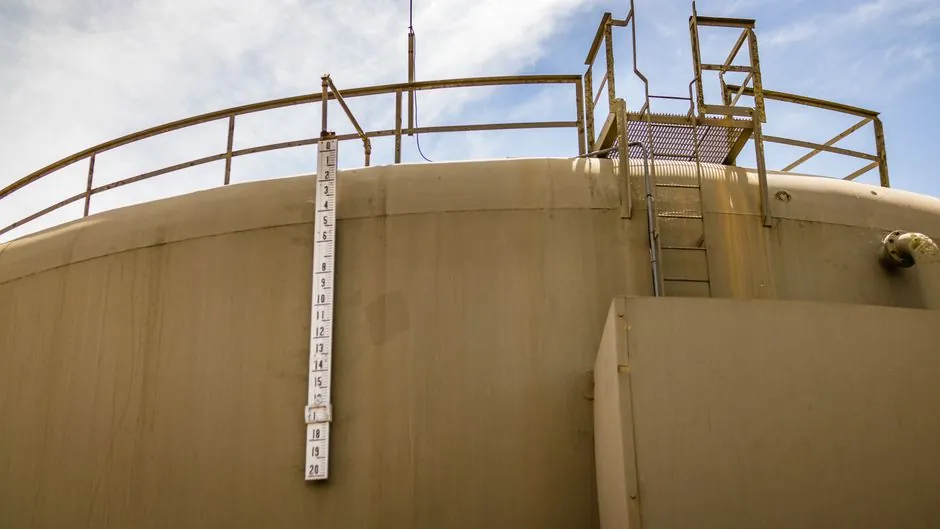
Landfill leachate is one of the most chemically aggressive industrial wastewaters a tank will ever see, and the dominant 2026 spec map for tank container selection is built around three material families: AISI 316L stainless, glass-fused-to-steel (GFS) panels per AWWA D103-09 and ISO 28765, and HDPE or FRP-lined carbon steel with a secondary containment bund [S1][S2][S4].
Design loads that drive the choice are not subtle: pH can swing across the full 1-14 range in a single site, chlorides routinely exceed the pitting threshold of 304-grade steel, COD hits 50,000 mg/L, and design temperatures must cover -10°C to +60°C for outdoor North-European cells [S1][S2]. Choosing on price alone, especially with welded carbon steel and no lining, is the single most common reason leachate tanks fail before year 10.
Three Material Families, Three Failure Modes
AISI 316L stainless, with 2-3% molybdenum, is the corrosion baseline for high-chloride, high-ammonia leachate; the "L" grade prevents intergranular corrosion at welds, and duplex 2205 doubles yield strength for large equalization vessels [S4]. GFS tanks from CEC bolt up glass-fused-to-steel panels fired above 820°C, deliver 3,450 N/cm² covalent bond adhesion, and pass a factory 1,500 V spark test for holiday-free coating at claimed lifespans of 30-50 years [S2][S5]. Epoxy-coated carbon steel and HDPE/FRP-lined carbon steel sit in the budget tier, with published lifespans of 10-15 years and 15-25 years respectively, but they require recoating schedules and UV protection that 316L does not [S1][S4][S7].
The trade-off is mechanical, not chemical: HDPE creeps under sustained load, GFS can be field-damaged by impact, and 316L is the only option that survives both chloride pitting and routine weld-zone inspection without a lining program [S4]. For an EPC buyer, the decision tree is short: 316L for premium 30+ year service, GFS for fast-build bolted tanks up to 60,000 m³, lined carbon steel or HDPE only when capital cost trumps lifecycle cost.
Capacity, Footprint, and the ISO Container Option
For transfer and overflow duty rather than bulk equalization, IBC tank and ISO container-format tanks dominate. Reynolds & Bauhm's containerised range runs 3.96 m³ (C1) to 55.20 m³ (C10) at 2,200-2,300 mm height, fitting standard ISO corner castings for road and rail haulage; free-standing low-, medium-, and high-profile formats extend to 105 m³ at 10,000 x 3,500 x 3,000 mm [S1]. Bulk bolted GFS panels cover 100 m³ up to 60,000 m³ in single-cell configuration, with roof options including GFS, aluminum dome, FRP, and membrane covers for odor and evaporation control [S2][S6].
Krampitz's KTD-FA-30-B double-walled unit, deployed at Deponie GmbH Altmarkkreis Salzwedel, sits in the middle: 29,200 L at 100% on an 8,180 x 2,280 x 2,405 mm frame, fully thermally insulated with an internal electric heater to prevent freezing, all stainless piping, and a vacuum leak detector on the roof that alarms on either wall breach [S3]. That configuration is the working template for cold-climate European cells where winter operation rules out simple atmospheric tanks.
Compliance, Detection, and the Secondary Bund
Regulatory framing depends on jurisdiction but the engineering content is consistent: AWWA D103-09 for bolted steel, ISO 28765 for vitreous-enameled steel, NSF/ANSI 61 for potable-water contact (used as a chemical-inertness proxy on some sites), ASME Section VIII for pressure-rated vessels, EPA 40 CFR and RCRA in the US, the EU Landfill Directive across Europe, and EA / SEPA permits in the UK [S1][S2]. CE and OSHA markings round out the typical export package from Chinese GFS suppliers [S2][S5][S7].
Secondary containment at 110% of primary capacity is the standard spec, with leak detection specified as standard equipment rather than optional; Reynolds & Bauhm pairs the bund with radar or ultrasonic level control and EPDM or Viton gaskets selected for the site's chemical profile [S1]. GFS panels add a built-in holiday-detection step via the 1,500 V spark test, which is the practical answer to the failure mode that defeats most field-applied coatings: sub-millimeter pinholes that go unnoticed until chloride finds the substrate [S2][S5].
Site Chemistry Gates: pH, COD, Chloride, Temperature
Specifying engineers should lock the envelope before choosing a lining. Reynolds & Bauhm publishes a working envelope of pH 4-9, COD up to 50,000 mg/L, design pressure atmospheric to 1 bar, and -10°C to +60°C design temperature for standard SS316/316L builds, with HDPE/FRP linings and EPDM/Viton gaskets as chemical-compatibility options [S1]. GFS vendors extend the pH envelope to 1-14, claiming full-range chemical inertia from the vitreous coating and 6.0 Mohs hardness against abrasive grit in raw leachate [S2].
Stainless vendors push the case harder on chloride: 316L's 2-3% molybdenum content is the minimum for resisting pitting in landfill-side matrices, and duplex 2205 is the upgrade path when equalization tanks exceed 5,000 m³ or when chloride concentrations exceed the 316L envelope [S4]. For cold-region or alpine cells, internal electric heating plus full thermal insulation (as on the Krampitz KTD-FA-30-B) is non-negotiable, and freeze protection must be specified alongside level instrumentation, not after [S3].
Decision Matrix: 316L vs GFS vs Lined Carbon Steel vs HDPE
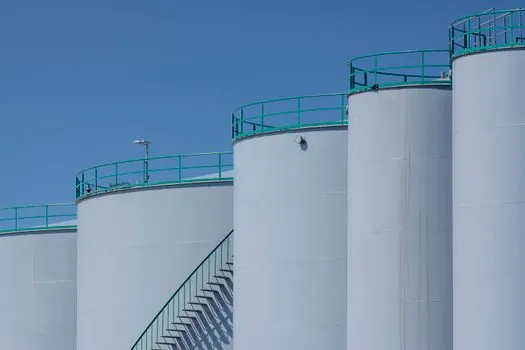
Corrosion and chemical defense rank AISI 316L highest on chloride, acid, and ammonia exposure, with GFS close behind for pH 1-14 inertness; lined carbon steel is "low to moderate" with blistering risk over time, and HDPE resists chemicals but is vulnerable to UV degradation and structural creep [S4]. Structural and load strength goes to 316L for high-tensile large-volume builds, with GFS bolted panels a strong second; lined carbon steel starts strong but degrades once coatings fail, and HDPE needs external support above modest volumes [S4].
Lifespan quotes from the same vendor set are 30-50+ years for 316L, 30-50 years for GFS, 10-15 years for coated carbon steel, and 15-25 years for HDPE, with maintenance ranging from periodic weld inspection (316L) to recurring sandblasting and recoating cycles (coated carbon steel) [S2][S4]. For an EPC working to a 25-year design life, the math typically eliminates coated carbon steel unless capex is constrained, and pushes the choice between 316L and GFS on build method: factory-welded stainless for premium sites, factory-bolted GFS for fast-track or remote locations. The full quarry-side analog, including lining and compliance gates, is laid out in Tank Container Selection for Quarrying: Spec Gates, Linings, and Compliance.
Limitations and Common Failure Modes
Every option on this map has a defined failure mode, and ignoring it voids the warranty in practice. GFS panels are vulnerable to impact damage during transport and installation; a single cracked enamel island becomes the chloride entry point the spark test was meant to prevent [S2][S5]. AISI 316L fails by chloride pitting if the molybdenum content is mis-specified or if welds are not properly passivated post-fabrication; standard 304-grade substitutions are the single most common cause of early-life pitting in leachate service [S4].
HDPE creeps under sustained hydrostatic load at elevated temperature, UV-degrades without protective coatings, and is vulnerable to environmental stress cracking at fusion joints [S4]. Lined carbon steel fails when the lining blisters and the substrate corrodes underneath, often invisibly, until a leak-detection alarm or a bund inspection catches it [S1][S4]. For any of these tanks, the practical mitigation is the same: a 110% secondary bund, leak detection as standard, and a documented inspection cadence tied to the lining or coating system in use, exactly the package bundled into the Reynolds & Bauhm, Krampitz, and CEC offerings [S1][S3][S6].
For procurement teams tracking the broader storage equipment market, the same secondary-containment and lining discipline that governs industrial valve selection in chemical service also governs the upstream tank package: material certificate, lining holiday test, and leak detection are the three documents an inspector will ask for first. On the operations side, the next decision node is the cleaning regime, and tank cleaning machine selection should be locked at the same time as the tank spec, since rotary spray heads rated for abrasive leachate grit differ markedly from those specified for potable or chemical service.