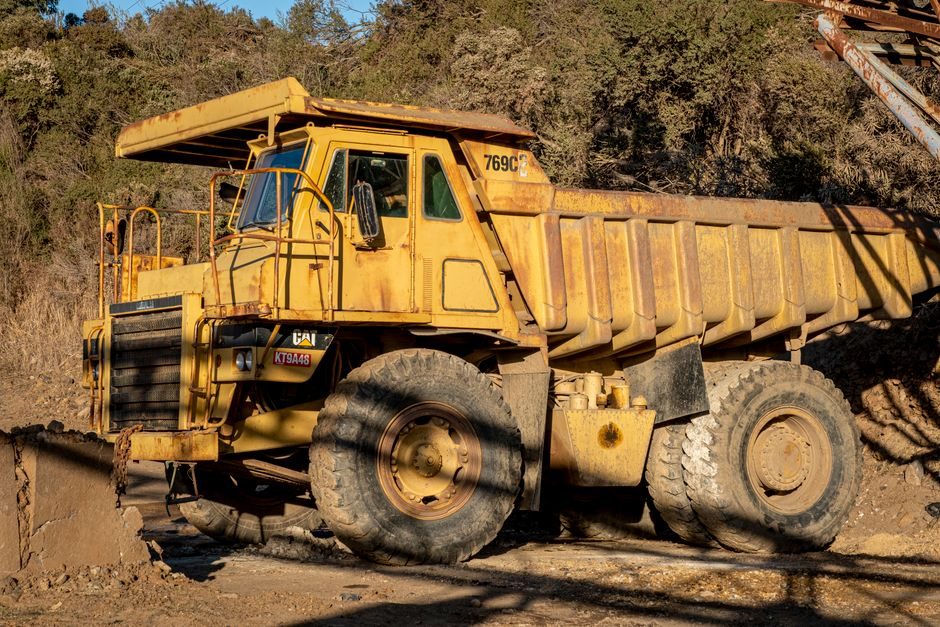
On earthmoving jobs in 2026, a wheel loader cycles into a stockpile, loads haul trucks, and pushes a feed pile; an excavator sits on a swing bearing and digs, trenches, or loads out from a fixed footprint. Matching the machine to the dominant work cycle, not the average job, is the single biggest driver of cost-per-tonne in mixed fleet procurement.
Current Chinese export listings confirm both machines are now sold as integrated product lines from the same manufacturer: WOLF Equipment in Qingdao bundles wheel loaders, excavators, and forklifts under one export programme [S2], while Jining Fullway Machinery ships wheel loaders, dumpers, and mini excavators from the same ISO 9001 / ISO 14000 audited facility [S8]. For buyers this means common spare-parts pools, common service training, and a single vendor audit — but only after the correct machine class is sized to the work.
Work-Cycle Definition and Why It Drives the Choice
A wheel loader is a four-wheeled, articulated-frame prime mover with a front-mounted bucket and a hydraulic lift-arm; the 2026 OEM product list from WOLF Equipment in Qingdao markets it alongside forklifts and excavators as a separate machine class with its own engine and chassis [S2]. A crawler or wheeled excavator is a machine with a rotating upper structure (house, boom, stick, bucket) sitting on either tracks or wheels, designed primarily to dig below grade and load out at a face. The structural difference — bucket on a lift arm vs bucket on a boom — is the engineering reason the two machines do not substitute cleanly for each other on a given cycle.
Selection against a work-cycle, not a tonnage number, is what separates a productive fleet from a wasteful one. A wheel loader is the right pick when the work cycle is "drive, fill bucket, drive, dump" with the machine moving continuously and material in bulk. An excavator is the right pick when the work cycle is "swing, dig, swing, dump" with the machine stationary and material being excavated from a face, trench, or hopper. Cross-using them costs fuel and time: an excavator loading a stockpile is essentially using a precision digger as a crane, while a wheel loader trenching is using a bulk mover as a hoe.
Operating-Weight, Bucket and Production Bands
For 2026 procurement, the practical band breakdown from current Chinese export listings is: small wheel loaders in the 0.3–1 m³ bucket / 7,600 kg class, with the Xc870K multipurpose loader rated at 3–6 t load, 0.3–1 m³ bucket, 7,600 kg machine weight, 4×4 drive available, ≥40 km/h travel, 2,180 mm wheelbase, and 3,230 mm dumping clearance [S9]. Medium-class wheel loaders sit in the ZL50G bucket/loader family with hydraulic transmission and front-discharge unloading [S3], while compact and agricultural mini-loaders appear in the US$3,000–17,199 MOQ-1 band from Chinese exporters with CE certification [S5].
Excavator and backhoe loader suppliers in 2026 list the multipurpose Xc870K as a hybrid: loader bucket 0.3–1 m³, machine weight 7,600 kg, 4×4 or 2×4 drive, maximum travel speed ≥40 km/h, dumping clearance 3,230 mm [S9]. Operating-weight brackets — mini (≤6 t), small (6–15 t), medium (15–30 t), large (30+ t) — are the standard way to band both machines for production-rate estimation. Mini-excavator and mini-loader pairings are a common export bundle from suppliers such as Aulander Machinery in Qingdao, who ship both product lines with ISO 9001, CE, and EPA certification evidence [S4].
Comparison on Four Decision Criteria
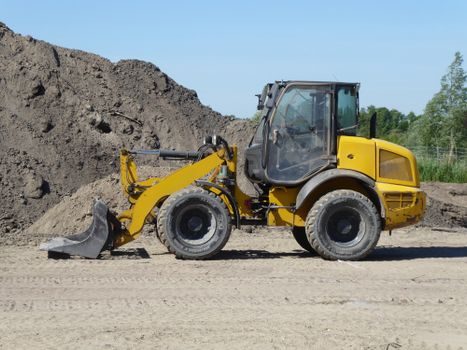
Buyers comparing a wheel loader vs an excavator on a 2026 job should score four criteria, drawing the line of separation at the work-cycle question: [S1]
1. Primary work cycle: wheel loader wins on drive-fill-dump cycles into a stockpile or haul truck; excavator wins on swing-dig-swing-dump cycles from a face or trench. 2. Mobility vs stability: wheel loaders offer ≥40 km/h road travel and quick repositioning [S9], good for multiple load points; excavators, especially crawler, offer low ground pressure and the ability to work on soft ground and slopes. 3. Dig depth and precision: excavators dig below grade with metre-plus reach and bucket accuracy, work that a wheel loader cannot do at all. 4. Bucket volume vs cycle count: a ZL50G-class wheel loader with hydraulic transmission and front discharge moves larger bucket volumes per pass at higher cycle rates [S3], but cannot dig; an excavator moves smaller volumes per pass but out of a hole.
For a fleet running both truck-loading and trenching, the backhoe loader is the bridge product. The 2026 Xc870K listing shows a machine weighing 7,600 kg with 0.3–1 m³ bucket, 4×4 drive, ≥40 km/h travel, and a backhoe rear, sold as a multipurpose unit at US$25,900–32,000 depending on quantity [S9]. For deeper pricing context by tonnage and emission tier, the Excavator 2026 Price & Cost Guide breaks the excavator class down against emission regulation. Buyers should treat the backhoe loader as a compromise machine — adequate at both ends, optimum at neither — and not as a substitute for sizing a wheel loader and an excavator separately on a high-utilisation site.
Matching Machine to Site Constraints
Site constraint #1 is ground pressure and travel surface. Crawler excavators spread load over a long track footprint, suiting soft or uneven ground; wheeled excavators and wheel loaders need a firmer surface but repay with road speed. The Xc870K's ≥40 km/h travel and 4×4 configuration [S9] is the spec point to compare against site haul-road length: long inter-load-point distances favour a wheel, short repetitive digs favour a track.
Site constraint #2 is attachment range. CSW Machinery's 2026 catalogue splits the attachment market cleanly: excavator side covers boring and welding machines, hydraulic hammers, hydraulic cylinders, undercarriage parts, G.E.T (ground engaging tools) parts, quick hitches, hydraulic thumbs, long reach boom/arm, and hydraulic shears; loader side is dominated by long reach boom/arm, hydraulic shears, and bucket G.E.T. [S6]. Xuzhou Amer International markets itself in parallel as a manufacturer of both excavator buckets and wheel loader buckets plus spare parts [S7], confirming that bucket and G.E.T. inventory is the single largest recurring cost line on either machine.
Site constraint #3 is export certification. Chinese suppliers in 2026 commonly list ISO 9001, ISO 14001, CE, and EPA as the standard compliance evidence [S4][S7][S8]; CE and EPA together cover the EU and US export paths in a single audit pass. Jining Fullway's 3 production lines and US$50M–100M annual output band [S8] is representative of the mid-tier supplier scale that ships container-load quantities of both wheel loaders and mini excavators under a single programme.
Use Cases: When Each Machine Earns Its Keep
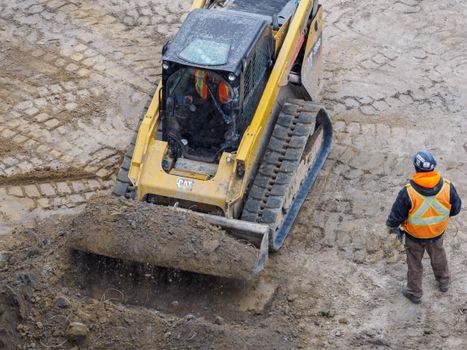
Wheel loader earns its keep on aggregate yards, quarry load-out, port bulk handling, road construction, and snow clearing — anywhere a bucket can drive into a pile and lift clear. A buyer running a 50-tonne-per-hour aggregate load-out with haul trucks is in wheel-loader territory; a 5-tonne mini-loader from a Chinese exporter (CE-certified, 1-piece MOQ, US$3,000–17,199 price band) [S5] is the right pick for farm, garden, and small urban public-area work where the alternative is a hand-loading team.
Excavator earns its keep on foundation digs, trenching, demolition with a hydraulic hammer, river dredging, and mining face loading. Attachments expand the excavator's reach: CSW's 2026 line lists hydraulic hammers, hydraulic thumbs, quick hitches, long reach boom/arm, and hydraulic shears as core excavator-side attachments [S6]. Where the work is mixed, the backhoe loader is a single-machine compromise with a 7,600 kg operating weight, 0.3–1 m³ bucket, 4×4 drive, and ≥40 km/h travel [S9]; the cost saving is one operator and one machine, the trade-off is slower cycle at each end.
A useful diagnostic: if the operator leaves the cab to check the bucket edge on every pass, the job is excavator work; if the operator never leaves the cab between cycles, the job is wheel-loader work. That single test, applied to the dominant cycle on a 2026 site, prevents most cross-specification errors before they reach the purchase order.
Limitations, Failure Modes, and Sourcing Standards
The most common procurement failure is buying a wheel loader to dig a trench — the machine physically cannot reach below grade with a front bucket, and operators working around that limitation destroy the machine's front tyres and articulation joint. The mirror failure is buying an excavator to load haul trucks from a stockpile: the cycle time, fuel burn, and machine-hour cost per tonne are typically 2–3× a wheel loader's on that exact duty, even before the excavator's higher hourly ownership cost is added. [S2]
Standards that 2026 buyers should expect to see on the export documentation chain, drawn from the supplier evidence base: ISO 9001 quality management and ISO 14001 / ISO 14000 environmental management on the manufacturing side [S7][S8]; CE marking for the EU market and EPA certification for the US market, both commonly bundled with ISO 9001 on a single supplier declaration [S4]; and HSE / QHSE management certifications carried by trading-company suppliers [S7]. Buyers should request the actual certificate numbers and verify them against the issuing body's register, not rely on the listed presence of a standard.
Two trackable signals to watch in the second half of 2026: first, the rollout of Stage V / EPA Tier 4 Final engine options on the medium wheel-loader platform, which is currently shipped in hydraulic-transmission ZL50G-class configuration with front-discharge unloading [S3]; second, the convergence of mini-loader and mini-excavator product lines under a single supplier programme, as already practised by Aulander Machinery [S4], Jining Fullway [S8], and WOLF Equipment [S2], which will continue to compress spare-parts and service-training cost for mixed-fleet buyers through 2026.