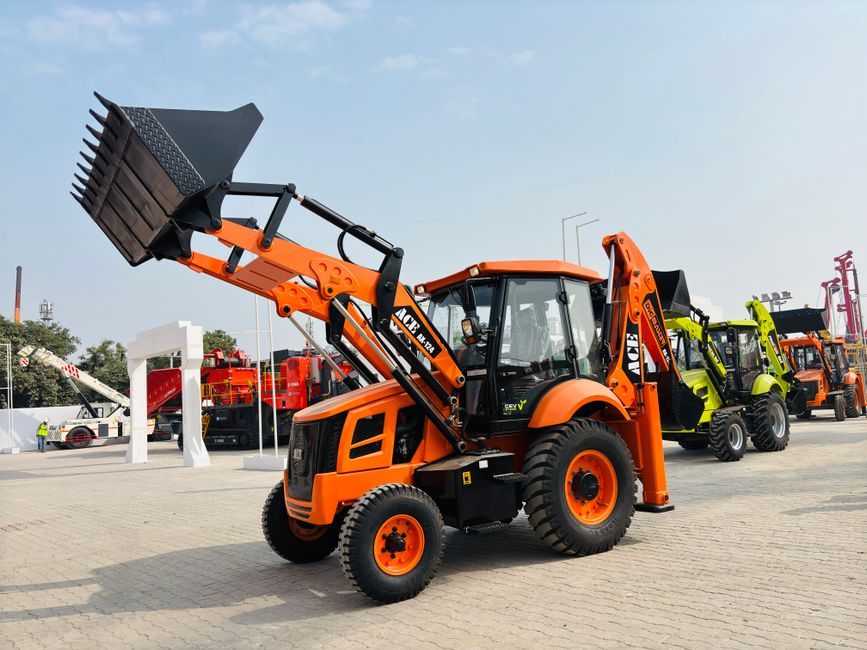
Wheel loader uptime is governed by a 10/100/250/500/1000-hour service ladder, with hydraulic pressure, payload and engine sensors recalibrated annually against OEM tolerance bands typically within ±2–5 % full scale [S4][S2].
Compact and mid-size machines in the 1–6 m³ bucket class share the same maintenance backbone; differences sit in filter sizing, axle oil volume and the calibration protocol of the optional onboard weighing system. The rest of this guide walks the intervals, the calibration passes, the spec bands a buyer should pin on a PO, and the failure modes that drive unscheduled downtime on Tier-4 Final and Tier-3 platforms [S4].
Service-Interval Ladder and the 500-Hour Hard Reset
The 10/100/250/500/1000 h ladder is the industry baseline: 10 h covers daily fluid walk-around and tyre pressure, 100 h covers engine oil and fuel filters, 250 h adds hydraulic return and pilot filters, 500 h is the hard reset with hydraulic oil, axle oil and coolant sample, and 1000 h closes the loop with gearbox oil and a full calibration audit [S4]. Sampling at the 500 h node feeds wear-particle analysis (ppm Fe/Cu/Al) and is the cheapest insurance against a $20k+ hydraulic-pump failure on mid-size units [S4]. Compact loaders in the 0.3–1.0 m³ class often collapse the 1000 h node into a 750 h gearbox drain because the smaller sump runs hotter under the same duty cycle [S4].
Operators who skip the 500 h sample typically see the first symptom as a 20–40 °C rise in hydraulic tank temperature — the leading edge of pump cavitation. Caterpillar's compact-equipment maintenance library treats the 500 h hydraulic-oil and axle-oil service as the single highest-ROI pass on a small wheel loader fleet, with 250 h as the filter-heavy mid-stop [S4].
Calibration Targets: Payload, Pressure and Engine Sensors
Three calibrations dominate the field: onboard payload (where fitted), hydraulic pressure transducers, and engine/aftertreatment sensors. Onboard payload systems on mid-size loaders are routinely re-zeroed every 250 h and re-trended against a weighbridge every 500 h, with a target accuracy band of ±1–3 % of machine operating weight for production-loading duty [S4].
Hydraulic-pressure transducers (work-port and pilot) drift with thermal cycling; a 0–350 bar work-port sensor is typically accepted within ±2 % full scale after a cold/warm two-point calibration, while 0–50 bar pilot-pressure sensors are held to ±1 % because the joystick command curve is non-linear in the lower 30 % of stroke [S4]. Engine sensors (intake manifold pressure, coolant temperature, NOx) live inside the ECU calibration and are not field-adjustable; the maintenance pass is a continuity/response check plus a software-reflash when the OEM issues a field product update, not a re-trim [S4].
Hydraulic, Axle and Engine: Spec Bands to Pin on a PO
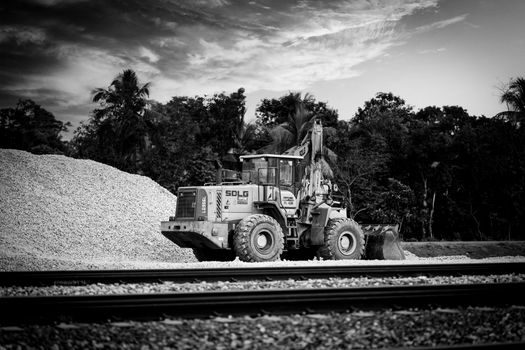
For a 3 m³ class wheel loader, the practical spec bands a maintenance planner should lock in: hydraulic tank 180–260 L, hydraulic ISO VG 46 mineral oil (or HVLP 32 in cold climates) with a 500 h drain and 1000 h flush, axle oil 18–32 L per axle with API GL-5 85W-90, engine oil 18–28 L meeting the OEM's CK-4 or E4 tier, and coolant drain at 2000 h or 24 months [S4][S2].
The comparison across the three main machine classes reads: compact (0.3–1.0 m³, 50–80 hp) uses single-stage hydraulics and 16–22 L axle volumes; mid (1.5–3.5 m³, 120–220 hp) uses two-stage load-sensing hydraulics and 22–32 L axle volumes; large (4–7 m³, 250–500 hp) adds a separate hydraulic cooler fan circuit and 35–55 L axle volumes [S2]. For a deeper spec-and-class walk-through see the wheel-loader selection guide, and for the closely related backhoe platform, the backhoe loader supplier and spec map overlaps on the powertrain side. The encyclopedia entry on wheel loaders covers the baseline machine architecture these intervals hang off.
Sensor Stack and Diagnostic Pass: J1939, Flash Codes and Drift Budgets
Modern wheel loaders run a CAN J1939 backbone that exposes engine, transmission and hydraulic data through a single 9-pin diagnostic port; the diagnostic pass is a 15-minute read of active and logged DTCs, followed by a guided troubleshooting tree on the OEM service tool [S4]. Where a Tier-4 Final aftertreatment sits, a 1000 h DPF ash service is typical and the maintenance plan should reserve a 2–4 h shop window for the active regeneration check [S4].
Drift budgets a maintenance engineer should write into the plan: coolant-temperature sensor ±2 °C between 40–120 °C; oil-pressure sensor ±5 kPa at rated speed; fuel-rate sensor ±3 % against a reference meter over an 8 h loading cycle [S4]. On Tier-3 platforms the aftertreatment chain is shorter, but the J1939 stack and the 1000 h engine sensor audit still apply — the maintenance library covers both emissions tiers under the same interval structure [S4].
Failure Modes That Drive Unscheduled Downtime

The top four field failure modes on a 1–5 year-old wheel loader fleet are: hydraulic-hose abrasion at the articulation joint, axle-seal weeping under high-cycle yard duty, electrical connector corrosion on the cab roof harness, and bucket-pin bore elongation above 0.5 mm [S4]. Each is detectable in a 30-minute walk-around if the 10 h service is taken seriously; each turns into a multi-day repair if the 250 h pass is missed.
A related failure mode on the supply side is mis-specified wear parts — a non-OEM bucket tooth or a sub-spec hydraulic filter that collapses at cold start. Shandong-based exporters such as Weihai Titan Heavy Machinery and Shandong Hiking Machinery list wheel loaders alongside backhoe loaders and skid steer loaders in the same catalogue, which is the right signal that the maintenance plan should treat shared wear parts (filters, buckets, teeth) as a category buy rather than a machine-specific one [S2][S3].
Where Calibration Goes Wrong and How to Audit It
Most calibration drift on wheel loaders is operator-induced rather than sensor-induced: a payload system zeroed on a slope, a pressure transducer re-trimmed against the wrong reference gauge, or a tyre-pressure change that shifts the empty-machine reference weight by 200–400 kg. The audit fix is procedural — a flat concrete pad, cold oil at 30–40 °C, a certified 50 t weighbridge, and a written log per machine that the maintenance planner can trend over 12 months [S4].
For the broader selection context, the wheel loader sizing map is the right companion read; for an adjacent water-treatment sizing pass, wheel loaders for water-treatment sites carries the same calibration principles into a different duty cycle.
Track the next pass on three signals: OEM-released Tier-4 Final sensor calibration software (Caterpillar ET, Komatsu KOMTRAX, Volvo MATRIS) on the 1000 h node; market pricing on Shandong-built compact loaders; and any 2026 revisions to the SAE J1939 calibration-conformance test used by major OEMs.