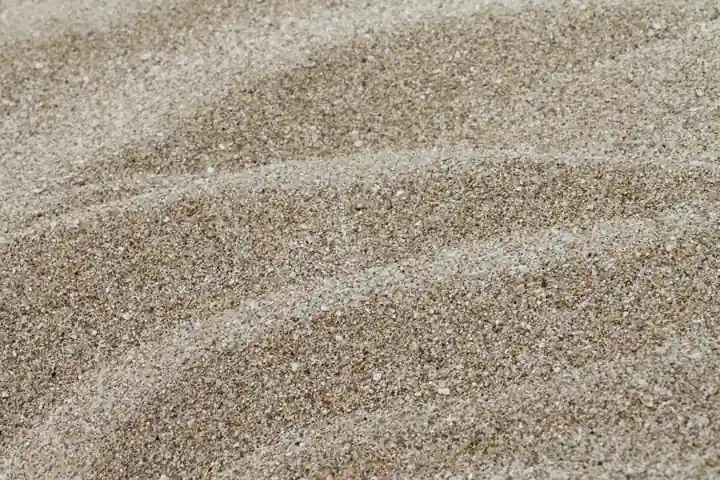
Aluminum foundries typically run AFS 50-100 fineness sand (roughly 100-200 µm) while steel foundries default to AFS 25-45 (around 300-600 µm), a gap dictated by the ~1,600°F temperature difference between the two pour windows and the surface-finish budget each metal leaves behind.
Aluminum pours at 1,250-1,400°F, steel at 2,850-2,950°F, and gray iron sits between at 2,300-2,600°F, and that single variable, not chemistry or cost, is what flips the grain size dial in the opposite direction for the two metals [S8].
Temperature Sets the Refractoriness Ceiling First
Sand in a mold is a refractory liner; if it cannot survive the pour temperature it fuses to the casting, so refractoriness is the first constraint a foundry works backward from [S1]. For aluminum, the sand only needs to withstand about 700°C (≈1,290°F), while steel castings require sand rated for 1,500°C and above, roughly twice the thermal load [S10]. That asymmetry lets aluminum shops spend their sand budget on smoothness, permeability, and burn-in control instead of raw heat survival, which is why fine silica with AFS 50-100 grain distributions dominates the aluminum floor [S2].
Silica sand is rated to roughly 1,700°C in foundry service, well above aluminum's pour band, so it does not need to be the coarsest, most thermally stable grain to do the job [S5]. The moment you cross into ferrous work the same silica is pushed close to its refractoriness limit, and foundries respond by moving up the AFS scale toward 25-45: coarser grains have fewer inter-particle contact points per unit volume, lower thermal-stress concentration, and better survive repeated thermal cycling without spalling.
Surface Finish Economics Pushes Aluminum to Finer Grains
Finer grains pack more densely and leave a finer imprint on the metal, cutting post-cast machining, and the American Foundry Society comparator quantifies the gap: green sand cast aluminum lands at 250-900 µin RMS while furan sand cast aluminum sits at 150-600 µin RMS, both materially rougher than die casting (90-200 µin) and shell molding [S4]. To claw that RMS number down, foundries drop to AFS 70-100, and the trade is direct: each step finer in grain size drops surface roughness but raises binder demand and permeability loss in a roughly inverse relationship [S9].
Aluminum castings tolerate a higher sand cost per pound because the metal itself is expensive and the value-added per kilogram justifies the spend; A319 and A357 alloys in particular show minimal creep strain at 150°C and benefit from smooth mold surfaces that reduce crack-initiation sites [S3]. A single surface defect on a 5 kg aerospace aluminum housing can scrap a part worth orders of magnitude more than the extra dollar in sand, so foundries bias toward fine grain rather than gamble on a coarse-grain pour.
Permeability, Burn-In, and Grain Geometry
Coarse sand gives high permeability but rough surface; fine sand gives smooth surface but low permeability, and the foundry picks a grain that balances both against the metal's gas evolution and surface tension. Hydrogen solubility in molten aluminum is high, and any steam or air trapped at the mold face will produce subsurface porosity unless the sand can vent it [S2]. AFS 50-100 sand struck with a controlled bentonite and water mix (typically 3-6% moisture) keeps enough interstitial void to vent while packing tightly enough to suppress the burn-in defects that coarse silica shows on complex geometry [S5].
Burn-in is the failure mode that flips the decision the other way for steel: coarse sand on a deep-drawing steel pour lets the metal penetrate between grains and fuse to the mold wall, and a coarser sieve stack trades surface for a thermal buffer that fine sand cannot provide at 2,900°F [S2]. That is also why specialty sands like chromite (refractoriness near 2,180°C) and zircon (around 2,550°C) enter the conversation in steel and iron shops, while aluminum foundries rarely justify the 3-10x price premium over silica for thermal reasons alone [S2][S8].
How Foundry Sand Type Maps to Metal and Process
A simple four-criteria matrix shows the split cleanly. (1) Refractoriness: silica rated to ~1,700°C covers aluminum (700°C pour) with margin but is borderline for steel (1,500°C pour) and iron, where chromite (~2,180°C) and zircon (~2,550°C) earn their place. (2) Surface finish: aluminum green sand 250-900 µin RMS vs die-cast 90-200 µin, and finer AFS numbers cut the upper end of that band. (3) Reclaim: silica typically survives 5-10 pours before replacement, synthetic ceramic sands 50+, and aluminum's lower thermal load means less degradation per cycle [S2]. (4) Cost: silica baseline, chromite roughly 3x, zircon 5-10x, and the aluminum industry's willingness to pay for fine grain depends entirely on defect-cost versus sand-cost math [S2].
The matrix matches the industry split between no-bake and cold-box processes for aerospace and automotive aluminum (lightweight, precision, low defect rate) versus resin-bonded silica for general industrial work in steel and iron [S5]. For procurement readers, the operative rule is: when the metal is aluminum and the pour is under 1,400°F, specify AFS 50-100 silica with bentonite and 3-6% moisture; when the metal is steel or iron above 2,500°F, step up to AFS 25-45 and consider chromite or zircon for the hot spots.
Limits and Failure Modes of the Fine-Sand Strategy
Fine sand is not a free upgrade. Three failure modes track directly to over-fining: gas defects from low permeability when moisture is pushed above 6%, burn-on when the grain is too fine to vent steam fast enough, and mold erosion when binders break down under the thermal gradient [S5]. The reclaim loop also suffers: silica that survives 5-10 cycles in an aluminum line degrades faster when the foundry tries to reuse it in a hotter iron pour, which is why mixed-metal shops keep separate sand systems and separate AFS targets per line [S2].
For a foundry running both aluminum and steel work, the practical guidance is to treat sand inventory as a metal-specific consumable, not a shared asset, because the grain size that makes aluminum castings clean will sand-blast a steel mold face and the grain size that protects a steel pour will leave an aluminum casting too rough to ship without heavy grinding [S10]. This split also explains why sodium silicate bonded sand is hard to reclaim in foundry lines in mixed shops: the binder chemistry that suits one metal's pour window fouls the reclaim loop of the other.
For the relevant spec sheets and selection criteria, see aluminum alloy, aluminum ladder, and sand cooler.